Who Can It Be Now? Michael Leroy Griffin was born on June 26, 1957, in Colusa, California. Griffin was the third-round pick in the 1976 June draft of the Texas Rangers out of Woodland High School in Woodland, California. After two years in the Rangers system, Griffin was part of a 9-player trade in November of 1978 in which he, Juan Beniquez, Paul Mirabella, and Dave Righetti were traded to the New York Yankees in return for Mike Heath, Dave Rajsich, Larry McCall, Domingo Ramos, Sparky Lyle, and cash. The next year -- 1979 -- Griffin made his major league debut with the Yankees. Getting traded and moving around was a big part of Griffin's career. He was traded again in 1981 as the player to be named later (along with Doug Bird and $400,000) going to the Cubs in exchange for Rick Reuschel. Bird and Griffin pitched back-to-back 1-run games against the Dodgers in August of 1981, leading to some typical Tommy LaSorda hyperbole: "Who are those guys? Christy Mathewson and Walter Johnson?" No, Tommy. No they are not. Griffin's stay in Chicago did not last long -- only to the end of spring training in 1982 -- at which point he was traded to the Expos for Dan Briggs. Griffin never appeared in the major leagues for the Expos, and at the end of August was traded again. This time, he went to San Diego in exchange for future White Sox and Mets manager Jerry Manuel. Griffin bounced around the minors for a few years after that -- going to the Rangers system in 1983, to Kansas City's system after 1984, and then to Baltimore after 1986. He made 23 appearances as an Oriole in 1987 for a team in sharp decline and did not pitch very well. He was back on the streets as a free agent after the 1988 season, but then the Cincinnati Reds gave him one last shot at the big leagues. He pitched 4-1/3 innings in 3 appearances in 1989, and that was the end of his big-league career. Mustache Check Yes. It's ginger bristles, but it counts. Everybody Wants You To get traded twice in the 1982 season, Griffin had to be wanted by two different teams as well. Because otherwise there's nothing, Griffin is a Wanted Man. A Few Minutes with Tony L. The only thing I remember about Mike Griffin was this card. As a ten-year-old, I don't think I'd ever seen as many freckles on any one person as appear on Griffin in this photo. As a pitcher, though, he is as memorable as the remnants of a drunken night after 20 shots. In other words, "he did what?" Since his retirement as an active player, Griffin has spent most of his time as a minor-league pitching coach. Starting in 1993 with Triple-A Indianapolis, Griffin spent several years in the Cincinnati Reds system as a pitching coach. After leaving the Reds system, Griffin hooked on with the Boston Red Sox in 1999. Griffin coached for 9 seasons (1999-2007) in the Red Sox system before joining the Baltimore Orioles organization. After spending 2008 in Double-A Bowie, Griffin has become a fixture as the pitching coach for Baltimore's Triple-A team, the Norfolk Tides, in the International League and coached there through 2014.
Who Can It Be Now? Rawlins Jackson Eastwick IIIwas born on October 24, 1950, in Camden, New Jersey. According to his biography in the recent SABR publication The Great Eight: The 1975 Cincinnati Reds, Rawly (pronounced "Rollie" and not "raw-lee") was raised in Haddonfield, New Jersey, which that book calls an upper-middle-class suburb of Philadelphia. Rawly's dad, who was Rawlins Jr., was an engineer for Bell Telephone. Rawly had a twin brother named Ralph, a sister named Nancy, and two older (also twin) brothers named Robert and Richard. In a later biography, he claimed that he received his father's name because his parents "ran out of names." In high school, Eastwick was, of course, a star athlete. Like all of his fellow baseball players, however, Rawly was a great high-school-baseball player, earning all-state honors and honorable mention high school All-American status in his senior year. Unlike most baseball players, the other sport in which Rawly excelled was wrestling -- in which he won the district high school championship twice. Eastwick's talent in baseball got him noticed by scouts, though, oddly enough, not by the nearby Phillies. According to a news article in 1976, the Phillies never spoke to him despite his playing practically in the shadows of Veteran's Stadium. Instead, the Cincinnati Reds selected Eastwick in the 3rd round of the 1969 June Draft. The 18-year-old Eastwick started his 1969 professional season in the Florida Instructional League before moving to the Gulf Coast League. His initial returns were unimpressive -- a 4.70 ERA, 60 hits allowed in 46 innings with 17 walks and 22 strikeouts. Still, the Reds bumped him to Tampa in the Florida State League in 1970, and he pitched better and probably in better luck as well. In 1971, he pitched both at Single-A Raleigh and Double-A Trois-Rivieres. His first exposure at age 20 to Double-A may have been a bridge too far -- he was hit pretty hard in 37 innings (5.35 ERA, all runs allowed were earned). And, the Reds organization turned him into a reliever. Usually, that's a pretty good sign that an organization does not believe in a pitcher; rarely do minor league closers become major league closers. In 1972, he returned to Trois-Rivieres as its closer. This time, Eastwick pitched superbly in 1972, racking up 20 saves and 9 wins (against 89 losses) in 66 appearances and 119 innings. This performance earned him a promotion to Triple-A Indianapolis for 1973. In the early 1970s, teams still had the mentality that your best pitchers should be starters and that the bullpen was merely a place to put guys who couldn't start. So, in 1973 and 1974, the Reds had him start 12 games each year just to make sure that he wasn't a starter. The effect of this was to increase his innings over 100 for the year in a mix of starting and relieving while also suppressing his strikeout rates. In any case, Eastwick got his first taste of big league baseball in September of 1974 for a Reds team that finished 98-64 -- 4 games behind the Dodgers for the NL West Crown. Eastwick pitched reasonably well in relief in his 8 appearances, throwing 17-2/3 innings and earning 2 saves while giving up just 4 earned runs. Nonetheless, the Reds assigned Eastwick to Indianapolis to start 1975. He tore up Triple-A during that first 6 weeks of the season and was recalled on May 20, 1975. Sparky Anderson had no qualms about inserting him into the role of "closer" immediately on Eastwick's promotion. The Reds lost the first game in which Eastwick appeared in 1975 and dropped to .500 (20-20) with the loss. Of course, the rest of the way, the Reds went 88-34 (a .721 winning percentage). Despite not having been called up till May 20, Eastwick made 58 appearances and finished 40 games. He threw 90 innings in that time and led the National League in saves with 22. For his efforts, he finished third in the Rookie of the Year balloting behind John Montefusco and Gary Carter. More importantly, the Reds won the World Series with Eastwick closing out 4 games -- saving 1 and winning 2 -- while giving up just 2 earned runs on solo homers. He got the win in Game 2 when the Reds scored twice in the top of the ninth off Dick Drago. He got the win in Game 3 when the Reds scored the winning run in the bottom of the tenth inning off Jim Willoughby and Roger Moret. He earned his save in game 5, then watched as Will McEnaney picked up the save in Game 7 at Fenway. The 1976 season was similarly successful for both Eastwick and the Reds. Eastwick once again led the National League in saves, this time with 26. He earned the 1976 NL Rolaids Relief Man Award -- a trophy he still has today. He finished fifth in the voting for the Cy Young Award (the only reliever to receive any votes) and even got 8% of the vote in the MVP Award voting, even though that put him just fifth on his own team behind Morgan, Foster, Rose, and Griffey. The only real downside for Eastwick personally had to be the fact that the Reds really didn't need him at all in the postseason, as they swept through both the Phillies and the Yankees that year. When 1977 dawned, however, things had changed in Cincinnati. Gone was Eastwick's running mate Will McEnaney -- literally, as the two worked out together in the offseason. The Reds had traded McEnaney to the Expos with Tony Perez for pitchers Woodie Fryman and Dale Murray. Eastwick was upset about it. He chose to speak out about the issue -- and his belief that he was underpaid at $29,000 a year in 1976 -- on, of all things, the Cincinnati Reds goodwill caravan through the Midwest. Nice timing. Yet, once the games started, Eastwick picked up where he left off in many respects. There were chinks in the armor, though -- his strikeout rate declined in the early going from 6.1 K/9 in 1975 to 5.9 in 1976 to a miniscule 3.5 with the Reds. Under free agency rules at the time, Eastwick was in his "option" year and was pitching without a contract while being paid at the same rate from the previous season. Eastwick claimed that the Reds were using him less in the first two months of the season to suppress his earning possibilities. Yes, more complaining. It should come as no surprise, then, that in early June the Reds told Eastwick that they were going to try to trade him by the June 15 trade deadline. He almost went to the Mets for Tom Seaver, but the contract situation scared the Mets away. The Cardinals took the chance that they could get him to sign and traded pitcher Doug Capilla -- later Eastwick's teammate on the Cubs -- to the Reds. Other than starting the only game he would start in his career in St. Louis, Eastwick's time in St. Louis was forgettable for all involved. Eastwick played out his option with the Cardinals. He then became one of the most sought-after free agents on the market. Perhaps oddly, he ended up signing a 5-year, $1.1-million contract (with a $320,000 bonus and a $156,000 salary) with the New York Yankees. That was odd because the Yankees didn't need a closer -- they had the great Sparky Lyle, who had won the Cy Young Award in the American League in 1977. Oh, and the Yankees also signed Goose Gossage. I mean, that money was good, but if similar money was available elsewhere, Eastwick and his agent should have rethought their position on that deal. For their massive outlay of funds and guaranteed money, the Yankees got damn close to bupkus -- Eastwick pitched in 8 games, faced 101 batters in 24-2/3 innings, and picked up 2 wins. Then, on June 15, 1978, the Yankees traded Eastwick to the Philadelphia Phillies for outfielders Bobby Brown and Jay Johnstone. Once traded, Eastwick blamed the problems in New York on Billy Martin. He couldn't have been any blunter about it, either. As the wire story put it:
"I guess Martin was trying to show up Steinbrenner," said Eastwick, who had been signed by the Yankees without Martin's approval. "Martin is very shallow[;] he has no intelligence."
One wonders how Eastwick really felt. He pitched okay for the Phillies in 1978. He walked more than he struck out, and his ERA of 4.02 flattered him as his FIP was 4.84. It shouldn't have been a surprise when, in 1979, the wheels fell off for Eastwick. Suddenly, his ERA of 4.90 matched the previous year's FIP -- even if his pitching in 1979 was incredibly unlucky (FIP: 3.80). Suddenly, at the age of 28, Eastwick's career looked tenuous at best. It became even more tenuous when, on April 4, 1980, the Phillies released him. He spent two months out of baseball before the Kansas City Royals signed him and put him in Triple-A. They gave him an opportunity in the major leagues, and then realized that Eastwick was not for them and released him at the end of August. In 1981, the Chicago Cubs gave Eastwick an opportunity to make the team as a minor league free agent. He actually pitched well for the Cubs -- a 2.28 ERA in 43-1/3 innings with a save. On August 19, 1981, though, he hit the 21-day disabled list. He came back after the trip to the DL and pitched reasonably well though he seemed to pitch only in lost causes (the team went 4-23 in his 27 appearances that year) He went to spring training with the Cubs in 1982, after which the Cubs released him on April 1, 1982. And, at age 31, that was the end of Eastwick's major league career. Mustache Check: Rawly makes it three straight for the smooth-faced crew. Trivial Pursuit Eastwick did not commit an error in his major league career until 1980 when, on July 2, he committed an error against the Twins. Indeed, counting only his National League appearances, he went 274 consecutive games without committing an error. My other favorite trivial item is this: Rawly Eastwick was the winning pitcher in an epic game that took place at Wrigley Field on May 17, 1979. In what Larry Bowa called "a howling wind" that was blowing out of Wrigley, the Phillies beat the Cubs by a final score of 23-22. Eastwick and Ray Burris were the only pitchers who did not give up a run in that game and, indeed, Eastwick retired all 6 of the batters he faced. Others who were not as lucky: Randy Lerch, the Phils starter, allowed 5 earned runs in 1/3 of an inning; Dennis Lamp, the Cubs starter, who bested Lerch by allowing 6 earned runs in 1/3 of an inning (game score: 15), Donnie Moore, who allowed 7 earned runs in 2 innings; Willie Hernandez, who gave up 8 runs (6 earned) in 2-2/3 innings; and Tug McGraw, who allowed 7 runs (4 earned) in 2/3 of a inning. Nanu Nanu This card was Eastwick's last card as an active player. He also appeared on a Fleer card in 1982. Eastwick missed being on a card in 1981 -- not even getting into the Traded set -- with the circumstances and timing surrounding his release in 1980. A Few Minutes with Tony L. With his limited exposure in baseball after 1977 -- which is when I first can remember anything from baseball -- I don't have too much of a recollection of Rawly Eastwick other than his unusual name. Eastwick's fame as a player was truly from the 1975 World Series. Even though most people remember or know little from that Series other than Carlton Fisk's golfshot home run and that the Reds won, Eastwick played a major part in that Series as I mentioned above. He also played a part in Fisk's home run. Back in the 8th inning with the score at 6-3 Reds, the Red Sox got two runners on to start the 8th off Pedro Borbon. Sparky Anderson -- who gained the reputation as "Captain Hook" in 1975 through his frequent use of the bullpen which, today, would look tame and abusive to the relievers -- brought in Eastwick from the bullpen. Eastwick struck out Dwight Evans swinging and induced Rick Burleson to line out to short left field. Then, Bernie Carbo stepped up to hit for the pitcher, Roger Moret. Carbo worked the count to 2-2, weakly tapping a 2-strike pitch foul to avoid striking out. Eastwick then served up a meatball which Carbo jacked out to center to tie the game.
These days, Eastwick actually lives in Boston. He had his own story about the Boston Marathon bombings as well, barely missing being present for the bombing itself due to stopping to get a t-shirt for his daughter Haylee. I guess people don't remember the Carbo home run, or perhaps it helps him get business. He leases commercial real estate for De Normandie Companies in Boston. So, if you need an office in Boston, give Rawly a call.
Who Can It Be Now? And what are they all looking at? Our three players are: 1. Jay Canfield Howell who was born on November 26, 1955 in Miami. Howell attended high school at Fairview High School and college at the University of Colorado both in Boulder, Colorado. Howell was drafted by the Cincinnati Reds twice -- first in 1973 out of high school and then in 1976 in the 31st round after his junior year at Colorado. He signed with the Reds days later and moved slowly up the Reds chain until he made his major league debut in 1980 for Cincinnati. In October of 1980, the Reds swapped Howell for backup catcher Mike O'Berry. Howell then pitched ten games for the Cubs in 1981. He went back down to Triple-A Iowa in 1982, where he stayed until August 2 when the Cubs sent him to the Yankees to complete a trade made a year earlier when the Cubs traded for Pat Tabler. The Yankees used him as a starter in 1982 and 1983 before realizing that Howell was better suited for the bullpen. So, at the age of 28, Howell became a setup guy for Dave Righetti out of Yogi Berra's bullpen in 1984. That was his last year as a Yankee, though, as he was a part of a blockbuster trade that saw him, Tim Birtsas, Stan Javier, Eric Plunk, and Jose Rijo go to Oakland in exchange for Bert Bradley, cash, and some guy named Rickey Henderson. Howell was an all-star closer for two of his three seasons in the Bay Area. He then found himself part of a three-way trade involving Oakland, the Dodgers, and the Mets. He went to the Dodgers, as did Alfred Griffin and (from the Mets) Jesse Orosco. The A's picked up Bob Welch and Matt Young, and the Mets got Jack Savage, Wally Whitehurst, and Kevin Tapani. Howell served as a closer in Los Angeles, and enjoyed his final All-Star season in 1989. He stayed in LA from 1988 through 1992 when, at the age of 37, he was one of the top setup men for Bobby Cox in Atlanta. Despite his success during the regular season, he never appeared in the NLCS for the Braves. Howell finished his career in 1994 with the Texas Rangers and did not return to baseball after the strike. 2. Carlos Manuel (Rubio) Lezcano was born on September 30, 1955, in Arecibo, Puerto Rico. He attended high school at Colegio San Jose before he came to the mainland for college at Florida State University. Perhaps highlighting the oddity that differentiated Puerto Ricans from other Americans, Lezcano attended FSU with fellow major leaguer Terry Kennedy. Kennedy ended up being drafted as a first round pick, but Lezcano signed with the Cubs as a free agent in 1977. Lezcano went immediately to the Double-A Texas League at Midland in 1977. He did not perform particularly well -- a slash line of .231/.294/.356 shows that to be true. The next season in spring training, therefore, Lezcano went to Arizona with something to prove to the Cubs organization. All he proved, however, was that he was a typical 22-year-old kid with more athletic ability than sense. Walking down the street in Scottsdale during spring training with some teammates, Lezcano decided that he should show his teammates how high he could jump. The story does not mention whether he was challenged to do this or whether he was bragging about it before the leap -- but it certainly was the embodiment of the joke about what the last words of a redneck are before he dies: "Hey y'all, watch this!" Anyway, in showing off his jumping ability, Lezcano hit the top of a street sign with his hand and caught a ring on the sign. He almost severed his right index finger from his hand. He had to have emergency surgery just to save the finger and, as a result, he had to miss the entire 1978 season. He did not make an appearance in the major leagues until 1980 as a result, and his major league career ended after a 7-game stint with the Cubs in 1981. He kicked around the minor leagues with the Cubs, Detroit, and Oakland through the 1984 season, but he never again appeared in the big leagues after 1981. 3. Elliott Tyrone Waller was born on March 14, 1957, in Fresno, California. By the time he reached high school, his family had moved to San Diego, where he attended Herbert Hoover High School -- the same high school as baseball legend Ted Williams, in fact. Waller was drafted out of high school by the San Francisco Giants in the 33rd round of the June 1975 draft; by that point in the draft, all but 6 teams had passed on making a selection. He did not sign with the Giants, however, and attended San Diego City College for two years. In the 1977 January draft, the Cardinals drafted him in the fourth round as a draft-and-follow player, and apparently Waller showed enough that spring to convince the Cardinals to sign him in May of 1977. After progressing a level each year from 1977 through 1980, the Cardinals gave him a September call-up in 1980. Waller got a single off Joe Niekro in his first major league at-bat, but he did not have any other hits that September or October. In December of 1980, Whitey Herzog was trading off what he felt were spare parts to other teams to try to improve the Cardinals. In one of those trades, the Cardinals obtained Bruce Sutter from the Cubs and, in return, the Cubs received Ken Reitz, Leon Durham, and Waller. Waller got a thirty-game trial in 1981, and hit .268/.303/.451 in those games. His play did little to convince the Cubs that he would be the Cubs' answer at third base. It also did not help that the Cubs traded away Ivan DeJesus to the Phillies and, in return picked up a hot-shot prospect named Ryne Sandberg and old guy Larry Bowa. The Cubs plugged Sandberg in at third base in 1982 and moved him to second base only after they signed the Penguin, Ron Cey, after the 1982 season. As a result, Waller was sent to the South Side of Chicago and the White Sox in exchange for Reggie Patterson. Waller did not appear for the Sox and, after the 1983 season, he signed with the Houston Astros organization. He played at Triple-A Tucson for four seasons before retiring as an active player after an 11-game call-up with the Astros in 1987. Everybody Wants You As mentioned above, Jay Howell was traded in August of 1982 as the player-to-be-named-later in a nearly one-year-old trade. Waller was traded after the 1982 season to the White Sox. Family Ties Carlos Lezcano is either the brother (if you believe news stories from 1978) or the cousin (if you believe Baseball Reference of former major-league outfielder Sixto Lezcano (whom we will meet later in this set). Nanu Nanu For both Waller and Lezcano, this card would be their last Topps card. Lezcano never got his own card with Topps -- in 1981, he was a Cubs "future star" along with Steve Macko and Randy Martz. A Few Minutes with Tony L. These Future Stars cards are fun both to see how good or bad the "prospects" in each team's farm system are and to see if Topps was remotely close on calling these guys "future stars." Certainly, if you measure who is a star by whether they make at least one All-Star team, then this card is a solid 1-for-3 with two flailing, horrible, cork-screwing-oneself-into-the-ground strikeouts. Perhaps it is appropriate, then, that the two guys who did not have very fruitful major-league careers have both stayed in baseball. Lezcano started his second baseball career as a minor-league manager in 1992 by managing the Seattle entry in the Arizona Rookie League. After three years in the Mariners organization, he spent three years managing for the Giants organization. From there, he did not manage in 1998, but was then hired on by the Milwaukee Brewers system for four seasons. After that, he spent 9 years as a minor league manager in the Padres organization. According to Baseball Reference's Bullpen, he managed last year in El Paso. Waller got his opportunity as a manager immediately after he retired from playing after the 1987 season. The San Diego Padres gave him the opportunity to manage their rookie-level club in Spokane, and he stayed in the Padres organization as an instructor in base running and outfield play for five years. He managed again at Spokane in 1994 and then spent a year on the major league staff in 1995. After that, he moved into the front office as the coordinator of all minor-league instruction for three seasons and as director of player development from 2000 to 2005. Since 2007, he has served as a major-league coach for the Oakland Athletics. Howell went a slightly different direction. He played until 1994. In 1998, he became the head coach at Cal State-Northridge, leading them to two Big Sky Conference titles. Eventually, though, he and his wife Linda moved back to Atlanta. He can be found now at the Lakewood 400 Antique Market in Forsyth County -- the flea market that I have attended in the past and written about on my other blog. I had no idea that Howell has a booth at that market, and it's not like he is selling baseball cards from it. If he was, I would certainly have stopped and talked to him. But, apparently, he welcomes the opportunity to talk baseball with customers at the market. Maybe that will be a story for my other blog on another weekend.
Who Can It Be Now? Julio Ruben Morales Torres was born on February 18, 1949, in Yabucoa, Puerto Rico. He attended Teodoro Aguilar Mora High School, and he appears to be the only player to make the major leagues from that school (though the school did produce two very late round draft picks in the late 1990s and early 2000s). Morales signed at the age of 17 with the New York Mets organization as an "international" free agent. He was very young for each of the leagues he played in for the Mets even though he stayed in A-ball for three seasons through the 1968 campaign. The 1968 offseason was remarkable in that major league baseball expanded by four teams that offseason. The American League added the Kansas City Royals and the Seattle Pilots while the National League expanded to put the Expos in Montreal and the Padres in San Diego. The two leagues were still separate legal entities, so the Padres and Expos selected only players affiliated with National League teams in the Expansion Draft that offseason. Despite the fact that Morales had just turned 20 years old and had not played any higher than the Single-A Carolina League, the Padres selected him with the 16th pick (out of 60) of the Expansion draft. The Padres pushed Morales to Double-A that year, and he responded well to the challenge and was rewarded with a September call-up in 1969. He made the Padres out of Spring Training in 1970, but struggled mightily with skipping Triple-A and was sent down midway through May. Morales spent most of 1970 and 1971 in Hawaii at Triple-A. Even in 1971, he was about 4 years younger than the league average in the Pacific Coast League, so his .272/.335/.415 year in 1971 gave hope again for the future. So, the Padres again called him up to the big club in September of 1971. But, come 1972, Morales made the Padres out of spring training and this time he stayed for the whole season. After 1973, though, the Padres decided that they wanted Glenn Beckert and Bobby Fenwick more than they wanted Morales, so they traded Morales to the Chicago Cubs for his first tour of duty there. The North Side of Chicago was good for Morales. Setting aside some of the statistical anomalies -- such as the 2 steals versus twelve times caught in 1974, for example -- the four seasons in which Morales played in Chicago in the mid-1970s were his best. Those seasons were the four seasons in which Morales played the most games in his career. Morales played all three outfield positions and liked playing with Jose Cardenal and Rick Monday there, as the clip linked here has him saying. He was also named for the only time to the National League All-Star team in 1977, leading one blogger to call him one of the five worst-ever all-stars in Chicago history -- but, as the 1982 Topps card points out, he even scored a run in that game. Another Cubs blogger disagreed that Morales was such a bad guy, even listing him among the 100 Greatest Cubs of All-Time. The Cubs thought so much of his All-Star appearance that the sent him to the St. Louis Cardinals for Hector Cruz and Dave Rader. After an unexceptional year in Busch, Morales had to call the moving vans again to move on to Detroit for his one season in the American League in his career. The Tigers also got Senor Smoke -- Aurelio Lopez -- in exchange for a minor leaguer and Bob Sykes. 1979 with the Tigers was the last time that Morales received regular playing time in the major leagues. He struggled both in 1978 and 1979 at the plate, with OBPs below .290 both years. This once again made him expendable, and the Tigers saw an opportunity to get a malcontent from the Mets -- Richie Hebner -- so Morales headed back to New York 11 years after he left the organization. Mets fans seem to remember Morales fondly despite the fact that he only played one season in Shea, as evidenced by the comments on the Ultimate Mets website, though getting rid of Hebner seemed to be one user's main concern. After one season of appearing off the bench in New York, Morales returned to Wrigley for the final three seasons of his career. He appeared fairly regularly during the strike-shortened 1981 season for the Cubs. By 1982, however, he was relegated to pinch-hitting and spot-starting duties behind Mel Hall, Gary Woods, Steve Henderson, Keith Moreland, Jay Johnstone, and Leon Durham, among others. Morales's career as a player ended after a 1983 season in which he hit just .195 in 63 games over 87 at-bats. Freeze-Frame Frankly, there is not much about Morales available that hasn't been said before. So, I'll use this story about Morales as sort of a TV/radio moment of his. It's all I've got, frankly, unless Morales's nephew who posted on the Ultimate Mets site wants to give me something more... I'm borrowing from another card blog here -- 1974 Topps, to be exact. The story goes that when Morales was a Met in 1980, he was on the postgame show with Ralph Kiner. Kiner reminded Morales that when Morales was a Padre he never appeared on the postgame show. The reason for this, it was said, was that Morales could not speak English well enough to be comfortable on the show. Then Morales learned that he would be paid to appear on the show, and suddenly he became a much better English speaker. A Few Minutes with Tony L. A guy like Morales falls through the cracks of baseball's history fairly easily. He was never a star despite being an All-Star, and teams never hesitated to trade him for someone else. His early career was spent mostly on terrible teams. Only the 1977 Cubs -- which finished 81-81 -- and the 1979 Tigers -- who finished fifth in the highly competitive American League East with an 85-76 record -- gave Morales an opportunity to play for a non-losing club. And, both of those teams traded him immediately after those seasons. So, I have no recollection of Jerry Morales at all personally. This is not to say that Jerry Morales has not had an impact on the game of baseball. First and foremost, his impact on Puerto Rican baseball was far higher than his impact stateside. As the book Puerto Rico's Winter League: A History of Major League Baseball's Launching Pad notes, Morales had a successful, consistent 18-year career in the Puerto Rican winter league for Caguas. He even tied for the league lead in home runs in the 1973-1974 season with 14 even though he was the lead-off hitter. After he retired from the Cubs, he immediately accepted a position with them as a roving hitting and outfield instructor. Even though he was only coaching in the minor leagues, he continued as a player in the Puerto Rican winter league through the 1984-1985 season with Santurce. Once he finished as a player everywhere, he coached in the Cubs organization through 1986. He scouted for the Dodgers from 1987-1990, and then his career goes silent for us until 2002-2004, when he was hired to be a coach for the Montreal Expos. He made a return appearance with that franchise as first-base coach for the Washington Nationals from 2007-2008 and then coached again at the age of 60 for the St. Lucie Mets. Perhaps his nephew or someone else who knows where Mr. Morales is these days can fill us in on how he is (hopefully) enjoying his retirement.
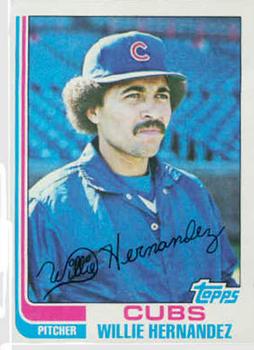
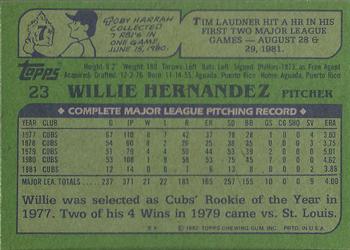
Who Can It Be Now? While the card says "Willie", we will call him what he preferred to be called: Guillermo. Guillermo Hernandez Villanueva was born in Puerto Rico in 1954 in Aguada. He attended high school in Puerto Rico as well prior to being signed as an amateur free agent by the Phillies in 1973. Before 1990, players out of Puerto Rico were exempt from passing through the amateur draft and were able to be signed once they hit age 16. Once 1990 came and the Puerto Ricans had to go through the draft, players from P.R. had to wait to sign until they completed high school. This rule is blamed for the fact that baseball is a dying sport in the Commonwealth of Puerto Rico, as detailed in this 2012 New York Times article. Hernandez signed at age 18 with the Phillies, but he did not pitch in their minor league system until the next year -- 1974. Hernandez was a starter through his minor league career with the Phillies and enjoyed a very successful season at age 20, which he split between AA and AAA. He posted a 14-6 record and a 3.11 ERA over the two levels, and his strikeouts actually increased in AAA over AA on a per-nine-inning basis. He struggled somewhat at AAA at age 21 in 1976, but those struggles did not deter the Cubs from selecting him in the Rule 5 draft in December of 1976. He stayed in the major leagues with the Cubs until the 1981 season. The Cubs sent him down to Iowa to take another crack at being a starter and to get work during the strike. Even though he was in his fifth season in the majors, Hernandez was still just 26 years old, so the work could not have hurt. In reality and as his biography on the SABR website points out, the best thing that happened to Hernandez was playing winter ball after the 1982 season and, then, going to spring training with the Cubs in 1983. In the winter league, former Baltimore Oriole Mike Cuellar taught Hernandez the screwball -- a pitch used to great effect by Fernando Valenzuela in 1981. Then, in spring training, Hernandez worked with fellow Cub Fergie Jenkins and learned the cut fastball. The cutter gave him a pitch to bust righty hitters inside, and it gave the perfect set up for the screwball. The rest, as they say, is history. Hernandez started using the cutter and the screwball some after the Cubs traded him to the Phillies in May of 1983. The Phillies used Hernandez exclusively as a relief pitcher once they got him. He appeared in three World Series games against the eventual champion Orioles that year, pitching four scoreless innings and allowing just two baserunners -- one on a walk and one hit batsman. The next spring, Detroit saw Hernandez as the lefty reliever they needed to augment Aurelio Lopez -- Señor Smoke -- at the back of the bullpen and traded away up-and-coming outfielder Glenn Wilson to the Phillies (with John Wockenfuss) for Dave Bergman and Hernandez. Sparky Anderson rode Hernandez hard -- having Hernandez appear in 80 of the Tigers 162 games, finishing 68 and saving 32 while pitching 140-1/3 innings. Hernandez responded by striking out 112, walking just 44, and giving up only 96 hits. For that season, Hernandez was both the AL Cy Young Award winner and the AL MVP in addition to being an all-star. After that 1984 season, Hernandez remained with the Tigers until the end of his career after the 1989 season. He never approached the heights of his 1984 season -- and with that workload in relief, that should not come as any surprise -- and even became a lightning rod for Tigers fans' disapproval when something went wrong. Even Sparky Anderson said that. Hernandez also gained some notoriety for showing up as a New York Yankee in 1995 as a replacement player during the spring training portion of the 1994-1995 lockout/strike. Hernandez apparently had been an agent and working for a steel manufacturing firm before coming back, but felt like he had not been given a fair chance to come back after elbow surgery in 1989. Needless to say, when the regular players came back, Hernandez returned to Puerto Rico. After baseball, a Toledo newspaper noted that Hernandez was spending his time five years ago as, "a cattle farm owner in the milk business in San Domingo[, Puerto Rico]." Rabbit Is Rich John Updike won a Pulitzer Prize for Fiction in 1982 with his novel Rabbit Is Rich. Here, the category will be used to talk about guys who at some point in their career famously held out or got a big, improved contract in some fashion -- and, more importantly, how it came about. In Hernandez's case, our story comes from October of 1984. At that point in time under baseball's collective bargaining agreement, a player could demand a trade by a certain point in the offseason from his current team. If the player was not traded and did not withdraw the trade request -- read as: got a better contract from his new team -- then the player would become a free agent as of March 15. Hernandez was aware of this rule. In the midst of the World Series, he demanded a trade. By doing so, he was seeking in essence to void the contract he signed with the Cubs prior to his two trades and work out an improved contract with Detroit. The gambit worked, as he signed a five-year, $5.2 million contract with Detroit prior to the 1985 season. It would turn out to be his final contract as a major league baseball player, as well. And maybe, just maybe, demanding a trade in the middle of a World Series is why Tigers fans were quick to boo Hernandez when the opportunity presented itself. A Few Minutes with Tony L. Up until 1983, Hernandez was one of a number of guys toiling away in bullpens and in rotations around the major leagues whose faces and names would be little remembered today. Hernandez, though, kept at it and picked up some new tools for his arsenal when he learned the screwball from Cuellar and the cutter from Jenkins. To be fair, my favorite Guillermo Hernandez story comes from the 1988 season. Hernandez had a public feud of sorts with Mitch Albom, the smarmy self-important writer for the Detroit Free-Press who later wrote the sappy Tuesdays With Morrie. Having watched Albom on ESPN's "The Sports Reporters" one too many times, I can honestly say that I would take Hernandez's side on this one no matter what happened. Anyway, Hernandez accused Albom of turning Detroit's fans against him and claimed that Albom called Hernandez "a crybaby" in stories during the 1987 season. So, let's go to the wire story for the fun:
Hernandez, without saying a word, picked up a large bucket of ice water, poured it over Albom's head, then threw the bucket onto the floor and walked away, muttering.
Albom remained seated, but said: "You're a class act, Willie. I wasn't even talking to you."
Maybe I'm taking out my dislike of ESPN on Albom a bit here, but this has to be my second favorite ice-water-on-a-reporter moment of all time after the time that Deion Sanders doused the self-important, self-righteous Tim McCarver with ice water in the early 1990s.