Showing posts with label Expos. Show all posts
Wednesday, November 19, 2014
Card #131: Stan Bahnsen
Who Can It Be Now?
Stanley Raymond Bahnsen was born on December 15, 1944, in Council Bluffs, Iowa -- just across the Missouri River from Omaha, Nebraska. Nicknamed the "Bahnsen Burner" for his mid-90s fastball -- a nickname which is certainly one of the first chemistry-experiment-related nicknames I've heard -- Bahnsen was the only real athlete in his family. His father Raymond was a brakeman for the Union Pacific Railroad, and his mother Viola was a homemaker.
As the Des Moines Sunday Register article linked above mentions, Bahnsen grew up throwing balls constantly at first a piece of canvas with a bull's eye on it and then at the garage door. His throwing at the garage door destroyed the door, according to his brother Jerry, so when Stan signed his first contract, the first thing he did was build his dad a new garage.
Bahnsen was recruited to play baseball for the University of Nebraska out of Abraham Lincoln High School in CB. He spent just one season with the Cornhuskers and was named to the All-Big Eight team and as a third-team All-American. As a result of his college playing, the New York Yankees selected Bahnsen in the first-ever amateur draft in June of 1965 in the fourth round with the 68th pick overall.
Based on his collegiate background, the Yankees sent Bahnsen to Double-A Columbus (Ga.) -- the "Confederate Yankees" (what a great team name, by the way) -- in the Southern League in 1965. He moved up to Triple-A Toledo in 1966 and made his major league debut in a September call-up that year -- notching a save against the Boston Red Sox in his first ever appearance. His next game was a complete game win -- 10-5 -- over the Washington Senators.
He did not make the team out of spring training in 1967 and, further, did not get called up to the majors that year at all either. This failure to make the team was blamed later on a back injury that affected his pitching motion.
The next year -- 1968 -- however, Bahnsen broke camp with the Yankees. All he did was finish 17-12 with a 2.05 ERA (2.64 FIP) in 267-1/3 innings with 68 walks and 162 Ks in what was by most measures (other than wins) his most successful season as a major leaguer. For his efforts, Bahnsen was named as the American League Rookie of the Year, earning 17 of the 20 votes. Del Unser of the Senators finished second, and if you click through that link to Baseball Reference, you might wonder who in their right mind was voting for Unser (.230/.282/.277, -1.5 WAR) over Bahnsen. At least I do.
Bahnsen spent parts of five seasons with the Yankees. He received criticism, according to his SABR biography, for his inability to pitch complete games. He finished "only" 36 of his 139 starts for the Yankees, which in the late 1960s and early 1970s would be considered unmanly, I suppose.
Thus, after the 1971 season and in the pre-Steinbrenner days of flailing aimlessly forward under the ownership of the media moguls at CBS, Bahnsen was traded to the Chicago White Sox in exchange for utility player Rich McKinney. McKinney played 37 games for the Yankees in 1972 before being traded to Oakland after the season.
Bahnsen finished 21-16 for the second place Chicago White Sox, teaming with Wilbur Wood to give the Chisox two twenty-game winners in what amounted effectively to a three-and-a-half man rotation under pitching coach Johnny Sain. Bahnsen started 41 games, knuckleballer Wood started 49 games, and Tom Bradley started 40. The rest of the pitching staff combined for 24 starts, with Dave Lemonds chipping in 18 of those 24 starts.
The White Sox tried the same approach to starting pitching in 1973 with less favorable results -- dropping to fifth place in an American League West Division propped up by the horrible Texas Rangers. Bahnsen lasted just one more season in the Second City. When his ERA ballooned to 4.70 in 1974 and then to 6.01 in 12 starts in 1975, the White Sox traded him to the Oakland A's with pitcher Skip Pitlock for pitcher Dave Hamilton and outfielder Chet Lemon. After 1974 and at the age of 29, Bahnsen never again threw more than 200 innings, topping out at 143 innings in 1976 with the A's.
Once in Oakland, Bahnsen pitched far better than he had in Comiskey and was a part of the 1975 A's team that was swept by the Boston Red Sox in the American League Championship Series that year. Unfortunately for Stan, he did not pitch in that ALCS so he did not get a taste of postseason baseball from the mound.
Bahnsen lasted into 1977 for Oakland. He was traded to the Montreal Expos as part of Charlie O. Finley's complete sell-off of anything that was not bolted down to the ground at the beginning of free agency. In return, the A's got Mike Jorgensen.
With the move to Canada, Bahnsen transitioned from being a rotation starter to being a swingman who might be available for a spot start once or twice a year but otherwise pitched out of the bullpen. Indeed, as the Expos acquired better talent starting in 1978 and bringing up Scott Sanderson and Dan Schatzeder in 1979 and Bill Gullickson, David Palmer, and Charlie Lea in 1980, Bahnsen was pushed further into the bullpen behind Elias Sosa, Woodie Fryman, and Fred Norman.
In 1981, Bahnsen was 36 years old and pitched as poorly as he had since 1977 -- a 4.96 ERA in 49 innings (4.84 FIP) with a K/BB ratio of 1.17. He did get to throw 1-1/3 innings in relief of Scott Sanderson in Game 4 of the NLDS against the Phillies -- holding the line on the Phillies and allowing his Expos to come back from a 4-0 deficit to tie the game at 5 (though he did give up a single to allow the score to go from 2-0 to 4-0...), only to watch Jeff Reardon lose the game in the bottom of the 10th inning on a solo home run by George Vukovich.
Bahnsen went to spring training in 1982 with the Expos. At the end of the spring, Bahnsen was among the final cuts. He signed with the California Angels on April 8 only to be released on May 14. The Phillies then signed him on May 31. He spent much of the 1982 season with the Phillies' Triple-A team in Oklahoma City before getting a September call-up that year.
He pitched very well for the Phillies in limited action -- 1.35 ERA (2.04 FIP) in 13-1/3 innings. But, that was not enough to earn him a spot in the majors the next season. After a disastrous 15-game stint in Triple-A Portland in the Phillies' organization in 1983, the Phillies let Bahnsen go and his time in organized baseball came to an end.
Mustache Check: Bahnsen was a good Midwestern boy, not some hippie from the coast. So he's clean-shaven.
Nanu Nanu
Despite appearing in 15 games in 1982 and despite the 792-card sets of the day, Stan Bahnsen did not appear on any additional Topps Cards as a player after 1982. So, this is his sunset card.
A Few Minutes with Tony L.
Bahnsen barely made any impact on me as a kid because he was a National Leaguer by the time I could remember things for myself. I do remember his 1978 Topps card, for some reason, and I knew his name. But I have no reason why I remember those things other than, perhaps, repetition.
Bahnsen has led an interesting post-baseball career. For 20 years, he worked with Norwegian Cruise Lines in promotions. He did promotional work for Arrow Shirts starting in the early 1970s and continued to do so after his playing career took him to other cities.
Amidst all that, Bahnsen continued pitching from time to time. He pitched in the Senior Baseball League in 1989 for the Gulf Coast Suns and in 1990 fro the Daytona Beach Explorers. Then, in the middle of a divorce from his first wife, he decided to be a trailblazer of sorts and moved to The Netherlands to pitch in the Hoofdklasse Honkbal league there. At the age of 48, he moved to Haarlem and became the first former major league pitcher to appear in that league (though Wim Remmerswaal started in the Dutch league before coming to the US).
Over the years and around his job with the cruise lines, he has spent a significant amount of his time teaching kids how to play baseball. You can find photos on Facebook of him in a Yankees uniform working with little kids -- probably 10 or 12-year-olds -- at the Players Edge Baseball Academy a couple of years ago. Bahnsen is a local legend in Council Bluffs. Even today, he has a park in town named for him.
These days, Bahnsen is still in the cruise industry. He organizes baseball-themed cruises for MSC Cruises USA. One cruise leaves on November 29 for a 7-night Caribbean tour with Kevin Seitzer, Juan Marichal, Amos Otis, and John Denny on board (in addition to Bahnsen). Another cruise is scheduled for February 7, 2015; that cruise currently has Art Shamsky and Gorman Thomas scheduled to be on board with Bahnsen. Both cruises depart from and return to Miami after visiting St. Maarten, Puerto Rico, and the Bahamas.
So, maybe you can combine your baseball card fun with a trip to make your significant other happy too!
Labels:
Cruising,
Dutch League,
Expos,
Nanu Nanu,
Stan Bahnsen
Saturday, September 6, 2014
Card #102: Dan Briggs
Who Can It Be Now?
Dan Lee Briggs was born in Scotia, California, on November 18, 1952. Briggs attended Sonoma High School in Sonoma, California. Briggs was young for his class -- graduating in 1970 -- but that did not deter the Angels from selecting Briggs in the second round of the 1970 June Amateur Draft with the 34th pick overall.
Briggs was drafted initially as a left-handed pitcher. At Idaho Falls in the short-season Pioneer League in 1970, the Angels had Briggs pitch and play outfield. In 1978, the transition from pitcher to outfielder came up when he tripled and then scored the winning run to push the Red Sox out of first place. Briggs was quoted as saying:
I was a pretty good hitter and the club thought I should become a position player, so I became an outfielder. Pitching is such an insecure job anyway that I felt I would like to become a position player.Despite minor dalliances on the mound later in his career -- including 7 appearances in 1984 and 1985 in the minor leagues -- Briggs effectively left pitching behind despite putting up a 1.29 ERA and a 2-0 record over 7 appearances (28 innings, 20 hits, 8 runs, 4 ER, 2 HRA, 19 BB, 33 K). Yes, he would have had to learned control, but a 17 year-old striking out 10.6 guys per 9 innings probably shouldn't have given up on pitching so quickly.
But that's just hindsight talking. His hitting at Idaho Falls was pretty good -- .305/.411/.437 in 224 plate appearances (with 27 BBs but 52 Ks). And that definitely was not a bad showing for a kid who was 2-1/2 years younger than the average player in the league.
Going forward, though, Briggs appeared to be on the slow-promotion scheme. He played another 51 games in Idaho Falls in 1971 because he fell flat on his face at Quad Cities in the Midwest League -- .171/.299/.195 in 97 plate appearances. The Angels promoted him to the California League in 1972, and he hit just .232/.315/.396 -- suddenly discovering some home
run power but striking out 118 times in 449 at-bats.
As a result, he started back in the California League in 1973 -- this time in Salinas rather than Stockton -- and he hit well enough to move up to Hitters Heaven in El Paso. In 1974, then, he was 21 and split time between Double-A El Paso and Triple-A Salt Lake City. He hit well at both stops, but the Angels did not give him a September call-up. That had to wait until 1975.
The problem that Briggs ran into was this: even though the Angels were not a very good ball club in 1974 or 1975 or 1976 for that matter, the fact was that Briggs was limited to being a corner infielder/outfielder. In 1975, those spots were filed by guys who had progressed more quickly -- Bruce Bochte (24 years old), Dave Chalk (24), and Dave Collins (22) -- or the veteran Leroy Stanton (29).
The other problem Briggs had was the fact that he simply appeared to be a Quad-A player -- a guy who ripped Triple-A apart but who could not hit major league pitching. Indeed, over 149 games from 1975 to 1977 with the Angels, Briggs hit just .204/.253/.286 with 3 HR, 23 BBs and 67 Ks in 383 plate appearances. For comparison's sake, in those same years at Triple-A Salt Lake City (and Indianapolis, where he spent some time "on loan" apparently with the Reds) his batting average was .310. His hitting in the majors just was not good enough to keep him in Anaheim.
As a result, the Angels let Briggs go. It took him until the start of spring training in 1978, but the 25-year-old Briggs hooked on with the Cleveland Indians. He spent most of 1978 in Portland -- smacking the ball around as usual (.330/.403/.562; 20 HR, 109 RBI, 6 SB). Even a bad Indians team, however, could not find room for Briggs to play in front of Johnny Grubb or Paul Dade in the corner outfield slots since neither Andre Thornton at first nor Buddy Bell at third would be stepping aside. Then, in September when Briggs got his chance, he only tallied 8 hits in 49 at-bats with 4 walks for a .163/.226/.265 slash line. I mean, you can hit the crap out of the ball all day in Portland, but you better not fall into a slump when you hit the majors.
So, Cleveland gave up on Briggs too. After losing out in a four-way battle for the left field slot in spring training in 1979, the Indians sent Briggs to San Diego for a player to be named later. The Padres actually gave Briggs his only 100 appearance season -- even though he had more plate appearances in 77 games in 1976. Briggs once again disappointed, hitting .207/.277/.357 with 8 of his 12 career home runs and both of his stolen bases. But at least he didn't play in the minor leagues that year -- the only time that happened for him during his entire career.
At the end of the season, though, the Padres had seen enough and sent Briggs to the Expos with infielder Bill Almon in exchange for Dave Cash. The Expos had Rodney Scott and Tim Raines ready at second base, so they did not need Cash (who played one season in San Diego and was done with his career). Briggs did not so much as sniff the major leagues in 1980, and the nine games he played in 1981 were all in September or October. Even then, the .091/.091/.091 slash line for the one single that Briggs got in 11 at-bats makes his inclusion in the set a true headscratcher.
Entering into 1982, Briggs recognized he was on his last chance. The Montreal Gazette quoted Briggs as saying that he had "to hit about .600 during this camp. I have to beat out some very good ball players." The story also mentioned that Briggs had some interest from teams in Japan and almost played there for the 1981 season. He changed his mind, but the story mentioned that Briggs had "taken out stock brokers' papers."
Briggs did not hit .600 that camp. Instead, he ended up traded to the Chicago Cubs during spring training. Once again, Briggs got a bit of a chance to pinch hit and play on the corners. Once again, he failed to impress. After his final at-bat as a major leaguer on July 3, his numbers stood at .125/.143/.125 on the basis of getting hit by a pitch and tallying 6 singles in 48 at-bats, along with a sacrifice hit.
The Cubs sold Briggs's contract to the Yakult Swallows in Japan midway through 1982. Briggs played all of the 1983 season for Yakult as well before coming back to the States and playing for the Triple-A Columbus Clippers in the New York Yankees' organization for 1984 and 1985. At the end of the 1985 season, Briggs's playing career came to an end.
Mustache Check: Briggs was a mustache guy for only a few years. He was clean-shaven on the Indians, Angels, and Clippers, but he sported a mustache with the Padres, Expos, and Cubs. So, here, he has whiskers.
Nanu Nanu
It's not entirely accurate to say that this is Briggs's final Topps card. Apparently, since Topps included him in the main set, they felt obligated to update his team status when he was traded to the Chicago Cubs. Yes, instead of including Wade Boggs or Tony Gwynn, we got Dan Briggs. But, 1982 is the last year that Briggs appeared on a Topps (or any other) baseball card as a major leaguer.
Don't You Want Me?
I've neglected using this tag for those guys who got cut during 1982. But, here's a great opportunity to use it since, well, I don't have a whole lot else.
A Few Minutes with Tony L.
At first, when I saw Dan Briggs's name, I wasn't sure if he was either the Briggs who played with the Brewers in the early 1970s or whether he was related. Then I saw that John Briggs was the outfielder for Milwaukee, and that John is an African-American born in Paterson, New Jersey. So, I was entirely wrong.
Since his retirement in the mid-1980s, Briggs settled in Ohio. He owned and operated a gym in North Columbus called Fitness Trend from 1984 to 1994. Briggs's LinkedIn profile mentions that this gym was the training headquarters for none other than one of the greatest upset artists in boxing history -- James "Buster" Douglas. Briggs also served as the Head Baseball Coach at Denison University in Ohio from 1989 to 1999. During that time and to the present day, Briggs is the co-owner (along with John Pacella) and is the marketing and program director for Big League Baseball School in Worthington, Ohio.
I have no personal recollection of Dan Briggs. However, one blogger from 2009 probably wishes he could say the same thing. You see, he attended Briggs's baseball school. What follows are his words and not mine, but it's pretty scathing:
MEET HIDEOUS DAN BRIGGS
This hideous player hits a big closer to home then [sic] most. You see, Dan Briggs opened up a baseball school here in central Ohio. While Dan could open this academy, titled "Big League Baseball Academy" and host a camp, Dan really could hardly take credit for being a big leaguer.
We always wanted to say that to him. I guess now is our chance. Sure, he's been to the show. He's probably had drinks bought for him, probably seen beautiful women, he's played catch in the outfield of the greatest parks in the world. But being a self promoting hitting instructor when you hit .195 in 325 big league games is about like having a stripper teach a high school health class about abstinence.It gets worse from there. Feel free to click over and read it, because it's pretty entertaining as a completely scathing take down of Briggs. Certainly, it's written by a less-than-impressed former student, but I personally wonder sometimes about these "baseball camps" that these former major leaguers run. This is a small glimpse inside.
Labels:
Dan Briggs,
Don't You Want Me?,
Expos,
Hideous Dan Briggs?,
Mustache,
Nanu Nanu
Wednesday, July 2, 2014
Card #70: Tim Raines


Who Can It Be Now?
Timothy Raines Sr. (not to be confused with his son) was born on September 16, 1959, in Sanford, Florida -- a smallish city of about 50,000 people an hour north of Orlando. Tim was one of 6 children who grew to adulthood and one of five boys born to Ned Jr. and Florence Raines.
Tim's dad was a semipro baseball player in Sanford, and all five boys were excellent athletes. Raines's SABR biography mentions that one local baseball all-star game featured four Raines brothers around the infield -- Levi at first, Sam at second, Ned III at third base, and Tim at shortstop.
Indeed, Tim was an excellent football player, starring at running back for Sanford Seminole High School. His SABR biography again mentions that he scored 18 TDs and averaged 10.5 yards per carry. Reviewing some game stories from the Daytona Beach Morning Journal confirms these crazy numbers to an extent. In one game write-up, the story went that Raines came back to football after planning initially to sit out his senior year:
Tim Raines had decided to sit out football to concentrate on a possible major league baseball career. But Sanford Seminole Coach Jerry Posey can thank his lucky stars that Raines changed his mind and joined the Seminole football team after the season opener. . . . Raines ruined the Bulldogs with his outside running and pass receiving. The 175 pound senior scored all four touchdowns for Sanford, three from the ground and one from the arm of quarterback John Litton. In all, Raines picked up 108 yards in 11 trips and added five receptions worth 66 yards in real estate against a reputed staunch [sic] DeLand defense.As that football story hinted, Raines was known already in high school as being an excellent baseball player. Thus, after he graduated high school in 1977, the Expos drafted Raines in the fifth round of the June Regular draft. He stayed in Florida and played for the Expos Gulf Coast League affiliate in rookie league ball and showed off the blazing speed that would be his calling card in the early part of his career and the on-base skills that he kept throughout his career -- .280/.381/.342 with 29 steals and only 2 CS in 189 plate appearances.
The Expos moved him to their Florida State League affiliate in 1978, and Raines responded well to the move. Despite being about 3-1/2 years younger than the average player in the league, Raines stole 57 bases (caught 21 times though) and hit .287/.400/.315 in 438 plate appearances. He also walked 64 times against just 44 strikeouts.
Perhaps the only worrisome issue there was the lack of power he was showing. That was remedied at Double-A in 1979, where in 650 plate appearances and at the age of 19, Raines hit .290/.390/.399 with 25 2B, 10 3B, 5 HR, and 59 steals against just 12 CS -- and he walked 90 times versus just 51 strikeouts. Those numbers earned him a late season call-up to the majors in 1979, where he got a taste of a pennant race as a pinch runner.
His 1980 season at Denver -- .354/.439/.501, 77 SB, 13 CS, 61 BB, 42 Ks -- showed that his previous seasons were not flukes (though certainly his numbers were inflated by playing in Denver). He got to play a few games in July and August for the Expos that season as an injury fill-in, and then went back to being a pinch runner in September.
Now, what I had forgotten about Raines was that he came to the Major Leagues as a second baseman originally and, in fact, played at 2B and SS in the minor leagues. Short wasn't really an option for Raines, who played there only sparingly. Playing 2B for the Expos in 1980 primarily was 26-year-old Rodney Scott, who himself stole 63 bases in 1980. Behind Scott was 23-year-old Tony Bernazard, who himself had a decent career in front of him. So, 2B looked pretty jammed up too.
The Expos realized, though, that they needed to make room for the 21-year-old phenom from Florida. They decided that Raines could be a leftfielder. They had picked up former Tiger Ron LeFlore after the 1979 season to play left. LeFlore still had incredible speed -- I mean, he stole 97 bases in 1980, after all, and with Scott set a record for most stolen bases by teammates in a season with 160. But LeFlore also was 32 years old and hit just .257/.337/.363 for Montreal in 1980. So, left field became Raines's position.
Raines grabbed the opportunity and ran with it. Literally. In 88 games for the Expos, Raines stole 71 bases, which led the league and was 32 steals more than second place Omar Moreno's 39. The gap between the two of 32 steals itself would have finished in third place, 2 steals ahead of Rodney Scott's 30.
Without the strike, Raines was on a pace to finish with 107 steals (the Expos played exactly 2/3 of their scheduled 162 games in 1981). I previously said that he would have stolen 121 bases. I think I had a methodology issue there because I think I forgot to extrapolate Raines's totals out against the Expos' remaining games; on Card 3, I think I simply extrapolated what would Raines's numbers would have been had he played 150 games.
Anyway and as a result, Raines finished second -- correctly -- in the National League Rookie of the Year voting behind the phenomenon that was Fernando Valenzuela. 1981 was also the first of his seven consecutive selections for the All-Star game.
Raines played in Montreal until after the 1990 season. It's possible that he would have left Montreal after the 1986 season, but in that year of owner collusion, he simply had to resign with the Expos on May 1. He was traded to the Chicago White Sox in December of 1990 with Jeff Carter in exchange for a minor leaguer, OF Ivan Calderon, and P Barry Jones. Raines spent five years on Chicago's South Side, continuing to get on base at a great clip and hitting with some pop.
After the 1995 season, Raines was sent to the New York Yankees in exchange for a minor leaguer to be named later. Raines did get a World Series Championship with the Yankees after the 1996 season and again after the 1998 season, though Raines did not play in the World series in 1998.
At the age of 39 in 1999, Raines played for the Oakland A's for 38 games, and it appeared that his career was over at that point. The reason for that was that Raines was diagnosed with lupus. Lupus is where a person's immune system begins attacking the person's own body due to a lack of antibodies in the system to prevent such attacks. Raines's lupus attacked his kidneys, causing him to retain water. He was treated during 1999, and he believed he was ready to play in 2000.
The Yankees, under GM Bob Watson, gave him a chance to make their club. Yet, the Yankees released Raines after spring training in 2000. Later that year, it appearing that his career was over, the Expos inducted Raines into their team Hall of Fame. Raines told then-owner Jeffrey Loria that he still wanted a shot to play. As a result, Raines signed after the 2000 season as a free agent with the Montreal Expos, and spent the 2001 season with the Expos as an elder statesman, fifth outfielder and, perhaps, as a reminder to Expos fans that the team used to be good 20 years before.
By this time, his son, Tim Jr., had played in High-A Frederick in the Carolina League and looked to be an adequate player -- definitely not as good as his old man, but decent. In 2001, Tim Jr. had worked his way up to Double-A and Triple-A baseball in the Baltimore Orioles system. As a result and at the very end of the 2001 season, the Expos and Orioles worked out a deal to send Tim Sr. to the woeful Orioles from the woeful Expos. That move allowed Tim Sr. and Tim Jr. to play in the same outfield against the Blue Jays on October 3 and in a three-game series against the Red Sox that weekend.
Even that did not sate Raines's desire to play baseball, so he signed on for the 2002 season with the Florida Marlins so he could play in his home state. Apparently that season at the age of 42 was enough to convince him that he was done, as he hit .191/.351/.258 in 114 plate appearances.
Mustache Check: You can't really tell on this photo. If we go by his 1982 Fleer card, though, the answer is yes:
Family Ties
As I mentioned above, Tim Raines Sr. was lucky enough to play in the same outfield with his son, Tim Raines Jr., thanks to the Baltimore Orioles in 2001. That feat had been done just one time before, when the Griffeys -- Ken Sr. and Ken Jr. -- played together in Seattle.
Another note above mentions how athletic Tim and his brothers were. If you read the SABR biography for Tim, you'll see that the Raines family believed that Tim's older brother Ned was actually the better player of the two growing up. Ned was drafted in 1978 in the January Draft by the San Francisco Giants out of junior college. Ned never made it past the California League, however, and his career in organized baseball was over after the 1980 season.
Trivial Pursuit
Raines played in the major leagues in four different decades -- the 1970s, 1980s, 1990s, and 2000s. He is only one of four players to steal bases in all four of his decades in baseball. The other three are Ted Williams, Rickey Henderson, and Omar Vizquel.
A Few Minutes with Tony L.
Tim Raines was a young star in 1982 -- on par in many respects with guys like Bryce Harper today. By that, I mean that if the Expos GM in 1982 had called up your favorite team's GM and offered a trade for Raines, you would just hope that you had enough minor league parts to get him.
Raines probably was better than Harper at that point, frankly, because Harper seems to be injured regularly and Harper appears to have a bit of an attitude problem. The only problem Raines had in 1982 was cocaine -- and he went to rehab for that and did not relapse. As far as I know, there is no rehab available for being something of a jerk.
Back on card 3, I raised the question -- without answering it -- of whether Tim Raines belongs in the Baseball Hall of Fame. Raines has received solid support in the 7 years he has been eligible -- with the percentages of the vote that he has received climbing at first through 2013, when he received 52.2% of the vote (with, of course, 75% needed for induction). This past year, he faded somewhat, getting 46.1% of the vote.
Should he make it?
In his favor, consider that four of his ten most similar players by similarity score are in the Hall -- Lou Brock, Max Carey, Fred Clarke, and Enos Slaughter. Another point in his favor is that those similarity scores are low -- ranging from 813 for Slaughter to 863 for Brock. A good sign of a unique, important player is that he is not nearly the same player as another in history. Also in his favor is the fact that the average WAR/WAR7/JAWS scores for the 19 Hall of Fame left fielders is 65.1/41.5/53.3, and Raines's scores are 69.1/42.2/55.6 -- making it appear that Raines is solidly above average when it comes to even being a Hall of Fame left fielder.
On the other hand, Raines is slightly below to much below average when it comes to other measures for Hall of Famers. His Black Ink score (league leading) is 20, while the average HOFer is 27. Raines ranks 107th in that category. His Gray Ink scores -- top 10 league finishes -- is 114, and the average Hall of Famer is 144. Raines is 182nd in that category. His "Hall of Fame Monitor" score is 90, and a likely HOFer is 100; his Hall of Fame Standards number is 47, likely HOFer is 50. In other words, Raines may not have been a dominant enough player in his time.
Bill James created the "Keltner List" in the 1990s in an effort to ask qualitative questions toward clearing up whether a player should be in the Hall or not. Last November, the "Cans of Cool" blog went through the Keltner List for Raines. The short Q&A version:
1. Was Raines ever the best player in baseball or suggested to be the best player in baseball? The answer is probably not, but he was around the top 5 to 10 players every year of the 1980s.
2. Was he the best player on his team? From '83 to '87, probably -- and in 1987 almost certainly.
3. Best player in baseball at his position? In his league at his position? Here's where Raines's misfortune of coming up at the same time as Rickey Henderson kicks in -- Raines was Henderson-lite. That's not a jab, either, because Henderson was an incredible, transcendent player who comes along once every 20 or 50 years -- if that frequently. Raines did everything Henderson did, but Henderson did all of them better. Raines might have been the best left fielder in the 1980s, though, before Barry Bonds emerged.
4. Impact on pennant races? In 1993 with the White Sox, definitely. In 1981, as a rookie, certainly. Other years, the Expos were good, but they could not get over the hump. He played significant time with the 1996 Yankees as well, but was nowhere near being a full-timer.
5. Good enough to play regularly past his prime? Sure, to an extent. Injuries cut his playing time more than a lack of ability did.
6. Best player in baseball history not in the Hall that is eligible? Certainly not. Barry, for all his failings, still is that guy.
7. Most players of comparable stats in the Hall? No, not really, though Brock is somewhat comparable and in the Hall. Raines shows better than Brock generally, though.
8. Do his numbers meet Hall standards? His stolen bases definitely do.
9. Was he better or worst than his numbers indicate? As the blog I mentioned says, he was a highly successful base stealer -- 84.6% success rate -- and he walked 450 times more than he struck out in an era of guys who struck out 150 times a season.
10. Is he the best player at his position not in the Hall? Nope, that's Bonds. Raines is second or maybe third if you count Pete Rose in the conversation and as a left fielder.
11. MVP consideration? He had three top 10 finishes, never won it, and he was not the guy who should have won it (using WAR) in any of those seasons.
12. All-Star seasons? He was a 7-time all-star and merited selection for probably 5 or 6 more.
13. If he was the best player on his team, would that team likely win the pennant? In his prime, probably.
14. Baseball history impact? Well, that Free agent collusion issue from 1987 revolved in large part around Raines and fellow Expos Andre Dawson. Maybe that's enough.
15. Did he uphold the Hall's standards of conduct? He had his issues with cocaine, certainly, but got clean shortly thereafter. That issue did not stop Hall voters from inducting Paul Molitor on his first go-round for the Hall (though Molitor's career numbers were a lot better).
In all, it's a close issue -- much closer than Dave Parker or, for that matter, Jim Rice, in my opinion. Based solely on the numbers, Raines probably should be in the Hall of Fame and should have been in the Hall of Fame long before Jim Rice even sniffed admission. Compare the WAR/WAR7/JAWS numbers:
Raines: 69.1/42.2/55.6
Rice: 47.4/36.2/41.8
Rice had to wait until his 15th year to be inducted, and he too had a backslide in voter support around 7 or 8 years into his candidacy. We will see whether the BBWAA will start a groundswell of support for Raines's candidacy in the years to come. It will be close, I think, but I believe Raines deserves admission -- and not solely based on the fact that he was a far, far better player than Jim Rice.
Friday, May 9, 2014
Card #38: Charlie Lea
Who Can It Be Now?
Charles William Lea was born on Christmas Day, 1956, in Orleans, France. He was born into a military family and arrived in the U.S. just three months after his birth. He really grew up in Memphis, Tennessee -- attending Kingsbury High School there before going to Shelby State Community College (now a part of Southwest Tennessee Community College) and the school then known as Memphis State University and now known as the University of Memphis.
He was drafted out of high school in the 15th round by the New York Mets in the June 1975 Regular Draft, by the St. Louis Cardinals in the second round of the June 1976 Secondary draft, and by the Chicago White Sox in the fourth round of the 1977 January Secondary Draft but did not sign with any of those teams. Not until the June 1978 Regular draft, when the Montreal Expos chose him, did Lea finally sign. It probably did not hurt the Expos chances of signing him that the team's Double-A Affiliate at the time when he was drafted.
The Expos assigned him to the Memphis Chicks in Double-A immediately after he was signed. He was a part of a Memphis pitching staff that had a team ERA of 2.98 and featured eight future or former major leaguers, including Scott Sanderson, Bill Gullickson, Bryn Smith, and David Palmer.
It took the Expos until 1980 to promote Lea past Memphis. His 9-0 start there, accompanied by a 0.84 ERA and just 34 hits allowed in 75 innings pitched, impressed the Expos enough to move Lea beyond his Memphis home. What the card back above neglects to mention -- and, since the line apparently was deleted to note Lea's no-hitter the previous season, I can understand it -- is that Lea pitched 2 games for Triple-A Denver in 1980 before the Expos called him up to the major leagues.
Lea was called up in 1980 in early June and made 19 starts for a Montreal team that finished just one game behind the eventual World Series champion Philadelphia Phillies. With being in a pennant race, manager Dick Williams used Lea as sort of a fifth starter in a four-man rotation. He still started 19 games, but, come the September pennant race, Lea pitched only in spots and, frankly, appeared to wear out near the end of the season -- his ERA went from 2.93 on August 19 to 3.72 by the end of the year.
Coming into 1981, Lea was expected to fill the same role as he had the previous year -- as a long reliever and spot starter. His numbers from that season bear out that that is exactly how he was used -- 11 starts in 16 appearances, pitching on irregular rest of anywhere from 2 to 8 days rest, and not being a member of the rotation.
As the back of the card says, on May 10, 1981, Charlie Lea became the second Expo pitcher to throw a no-hitter (and threw the third no-hitter overall) in Montreal Expos history. The other two pitchers to do it were Bill Stoneman twice (in 1969 and 1972) and Dennis Martinez's perfect game in 1991. And, it was the first one in Olympic Stadium. Here's a video of the final out being caught by Andre Dawson:
The AP wire report about the game called Lea "an unlikely candidate to pitch a no-hitter." The same story quoted Lea's catcher for the game, Gary Carter, as saying, "Nobody expected a no-hitter from Charlie. But he had a good fastball and good command of his pitches, and everything fell into place." Based solely on Lea's ERA coming into the game -- 7.36 -- it is tough to disagree.
Even a closer look at the game log shows that the no-hitter was not something anyone would have expected. Coming into that game, Lea had started two games in 1981. In his first start, he got rocked, giving up hits to 9 of the 18 batters he faced and walking one while giving up 6 runs in 2-2/3 innings to the New York Mets. In his other start, he went 4 innings and gave up 3 runs, which brought his ERA down to 10.57.
The no-hitter, though, started a run of three four consecutive games for Lea that he won and pitched well. He had three games in a row that he pitched very well -- 25 innings, 8 hits, 7 walks, 16 strikeouts, no runs and two complete game shutouts -- and a fourth where he was wild -- 7 walks in 7 innings -- but avoided trouble and gave up just one run.
Unfortunately for Lea, that 7-walk start on May 27 would be the best his numbers looked all season. Just prior to the strike stopping play for nearly two months, Lea was absolutely annihilated by the Reds -- 10 hits, 9 earned runs, 2 homers allowed, and no strikeouts in 3-1/3 terrible innings. Lea pitched just 5 times after the strike ended and watched as his ERA climbed from 2.09 on May 27 to 4.62 to end the season. On the basis of his struggles, Lea was only a bystander in both the NLDS against the Phillies -- the only post-season series the Expos ever won in their 35-year history -- and the NLCS against the eventual World Series champion Los Angeles Dodgers.
In 1982, Lea finally got the chance to pitch reasonably regularly as an Expos starter. He was a part of the Expos rotation with Steve Rogers, Bill Gullickson, Scott Sanderson, and David Palmer that, along with the bullpen, had the 2nd best ERA, the fewest walks, and the third-most strikeouts in the National League. Despite a strong offense and pitching, the Expos finished a disappointing third under Jim Fanning -- underperforming their Pythagorean W-L record based on runs allowed by four games.
By his stats, though, one can see that the light really seemed to come on for Lea in 1982. His walks went down by 0.8 per nine innings, his strikeouts went up by 1.5 per nine innings, and his hits allowed went down by 1.5 per nine innings. From all indications, he was learning how to be successful on the major league level.
Those indications were correct, as his 1983 and 1984 seasons were extremely successful ones -- his combined statistics for those two years resulted in a 31-21 record and a 3.00 ERA over 446-1/3 innings over his age 26 and 27 seasons.
Outside of the no-hitter -- which, to be quite honest, includes a fair amount of luck incorporated with the skill to get hitters to make outs -- the pinnacle of Lea's career on the field had to be the 1984 season. As a team, Montreal were not very good, finishing 78-83. But Lea received the honor of starting the All-Star Game in San Francisco that year on the strength of his 13-4 win-loss record at the break. The second half of his year was less successful, however, and he started suffering from shoulder pain. The Expos gave him 9 days rest between his second to last and last starts of the season, yet he did not make it past the fourth inning. He did not pitch again after September 16.
Lea did not pitch in either 1985 or 1986. He was placed on the disabled list in March of 1985 with what had been diagnosed as shoulder tendinitis. By May 24, 1985, he had gone under the knife to fix his shoulder. He was optimistic at that point and was quoted in the story as saying, "We still don't feel there's anything major wrong, but small things can cause problems. I'm disappointed that I'm not going to pitch again this year, but something's definitely wrong with my shoulder and there comes a time when you have to make a decision."
While optimistic in May of 1985, Lea did not pitch at all until 1987, when he spent most of 1987 trying to rehabilitate in the minor leagues. He would not pitch again for the Expos until exactly two years after his previous start -- September 16, 1987 -- and in that start, the reigning World Series champion Mets knocked him out of the box after just one inning. That was the last time that Lea appeared in an Expos uniform as a player.
He pitched just one more year in 1988 for the Minnesota Twins. He didn't miss bats as well as he used to, giving up 156 hits in 130 innings and finishing with a 7-7 record and a 4.85 ERA. Even in the high offense late 1980s, that was not a very good performance. He never pitched again in the major leagues and retired after again feeling pain in his right shoulder in the spring of 1989.
Lea passed away unexpectedly of a massive heart attack on November 10, 2011, at the age of just 54 years old. To honor Lea's memory, the Memphis Redbirds created the Charlie Lea Award in 2012 to recognize Memphis's top high school pitcher. Lea also was honored with a statue at AutoZone Park -- the home of the Redbirds -- of him in his windup. It's not your typical statue, though:
![]() |
| Photo by Darrin M. Devault (taken on May 9, 2012) of http://killebrewfortorre.blogspot.com/ |
This Is Radio Clash
Once Charlie Lea realized that his shoulder was not going to allow him to pitch any more, he headed back to Memphis. He finished his degree in business administration at Memphis State and raised his two sons there with his wife. Eventually, he spent 11 years as the radio broadcaster for the Memphis Redbirds, the Triple-A team that replaced the Double-A Memphis Chicks.
A Few Minutes with Tony L.
In 1982, I knew who Charlie Lea was because of two things -- the 1981 no-hitter, and his 1981 Topps baseball card where he is pictured smiling with a huge cheek full of tobacco.
Writing this entry has been somewhat difficult for me personally because I got to know Charlie's son, Brian, personally because Brian and I worked together for a year. Brian already has established himself in his chosen field of the law -- Brian clerked for Supreme Court Justice Clarence Thomas during the 2011-2012 Supreme Court Term (scroll up to see him there). Whether you agree with Thomas's politics or not, the fact remains that clerking for a Supreme Court Justice is one of the most prestigious short-term positions that the law has to offer. Luckily, Charlie got to see Brian achieve this height since the court's term runs from July to June of each year.
Thanks also to Brian asking him to do so, I was lucky enough to receive a few autographed items directly from Charlie in May of 2011.
Charlie was happy to oblige my request, sending this photo card and a signed version of that 1981 Topps card to me even though I hadn't sent him anything. It confirmed all the news stories that circulated about Lea at his passing - that he was gentle and kind and passionate for the game of baseball.
If one's children reflect who they are as a person, then I can honestly say that Charlie must have been one of the nicest, most genuine people around. I'm sorry I never got the opportunity to thank him for his kindness in person.
Labels:
Charlie Lea,
Expos,
Gone Too Soon,
No-Hitter,
This Is Radio Clash,
True Gentleman
Wednesday, April 16, 2014
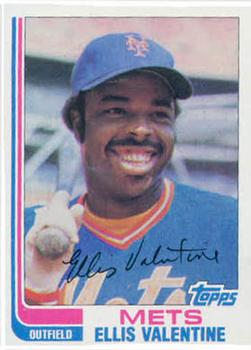
Card #15: Ellis Valentine
Who Can It Be Now?
Ellis Clarence Valentine was born in Helena, Arkansas, in 1954, and graduated high school from Crenshaw High School in Los Angeles -- a school which produced Darryl Strawberry, Akbar and Kabeer Gbaja-Biamila, Ice-T, Milwaukee Bucks legend Marques Johnson, and UConn basketball coach Kevin Ollie, among others. Valentine was the first of those guys from Crenshaw to make a name for himself, which makes sense since the school did not open until 1968.
Noted journalist Jeff Pearlman -- in the news again recently for the fifteenth anniversary of his writing that John Rocker interview in Sports Illustrated -- interviewed Valentine on his website. Valentine came from a good family. His dad worked for the City of Los Angeles as a trash man, and his mother had her own beauty salon. Valentine himself admitted in his interview with Pearlman that he, "took a lot of things for granted, growing up. And a lot of it didn't come to a head until it all came crashing down after my career was over."
Valentine was chosen by Montreal in the June 1972 draft in the second round with the 29th pick overall. Guys drafted before him in the first round included Chet Lemon, Scott McGregor, Dick Ruthven, and Rick Manning, among others. Valentine made it to the major leagues for the first time in 1975 at the age of 21 for a cup of coffee, then spent half a season at AAA in 1976 before making it to the majors for good with the Expos in 1976.
In the seasons in which he turned 23 and 24 -- 1977 and 1978 -- Valentine put up back-to-back seasons of 25 HR, 76 RBI, and 13 SB. In 1977, he made the All-Star team for the one time in his career. In 1978, he won a Gold Glove -- likely based in many respects on his incredible, NL-leading 25 baserunner kills (because, after all, he still committed 10 errors that year).
Things were going well for Valentine until 1980. On May 30, 1980, on a Friday night in Busch Stadium in St. Louis, Valentine came to bat in the top of the sixth inning against reliever Roy Thomas. Thomas had come on in relief of Jim Kaat, who had been hammered by the Expos to the tune of 6 runs in 4 innings. With two outs and no one on base, a fastball rode up and in on Valentine and broke his cheekbone in six places.
When he came back, he needed to protect his jaw and cheek from further damage. He began wearing part of a football facemask to protect himself. His 1981 Topps card is proof:
Frankly, after the injury, Valentine was not the same player, and he said exactly that in his Pearlman interview: "I wasn't the same hitter any longer. I wasn't the same athlete any longer. I'd become a different person because of it. I prayed over it, and I realized getting hit in the jaw wasn't fun. From a guy who throws the ball over 90-plus miles per hour."
In May of 1981, Valentine was traded to the Mets for Jeff Reardon and Dan Norman. He wasn't hitting well, and he was going to the plate and hacking like crazy. I mean, when a guy walks 11 times in 261 plate appearances, that's hack-tastic. 1982 was worse -- 5 walks in 350 plate appearances. He had more sacrifice flies -- 7 -- and grounded into more double plays -- 11 -- than he did walks. At age 28, he was nearly washed up rather than reaching his peak.
Valentine signed with the Angels for the 1983 season and played a part-time role with them. He didn't play anywhere except for one game in AAA in 1984, and then hooked on with the Rangers for a year. At age 31, he was done with baseball.
Pass the Dutchie
Valentine's life -- both in baseball and, more importantly, after baseball -- has been marked by his relationship with drugs and drug abuse. In that excellent interview with Jeff Pearlman, Valentine said that his worst years for drugs were actually the years in the late 1970s -- his best years in baseball:
But mostly the later part of my years in Montreal, that's when it was really becoming a problem. I'd always dabbled around with a few things in high school, like most other kids. That was the era--we'd smoke a little pot, drink a little wine, play a little rock and roll. But when I got to Montreal things grew. They escalated. I made more money, and you do more things, blah, blah. It got a little out of control. The year my injury happened in 1980--that was the season I really started to intervene on that.It's a good thing that he did, because for the past 25 years, he has worked in substance abuse counseling and behavioral intervention. My final quote from the Pearlman interview sums this up:
I've had two real jobs in my life. I've been a baseball player and I've been a counselor. I love this. I have more joy from this, because when you're involved with another person and you help another person change his life, it's just something to it. I could hit home runs. That was fine. That was for me, and for the team, and that whole stuff. But I really didn't even know how to be a teammate at the time. I was just a kid.Freeze-Frame
Ellis Valentine appeared in a 1978 episode of Fantasy Island called "Superstar/Salem" with George Brett, Ken Brett, Steve Garvey, Tommy Lasorda, and Fred Lynn -- and, also, Gary Burghoff (Radar O'Reilly on M*A*S*H) and Leslie Nielsen. Here's a non-speaking clip for Ellis:
And a speaking clip:
A Few Minutes with Tony L.
In searching for material for this post, I can honestly say that this is the first time that I have had far too much material to use or incorporate into the article. I mean, for Gary Alexander, we had to resort to a Facebook page to see that he likes taking cruises and is a firefighter.
For Valentine, though, there are a ton of resources. There is that in-depth interview with Jeff Pearlman I referenced many times above. Of these first players, though, Valentine is the first to have embraced fully the social media age in which we live:
- He has his own website through which you can purchase the right to get him to sign autographs at $12 each (which is probably half of what you would pay at a show for him).
- He is on LinkedIn, itself a fun trip to see all the former baseball players whose current jobs and resumes can be seen there -- and you can see how many people it will take for you to get introduced to him as well!
- He is very active on Twitter, posting a photo of himself over the weekend with Goose Gossage.
- He still loves his funkadelic 70s music as well -- just check out his top 10 list at this website.
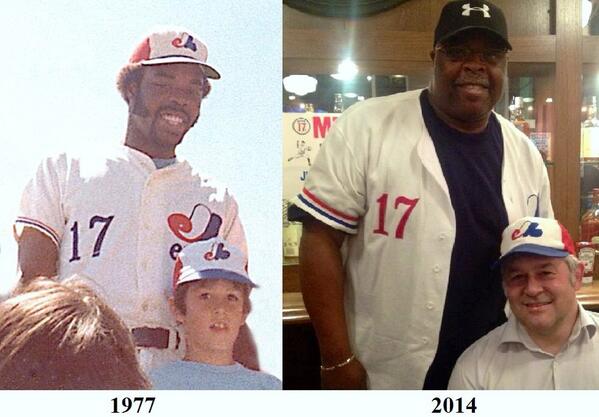
He has also been very active and in the news recently because of Jonah Keri's new book about the Montreal Expos called Up, Up, and Away. He appeared in Montreal for the book's release. In doing that, he recreated photos that were taken in the 1970s in Montreal:
Valentine even got a special gift back from the man whose father housed Valentine in the 197os -- the bat that Valentine used to hit the first ever home run in Olympic Stadium. That story contains the interesting trivia that Valentine not only hit the first Olympic Stadium homer, but he also hit the last homer in the Expos former home, Jarry Park.
Like I said, there was a lot of material.
Ellis Valentine is a guy who was a pretty big star for a little while about whom people inevitably ask the "What if" questions -- what if he didn't get hit in the cheek? What if he didn't become addicted to cocaine? What if his legs weren't destroyed by the Olympic Stadium AstroTurf?
The answer to those questions very well might have been that we as humans would have lost out on getting the best that Ellis Valentine had to offer. Because, in the end, he's done a lot more for society since baseball than he likely would have done had baseball continued being his profession.
Thank you, Mr. Valentine, for turning your negatives into positives for those who need the help.
Labels:
Ellis Valentine,
Expos,
Freeze-Frame,
Mets,
Mustache,
Pass the Dutchie,
Twitter
Tuesday, April 1, 2014
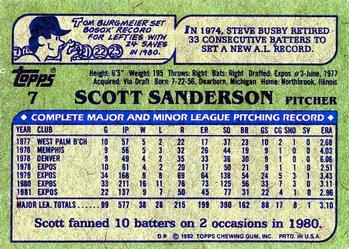
Card #7: Scott Sanderson
We are done with the subset highlighting the 100-game 1981 season. Now, into the base set.
Who Can It Be Now?
Scott Douglas Sanderson was born in Michigan but attended high school in suburban Chicago at Glenbrook North High School in Northbrook, Illinois. He was drafted in 1974 out of high school in the 11th Round by the Kansas City Royals. He turned down their offers and instead moved to Nashville, Tennessee, and attended Vanderbilt University.
After spending three years in Music City wearing the Black and Gold, Sanderson was drafted with the 54th pick overall in the 1977 draft by the Montreal Expos. The Expos promoted Sanderson aggressively through their system, as his 1982 card shows. Just 28 games in the minor leagues later, Sanderson was starting games in Quebec by August of 1978.
Sanderson enjoyed a long career in the majors, pitching for 19 seasons with Montreal, his hometown Cubs, Oakland, and the Yankees before flipping through brief stops with the Angels, Giants, and White Sox in 1993 through 1996. He was an all-star once but never won more than 17 games in any one season. His trademark was his control -- he finished in the top 10 in 5 different seasons for fewest walks per nine innings.
He finished his career with 163 wins, 143 losses, and a 3.84 ERA over 2,561-2/3 innings of work. He did not receive any votes when he was considered for the Hall of Fame in the 2002 vote, and that was probably the correct decision by the voters.
One of the cheesiest commercials in 1982 was for Florida Orange Juice -- with the catchphrase "Orange You Smart." I am using that catchphrase here to talk about players who went on to use their brains in their post-baseball careers.
Sanderson was an anomaly of sorts -- for most of the latter part of his career, he did not employ a player agent. He did this for a reason: he used himself as a guinea pig or crash-test dummy of sorts so that he was prepared for his post-baseball career. He became a player agent.
Indeed, Sanderson combined his religious beliefs with his intellect to work with Moye Sports out of Suwanee, Georgia. As of 2008, when the story linked in this paragraph was written, Sanderson was representing such baseball players as Josh Beckett, Lance Berkman, and Todd Helton and other athletes such as then-Detroit quarterback Jon Kitna and later gold-medal winner U.S. Sprinter Allyson Felix.
Some websites have poked fun at the idea that a Christian player agent would still be, well, an agent. For example, back in 2008, Josh Hamilton was trying to negotiate a long-term contract with the Texas Rangers. Midway through contractual negotiations, Hamilton changed agents and hired the Moye firm. Deadspin's headline: "Jesus Saves, But Still Takes His Usual 15 Percent."
That 2008 story noted that Sanderson was involved with a ministry called "Unlimited Potential, Inc.", but a review of that company's website seems to indicate that he no longer is -- though former major leaguers Mickey Weston and Tony Graffanino are.
A Few Minutes with Tony L.
In 1982, I am certain that I conflated and confused Scott Sanderson with Bill Gullickson. Perhaps I was on to something even then because, using Similarity Scores, the most similar player to Scott Sanderson over their major league careers was Gullickson. Others appearing on this list were Doug Drabek, Vern Law, Jim Lonborg, and Paul Splittorff.
As I got older, I started cheering for Sanderson because I attended (and graduated from) Vanderbilt. In the early 1990s in terms of representing Vandy in the major leagues, we had Scott Sanderson and Joey Cora and, um, that was it. The 1970s and 1980s were not great for Vanderbilt baseball.
It took until the 2000s for Vanderbilt to step up its game in baseball. More recent Vanderbilt guys in the majors have included Mark Prior (though he transferred after his freshman year), Jeremy Sowers, David Price, Pedro Alvarez, Mike Minor, and Sonny Gray.
As of 1982, though, the only thing I knew about Sanderson was that he was a pretty good pitcher on a good Expos team, and he might have been Bill Gullickson but not Steve Rogers.
Subscribe to:
Posts (Atom)