Showing posts with label Phillies. Show all posts

Sunday, January 17, 2021

Card #152: Ramón Aviles


Who Can It Be Now?

Ramón Antonio Aviles was born on January 22, 1952 in Manati, Puerto Rico. Not to ruin the conclusion, but Mr. Aviles also passed away in Manati on January 27, 2020. I bring that up because, for this biography, I will be borrowing liberally from the excellent RIP Baseball, which posted a full obituary last year for Mr. Aviles. 

Aviles grew up wanting to be a doctor, but his family's more humble blue collar background (his dad was a police officer) meant that he could not afford to pursue that dream. Aviles attended Fernando Callejo High School in Manati -- a school which also produced Carlos Beltrán and brothers Javier and José Valentín. 

Aviles became an excellent baseball player -- good enough for the Boston Red Sox to sign him in the fall of 1969 as an amateur free agent at shortstop in the years before Puerto Ricans were merged into the draft. As RIP Baseball notes, Aviles got his chance thanks to his pal Juan Beniquez, who convinced the Red Sox to give Aviles the tryout that led to Aviles's signing. 

From there, Aviles began his slow climb up the Red Sox ladder, spending 1970 and 1971 in low-A and high-A ball. After the 1970 season, the Red Sox had identified Aviles as having sufficient potential as a hitter to suggest that he learn 2B and 3B in addition to shortstop with the idea that the versatility for he and a few other infield prospects would aid in their climb up the ladder and into the major leagues. This paid off eventually. Aviles moved up to AA for the 1972, 1973, and 1974 seasons, then ascended to AAA starting in 1975. He played full seasons in 1975 through 1977 in AAA. 

Aviles was on track to make the major league team in 1977, but he was sidetracked when he and Jim Rice collided with one another trying to make a play. Aviles separated his shoulder -- you would expect that the guy who is 5'9" tall and weighed 155 pounds would lose in a collision with Jim Rice. 

The Red Sox did give him a cameo appearance in 1977, calling him up in late June when the Red Sox needed an outfielder. Don Zimmer apparently wasn't told about the call up and only used Aviles one time in a doubleheader against the Brewers in mid-July. He was brought on to pinch hit for Bernie Carbo and executed a perfect sacrifice bunt, moving Carlton Fisk to third base and George Scott to second base. For what it's worth, the Sox did not score that inning -- the Brewers walked Butch Hobson intentionally before Rick Miller hit into a flyball double play thanks to Jamie Quirk throwing Fisk out at the plate.

In any event, that was Aviles's only appearance for the Red Sox, who sold his contract to the Philadelphia Phillies at the end of spring training in 1978. The Phillies parked Aviles at AAA in 1978, where he played second fiddle to future major leaguers Jim Morrison and Todd Cruz, and for part of 1979. But the Phillies gave Aviles a chance at playing in the big leagues when Manny Trillo broke his arm on May 2, 1979. Aviles had the best hitting stretch of his career -- hitting .480/.536/.560 in his first 9 games with the Phillies before cooling off. He was sent back down to AAA in June after Trillo returned, but the seed had been planted with the team that Aviles could be a fill-in for the Phils. 

Aviles parlayed this opportunity into a three-year stint with the Phillies. He still spent a couple of weeks at AAA in 1980, but he was called up in early 1980 when Trillo got hurt again -- this time a sprained ankle. The team decided this time to keep Aviles around, and him serve as the backup infielder to Trillo and Larry Bowa. Because of his role as the backup infielder, Aviles was the proud owner of a World Series ring for the 1980 Phillies even though he did not appear at all in the Series. 

He struggled in 1981 to hit anywhere near as well as he had in 1979 or 1980. He went back to AAA for a while, and only really appeared as a late-inning defensive replacement. Shortly after the 1981 season ended, however, the Phillies traded him in a minor deal to the Rangers for pitcher Dave Rajsich. 

Neither Aviles nor Rajsich appeared in the majors after the trade and, in fact, both men's major league careers were over before they were traded. Because he failed to make the team out of spring training, Aviles asked the Rangers to trade him. They obliged, and he went back to the Phillies system. 

He played in 1982 there and then served as a player/coach in 1983. That role set the stage for his next chapter: coaching and managing throughout the minor leagues. For the next 25 years, Aviles served as a minor league coach, manager, and roving instructor. He spent most of his time in the low minors, though he did hop up to AAA in 1996 when the Phillies fired Butch Hobson due to Hobson's arrest for cocaine possession. He also managed regularly in the winter league in Puerto Rico and won a number of championships there as well. 

In 2005, he hopped into the Brewers system just in time to manage Ryan Braun for Braun's first pro season with the West Virginia Power before he closed out his career as the manager in 2008 with the Burlington Lake Monsters and in 2009 as the hitting instructor for the Hagerstown Suns. 

Aviles suffered from diabetes and high blood pressure. He was scheduled to start kidney dialysis to help treat his issues, but he passed away on January 27, 2020 just before that treatment could start. He was 68 years old. 

Family Ties

Aviles's nephew is Mike Aviles, who spent 10 years in the majors as a utility player for the Royals, Red Sox, Cleveland, Tigers, and Marlins starting in 2008 and ending in 2017. 

Trivial Pursuit

According to RIP Baseball's citation to a 2006 profile of Aviles in Florida Today, Aviles was the first -- and perhaps only -- Puerto Rican to win a Caribbean World Series as a player, manager, and general manager. Overall, Aviles won a total of 25 championships in professional baseball as a player, manager, coach, and general manager. 

Nanu Nanu

This is Aviles's final appearance on a Topps baseball card. 

His baseball card history is all over the place. He made his debut on a card in 1978 in the SSPC 270 set as a member of the Red Sox. After his 1979 appearances with the Phillies at the age of 27, Topps put him on the Phillies "Future Stars" card in the 1980 set with Kevin Saucier and Dickie Noles. He appeared in 1981 and 1982 in the Topps and Fleer sets, but he never appeared on a Donruss card.

A Few Minutes with Tony L.

Aviles clearly was a baseball man to his core once it became clear to him that he would never become a doctor. His roles in the Phillies organization from 1983 through 2002 meant that he played an intimate role in developing at least some of the players that would go on to help the Phillies to make the World Series in 1993. 

As was the case for Dave Edwards, I do not have any independent recollections of Aviles as a player. That's probably not surprising. Aviles only played in 117 games, only had 223 plate appearances, and his major league career ended before I hit double digits in terms of age. Even his only appearance against the Brewers took place when I was just five years old and hadn't even started kindergarten.

Feel free to share any memories that you have of him as a player, coach, or manager below. 

Wednesday, November 5, 2014

Card #127: Lonnie Smith


Who Can It Be Now?
Lonnie Smith was born on December 22, 1955, in Chicago, Illinois. His family moved to Los Angeles during his childhood, and, as a result, he was a part of the baseball-mad Compton, California, scene in the 1970s which included guys like Eddie Murray and, from Centennial High School where Smith attended, Al Cowens and Reggie Smith. 

Lonnie starred in baseball in high school, leading the Philadelphia Phillies to draft him with the 3rd overall pick in the 1974 June Draft. Smith was assigned to Auburn in the short-season New York Penn League to begin his minor league grooming. At Auburn and at every stop in his time in the minor leagues prior to becoming a major league regular in 1980, Smith did three things very well: he hit for average, he stole bases, and he got on base. In other words, other than not being a power hitter, he was always an asset at the plate. His worst year in the minor leagues came in 1977 in his second year at Triple-A -- and he hit .277/.347/.373 with 45 steals in 52 attempts that season. 

Yet, Smith stayed at Triple-A for four full seasons with barely a call-up included for probably three reasons. First, the Phillies were regularly winning the NL East -- doing so in 1976, 1977, and 1978 before dropping to fourth place in 1979. Second, the Phils had a fairly solid outfield with Greg Luzinski thundering around left field, Garry Maddox covering three-fourths of the known world in center, and Jay Johnstone or Bake McBride filling right field. 

Finally, something everyone knows about Lonnie Smith is that he was a brutally bad fielder. His nickname was "Skates," after all, because he looked like he was playing baseball while wearing rollerskates -- as one writer put it, "Lonnie Smith ran around like he was on skates. He would fall down anywhere. On the bases. Running for a fly in the outfield." Noted baseball analyst Bill James put it this way in 1987: "You've probably heard what a bad outfielder he is, and let me tell you: They ain't lyin'. He really does fall down almost every game. . . . He can't thrown and has a curious inability to position his glove on a ball hit right at him."

As a quick aside, James actually appreciated how skilled Smith was at disaster recover, as he wrote in his 1986 Baseball Abstract:
Many players can kick a ball behind them without ever knowing it; Lonnie can judge by the pitch of the thud and the subtle pressure through his shoe in which direction and how far he has projected the sphere.... He knows exactly what to do when a ball spins out of his hand and flies crazily into a void on the field, when it is appropriate for him to scamper after a ball and when he needs to back up the man who will have to recover it. He has experience in these matters; when he retires he will be hired to come to spring training and coach defensive recovery and cost containment. This is his specialty, and he is good at it.
Smith made his debut in the majors in 1978 with the Phillies in a late-inning double-switch/pinch runner role. He made the team out of spring training in 1979, but that lasted just 16 games before he was sent down to Triple-A again when he did not get a hit in his 6 plate appearances. 

Finally, in 1980, he stayed in the major leagues for an entire season, serving as a fourth outfielder with the Phillies. He played all three outfield positions, appearing more frequently early in the year in right field before the club starting using him in place of Greg Luzinski, whose struggles led Dallas Green to use Smith more frequently down the stretch. Smith responded with a .339/.397/.443 slash line, helping the team earn its first World Series title in its long history.

Smith's reward was to watch the Phillies trade pitcher Bob Walk to the Atlanta Braves in exchange for left fielder Gary Matthews. While Sarge had an awesome year in 1981, it indicated also that the Phillies seemed not to trust Smith. That lack of trust was confirmed on November 20, 1981, when Smith was traded away.  Smith was part of a three-team deal involving the Cardinals, Phillies, and Indians. The Cardinals gave up pitchers Silvio Martinez (who never pitched in the major leagues after this trade) and Lary Sorensen (a fungible innings eater who spent one year in St. Louis). The Indians sent catcher Bo Diaz to the Phillies. Meanwhile, Lonnie Smith came to the Cardinals and was plugged immediately in as the starting left fielder.

Smith responded with one of his best years in the major leagues in 1982. He led the National League in runs scored with 120. He stole 68 bases (though he was caught a league-leading 26 times) while hitting .307/.381/.434. He appeared on the only All-Star team of his career that year, and, to top it off, he finished second in the MVP voting behind Dale Murphy (though neither player was the best player in the league that year; that honor by WAR belonged to Andre Dawson). To top it off, he helped lead the Cardinals to the World Series title -- Smith's second in three years -- and he probably should have been the World Series MVP over Darrell Porter.

And all of this took place before Smith turned 27 years old. 

He remained in St. Louis until 1985. In the wake of Smith's admissions that he was addicted to cocaine (more on that below) and his testimony in the Pittsburgh drug trials, the Cardinals decided to ship him across Missouri to the Kansas City Royals in exchange for prospect John Morris. The result: ho-hum. Another World Series Title for Lonnie Smith -- this time over his former Cardinal teammates.

Smith's time in Kansas City, though, is one on which he does not look back fondly. After 1987 -- a season in which he played in just 48 games -- Smith was cut loose to make room for Bo Jackson. In the depths of that offseason, Smith literally contemplated going to Kansas City to shoot John Schuerholz (both links in this paragraph are to stories about this time in Smith's life). 

It did not help that Smith was still struggling with chemical dependency at this point. But, Smith was convinced that Schuerholz was bad mouthing Smith to other GMs around the league, and Smith wanted to take his frustration out on Schuerholz. Shortly after that, however, the Atlanta Braves then-GM (and later manager) Bobby Cox made Smith an offer of a minor league contract to show that Smith could still play. 

While Smith's 43-game stint for a terrible Braves team in 1988 was not overwhelming, he did get the opportunity in 1989 in spring training to show that he could still play. Smith responded by being the best player in the National League by WAR -- clocking in at 8.8 wins above replacement -- almost 2 wins better than NL MVP Kevin Mitchell and 0.2 wins better than second place Will Clark. Of course, with Smith being worth nearly 9 wins above replacement, the rest of that Braves team was godawful terrible since the team finished 63-97. And yes, a team slash line of .234/.298/.350 is terrible, no matter Smith's fantastic .315/.415/.533 line highlighted by 21 HR and 76 BB in 577 plate appearances.

With the Braves, Smith would appear in two more World Series. Strangely, if not for Otis Nixon's cocaine problem, Smith almost certainly would not have played a key role in the 1991 season for the Braves. But, as Rick James said on the Dave Chappelle Show, "Cocaine is a hell of a drug." Cocaine almost killed Smith's career, and another man's cocaine problem gave him another chance.

But this time, Smith was on the losing end. Indeed, Smith's brain-freeze may have cost the Braves the 1991 World Series. Smith led off the 8th inning by singling off Jack Morris. Terry Pendleton then hit a double into the left-centerfield gap. Inexplicably, the speedy Smith came to a stuttering stop around second base, having been fooled into thinking that the ball would be caught. Smith explained it a decade later as being the result of a delayed steal on which he did not know what happened with the pitch. Instead of scoring -- as one would expect -- he ended up on third base and never scored that run. The Twins won the game in the 10th inning, and the Braves would have to wait until 1995 for their only World Series victory during that incredible 1990s decade.

After the Braves let Smith go after the 1992 season, he signed with the Pittsburgh Pirates as a free agent. The Pirates were trying to replace Barry Bonds with a combination of Al Martin, Orlando Merced, Andy Van Slyke, and Smith. Obviously, that did not work out, and the Pirates ended up trading Smith to the Baltimore Orioles in September of 1993. Smith stayed with the Orioles in 1994, but he did not return to play after the 1994 strike.

Mustache Check: The stylish Lonnie Smith has cool sideburns and a little upper lip hair to match.

Pass the Dutchie
In many respects, Smith was one of the key witnesses in the Pittsburgh drug trials in 1985. The defendant in that case, Curtis Strong, was a former cook for the Phillies before going to Pittsburgh, and Strong supplied Smith with drugs regularly. Some of Smith's testimony included:

  • He bought cocaine 3 weeks before the 1982 World Series
  • He would use cocaine with teammates Keith Hernandez and Joaquin Andujar regularly
  • Former Phillies teammate (and former Brewer) Dick Davis introduced Smith to Strong and, with Gary Matthews present, Smith bought cocaine from strong
  • Smith would call Strong from his home in South Carolina to have Strong ship him cocaine through the mail
  • Both Bake McBride and Nino Espinosa on the 1980 Phillies were regular amphetamine users
  • Smith had heard that Pete Rose, Randy Lerch, Greg Luzinski, and Larry Bowa were regular amphetamine users, but he never saw any of them using.
A Few Minutes with Tony L.
In 1982, Lonnie Smith was the target of as much vitriol from 10-year-old Tony as anyone on that Cardinals team that beat the Brewers. As I said above, he easily could have been named as the World Series MVP for his .321/.345/.536 slash line in the 1982 World Series over catcher Darrell Porter, who hit .286/.310/.464.  

As I have softened over the years, I have to admit that it is more difficult now to hate Smith than it was as a 10-year-old. The guy has done the right things in kicking a deep cocaine habit, seeking help, and trying to live a clean life. From his time in Atlanta -- which overlapped with my moving to the South -- I got a better impression of him as a guy who just wanted to do well for his team, tried really hard, and sometimes just couldn't keep his feet. Especially after that 1991 World Series, I couldn't help but feel bad for the guy.

In writing this, I gained a new appreciation for Smith on a statistical level as well. I had no idea that he had a lifetime OBP of .371. A guy with that kind of ability to get on base -- based off walks, hitting ability, and not being afraid to get hit by a pitch (he led the league in 1982, 1983, and 1984 with the Cardinals with just 9 HBP each year).

I also was not aware of the deep-seated enmity that Smith felt for John Schuerholz. From the stories I read and linked to above, it's pretty clear that Smith still holds a grudge over the whole situation in the late 1980s. Smith stated that he avoided Schuerholz during the years that the two overlapped in Atlanta. However, Smith also made clear that he respected Schuerholz's baseball acumen. But, Smith just didn't trust the guy.

After baseball, Smith retired. Literally. He settled with his second wife in Fayetteville, Georgia -- about 30 miles south of downtown Atlanta in a comfortable gated house where he cooks for his three daughters before they go off to school.  

And, for what it's worth, Lonnie also spends some of his time responding to requests for autographs -- he rates at a 100% return rate on Sports Card Forum. So send him some mail!

Friday, September 5, 2014

Card #101: Mike Schmidt In Action


Who Can It Be Now?
It's still Mike Schmidt. In yesterday's post, I glossed over much of Schmidt's background other than his failure to be drafted directly out of high school due to his knees.  A book available at least partly through Google Books called Mike Schmidt: Philadelphia's Hall of Fame Third Baseman gives a bit more information about this told from the perspective of Phillies scout Tony Lucadello.

Lucadello claims that he started following Schmidt when Schmidt was a sophomore in high school. One of Lucadello's local bird dogs, a guy named Ed French, told Lucadello about Schmidt. Schmidt was called an excellent athlete and an above average prospect -- but he was also incredibly raw. In other words, he was a toolsy prospect according to Lucadello. 

Stopping there for a moment, one can see this a bit in Schmidt's minor league numbers, but playing college ball definitely refined Schmidt's talents. To an extent, Schmidt's minor league numbers show his rawness -- at least in his first season in the minors in Reading where Schmidt struck out nearly three times more than he walked. 

Going back to Schmidt's high school years now and to Lucadello's story. What I really don't understand about the story Lucadello tells is this: if Lucadello was impressed enough to "follow" Schmidt, why couldn't he convince the Phillies to take a chance on Schmidt straight out of high school? Perhaps it was, as Lucadello said, that other scouts dismissed Schmidt as "damaged goods" due to the injuries to his knees that Schmidt suffered playing football.

That said, one of Schmidt's high school coaches, Dave Palsgrove, talked about Schmidt's work ethic. Even in high school, Schmidt had issues making contact -- but if he did, he would hit it hard somewhere. Schmidt stayed after practices to get better at fielding popups and ground balls, and he would go to batting cages on his own to hit. Schmidt even got a scout for the California Angels, Buddy Bloebaum, to teach him to switch hit. 

Despite all that, only small schools were interested in Schmidt for baseball so Schmidt went to Ohio University on his/his parents' own dime to become an architect. Having worked in construction law for many years, I can tell you that Schmidt would have been a typical architect -- incredibly sure of himself and his own abilities and always quick to say that others should listen to him to learn.  Okay, that's snarky, but architects tend to be pretty narcissistic; Schmidt's confidence in himself as evidenced through both his interviews during his playing days and in his columns for the AP is typical for a more senior architect.

Okay, back to Schmidt and away from my amateur psychology.

Schmidt himself recognized that he developed as an athlete in college.  Again, from the book above:
I was about the fourth or fifth best baseball player in high school -- a .250 hitter, and if you don't hit .400 in high school, nobody knows you're alive. I was always the kid with potential, but even that potential was jeopardized by a couple of major injuries in high school. I was also a late bloomer when it came to confidence and aggressiveness. I don't think I was really willing to fight for myself until I got to college. Not that I wasn't cocky in high school about my athletic ability. I knew I had as much talent for sports as anyone -- I felt that whatever the season, I'd be the best athlete. But there were other players who had all the physical qualities I had and something else besides: they were meaner than I was, tougher mentally.
Schmidt was invited to walk on to the Ohio University baseball team. He sat as a freshman behind shortstop Rich McKinney (drafted by the White Sox in the first round of the 1968 Draft). Schmidt came to national prominence due to that College World Series run I mentioned yesterday. 

When I left off with Schmidt's career yesterday at 1982, I mentioned that I would finish his career today.  Well, Schmidt won one more MVP award in 1986 -- though WAR says that Mike Scott was at least 2 wins better than Schmidt and 1.6 wins better than anyone else in the league. the fact that Schmidt won the MVP at the age of 36 came probably because he led the league in homers and RBI that season.  1986 was also the first time in his entire career that he struck out less than 100 times in a full season (he struck out 71 times in 102 games in 1981).

But, when Schmidt's abilities started to slip, they went fast. He went from being the MVP in 1986 and putting up another strong season in 1987 to getting hurt in 1988. He was put on the Disabled List after playing both ends of a doubleheader on August 12, 1988, due to shoulder problems. He ended up visiting Dr. James Andrews in Birmingham in September and undergoing rotator cuff surgery. Andrews was quoted as saying that he found just a small pit in Schmidt's rotator cuff that needed to be repaired -- a slight tear.  

Schmidt came back in 1989, but it was evident quickly that he was not the same player. He started the season reasonably well -- hitting 5 homers in his first 17 games -- but then he really started to struggle. Over the final 25 games of his career, the Phillies performed poorly -- winning just 7 -- and the team's struggles mirrored Schmidt's.  He hit only one home run, he had just 12 hits in 80 at-bats and only 2 hits in his final 41 at-bats, and he was struggling to make good contact, slashing at .150/.278/.200. Topping it off, the normally sure-fielding Schmidt had made 8 errors at third and five in his final 21 games. As Schmidt himself put it in his retirement statement:
My skills to make the adjustments needed to hit, to make the routine play on defense and to run the bases aggressively have deteriorated. Realizing this, I have decided not to keep on playing, but to retire effectively immediately.
Mustache Check: It's still there.

The World According to Garp
Schmidt has co-authored three books. The first was a reasonably brief (191 pages) autobiography called Always on the Offense that was ghosted by Barbara Walder. His second book was an instructional book called The Mike Schmidt Study: Hitting Theory, Skills and Technique that he co-wrote with/had ghosted by Robert Ellis. 

Schmidt's final book was co-authored with/ghostwritten by one of the original founders of Rotisserie Baseball, Glenn Waggoner (who appears in the 2014 Topps Allen & Ginter set). This book is called Clearing the Bases: Juiced Players, Monster Salaries, Sham Records, and a Hall of Famer's Search for the Soul of Baseball.  To be honest, I'm hesitant to read this book since I fear it may sound an awful lot like Schmidt's "Get off MY lawn" sentiments that I went through yesterday. But, at least it's available for just $5.58 from Amazon.com!

Rabbit Is Rich
In both 1985 and 1987, Schmidt was the highest paid player in the National League, pulling in over $2.1 million in each of those years. In 1986, he was the third-highest paid player behind two members of the New York Mets -- George Foster (who played just 72 games that year for the Mets before they released him on August 7) and Gary Carter.

A Few Minutes with Tony L.
There is no question whatsoever that Mike Schmidt is a deserving member of the Baseball Hall of Fame. When he retired in 1989, Schmidt was behind only Hank Aaron, Babe Ruth, Willie Mays, Frank Robinson, Harmon Killebrew, and Reggie Jackson on the all-time home run list. 

During the past twenty-five years, Schmidt has been passed by Barry Bonds, Alex Rodriguez, Ken Griffey, Jim Thome, Sammy Sosa, Mark McGwire, and Rafael Palmeiro.  Out of those, only Griffey and Thome have not been linked definitively with steroid use. So, in the "probably clean" category, Schmidt is tenth. Of course, literally everyone who played major league baseball "might" have used PEDs of some sort -- whether it was greenies/amphetamines, cocaine (not that coke enhanced anyone's ability), steroids, or chocolate bars -- so that's where I'm leaving that discussion for now.

Schmidt was inducted into the Hall of Fame in 1995 by himself at the first time of asking. He received 96.5% of the vote. It's easy to ask this question, but what more could the guy have done to get inducted? I am guessing it is because he only had a career batting average of .267. 

I mean, this is probably the best third baseman ever to play the game -- Bill James said in his Revised Historical Baseball Abstract that Schmidt and George Brett are 1 and 2, with Eddie Mathews third and Wade Boggs fourth -- and I don't have any reason to disagree with James on that.

Yesterday, I mentioned Schmidt's complaining about autograph seekers stalking him on the streets during his playing days. I can understand that complaint, certainly -- I'm sure that he'd like to walk the streets without being mobbed. It may just come down, however, to the fact that he was not getting paid for his autograph.  Yes, more snarkiness from me, but it's tough not to be a bit snarky when you go to Fanatics.com and see the wide variety of autographed items that Schmidt has for sale -- balls for $160, incribed balls for $400, bats for $200, photos for $130 to $180, a variety of Topps cards for $110-140 a piece, etc.  

I don't begrudge him the right to make money off his signature at all, but it is a bit ironic that this is a guy who complains about little Johnny not being able to get autographs inexpensively.

Thursday, September 4, 2014

Card #100: Mike Schmidt


Who Can It Be Now?
The iconic Michael Jack Schmidt was born on September 27, 1949 in Dayton, Ohio. He attended high school at Fairview High in Dayton and graduated in 1967. Perhaps surprisingly for a future Hall of Famer, Schmidt was not drafted out of high school. The likely reason for this "oversight" is health. Throughout his career, Schmidt had knee problems. Those knee problems started in high school and led to him having major surgery on both knees during high school.

The major leagues' loss was Ohio University's gain. Schmidt led the Bearcats to the College World Series in 1970, where they lost to Florida State and Texas despite beating eventual champions USC in their first game in Omaha.  After playing all four years at OU, Schmidt was drafted by the Philadelphia Phillies with the 30th pick overall in the Second Round of the 1971 June Draft -- one spot behind eventual Hall of Famer George Brett and 15 spots after another eventual Hall member, Jim Rice.

The Phillies assigned Schmidt to Double-A Reading, where Schmidt struggled to make contact and, further, struggled to field the ball cleanly at shortstop. Schmidt was the starter for Reading at short in 1971 and made 23 errors in 74 games. Despite the less-than-stellar slash line of .211/.302/.350 at Reading, the Phillies pushed Schmidt to Triple-A Eugene for the 1972 season. There, Schmidt spent 76 games at second base and 52 games at third base while hitting 26 homers and slashing at .291/.409/.550 in a Pacific Coast League in which the league hit .274/.348/.409.

His season in Eugene led to a September call-up with the Phillies. Schmidt played only third base and looked overmatched at times -- 15 Ks in 40 plate appearances and just 1 HR. Despite this, Schmidt never again played minor league baseball. He sat on the bench for the first 10 games of the season, watching Cesar Tovar play, before getting his chance as a regular starting in late April.  

To say, however, that his 1973 season was not his best season would be too kind. While he did rack up 18 HRs and 62 BBs in 443 plate appearances that season, he struggled mightily to make contact. He struck out 136 times. In his 367 at-bats, he totaled 72 hits -- giving him a .196/.324/.373 slash line. His power and on-base skills were evident, but Phillies fans focused solely on that .196 batting average and, as one story from 1989 put it, "[f]or the next 13 years, Phillies fans never forgot or forgave him." A story from 1982 expanded on this: "It wasn't just his numerous strikeouts as a result of swinging for fences, but the nonchalant way he seemed to accept the whiffs that drove the fans wild."

Schmidt himself was not happy with this season, and recognized that he had issues. In that same 1989 story, Schmidt claimed that he "lacked . . . confidence, an understanding of patience. I didn't have a real good feel for failure. I was not good at handling failure. I got frustrated and I was real stubborn."

To some extent, that stubbornness may have helped him to tune out the booing and to ignore the batting average. Starting in 1974, Schmidt led the league in both home runs and in strikeouts for three consecutive seasons.  He also led the NL in slugging in 1974 at .546 and was named to his first all-star team as Ron Cey's backup

But, at a time when guys striking out 100 times was not common -- just 11 players did it in 1975, for example -- Schmidt struck out a massive 180 times. Though strikeouts are just another out, as sabermetricians like to point out, fans in Philly were not as forgiving.

What those fans seemed to forget, though, was this: this three-year span -- over which Schmidt hit .264/.379/.531 with 112 HRs, 66 SBs, 307 BBs and 467 Ks in 2065 plate appearances -- were the years during which Schmidt was 24, 25, and 26 years old. His numbers even in those years were incredible. Every year saw him walk 100 times or more. He almost hit that magical 30/30 mark in 1975, coming up one stolen base short. Indeed, in the wake of that 1975 season, then GM Paul Owens turned down a trade offer of Dave Cash and Schmidt for Reggie Jackson.  


As hindsight tells us, Schmidt would only get better. Indeed, after 1976, he would lead the National League in strikeouts just one more time -- in 1983 with 148. At the same time as Schmidt was learning to make better contact, he started being recognized for the fact that he was also one of the best fielding third-basemen in the game and probably was the best in the National League. Beginning with 1976 and ending with 1984, Schmidt won 9 consecutive Gold Gloves. Tim Wallach received the 1985 award, but Schmidt came back in 1986 to win his 10th and final Gold Glove. All time, his 10 trail only Brooks Robinson among third-basemen for most all time -- and Schmidt is the NL's all-time leader for third basemen.

Schmidt peaked in 1980 and 1981, winning consecutive MVP awards. According to WAR, he was probably second best in 1980 behind teammate Steve Carlton, but he definitely deserved the award in 1981.  It's a shame that the 1981 season was interrupted by the strike, because Schmidt was putting up some ridiculous numbers that year -- in just 102 games, he had 31 HR, 91 RBI, .316/.435/.644 (the last two numbers both led the league), 228 total bases and 18 intentional walks. 

As those numbers make clear, it's no surprise that Topps handed Schmidt one of the marquis card numbers for the 1982 Topps set. With his In Action card tomorrow, we'll see how the rest of his career played out.

Mustache Check: It's ginger, it's thick, and I don't know if Mike Schmidt would ever look right without his mustache. Well, here, he kind of looks like an older version of Brett Favre...

This Is Radio Clash
In both 1990 -- the year after his retirement -- and in cameo appearances in later years including this year, Mike Schmidt has served as a broadcaster for the Philadelphia Phillies.

Freeze-Frame
Well, sort of. After the 1980 World Series, the Royals and the Phillies squared off on the old-school original version of Family Feud -- the one where Richard Dawson hosted the show after he showed his game show chops on the old Match Game. Schmidt took part along with Larry Bowa, Garry Maddox, Dale Unser, and Dick Ruthven against Royals members John Wathan, Willie Wilson, Paul Splittorff, Dan Quisenberry, and Dennis Leonard.

I almost gave this one its own category called "I Lost on Jeopardy", but that song wasn't released by Weird Al Yankovic until 1984. Too bad.


A Few Minutes With Tony L.
If you were a baseball fan in 1982, you knew who Mike Schmidt was. I mean, it would be nearly impossible to be a fan and not know who the back-to-back NL MVP was. It was exciting to pull one of his cards out of an unopened pack back then because, well, it was a star card and those were our hits back then.  

I'll talk more tomorrow about Schmidt's legacy as a player. Today, though, I want to talk about Schmidt as a person today. He comes across as a bit surly.

First, here's a long, rambling story on USA Today about autographs. Some high points include his claim that he was stalked for autographs and retired because of it (and not due to his declining abilities, as he said in 1989); that kids these days won't get the thrill of getting autographs from their parents and grandparents because people are charging for autographs; and, if something has his signature on it, it goes from being $10 to being $100 and shouldn't Mike Schmidt get a part of that monetary increase through charging?  Yeah, that story meanders a bit.

Second, apparently that "charge for autographs" thing isn't that big of a deal so long as you write legibly. Yes, Mike Schmidt complained about the penmanship of current baseball players. He got back on his soapbox to reiterate the same complaint we autograph collectors have heard since the early 1980s -- "You're going to sell that, I don't care what you tell me!" But, then he whines about how the current Phillies in 2012 signed free signed balls that the clubhouse man got for Schmidt to sell for charity so illegibly that Schmidt couldn't make out their names. Oh, the nerve of these kids.

Third, here is an interview with Schmidt on ESPN from 2011. In that story, he says the biggest problem with the major leagues today is that "players are not motivated as much to attain a higher level of play [because of] the amount of money players are making and the security the players have causes a lack of accountability." He continued, "I think too many players who could be better than they are and could eventually become great won't [become great] because they signed long-term mega-money contracts. ... [They're treated like] celebrities and mega-stars, and their career batting average is .248 and very mediocre to below average in terms of statistics over the course of their career."  This is coming from a guy who was the highest paid player in the National League in 1985 and 1987.

Then, just a month ago, Schmidt once again started yelling at the kids on his baseball stadium lawn.  He complained in his AP column that "today's hitters don't want much help." He talks in that column about getting together with his 1980s baseball contemporaries George Brett, Robin Yount, and Paul Molitor at Cooperstown (with Reggie Jackson, Eddie Murray, or Ozzie Smith dropping in) and talking about working with their major league teams today.  His main point: "To the man, we find it amazing that this generation has little interest in our help."

Now, intuitively, one would think that hitters would seek out the Hall of Famers in camp for advice. Wait, what's that you say? Here's a quote from a Hall of Famer about working with hitting coaches:

"If I had listened to people my whole career and didn't trust in my own knowledge of the game, I'd be dipping ice cream cones in Dayton, Ohio, right now at my dad's restaurant."

Yes, you guess it. The person who said that was Michael Jack Schmidt, May 9, 1989

Not to be disrespectful, but why should Schmidt expect players today to listen to him when Schmidt himself didn't?

Wednesday, June 4, 2014

Card #53: Greg Gross


Who Can It Be Now?
Gregory Eugene Gross was born on August 1, 1952, in York, Pennsylvania.  He grew up in York County in a little town called Goldsboro though, as he said in a story in The Sporting News in 1974, the mailing address for the whole town was Etters.  Gross's father was a steelworker, so Gross had a humble background.  

He worked out for the Phillies scouts in high school, but he was drafted in the fourth round of the 1970 June draft (80th overall) by the Houston Astros.  He signed almost immediately after the draft and, as a 17 year-old, spent his summer in the Appalachian League in Covington, Virginia.  He hit so well there that the Astros skipped him up to Double-A Columbus (GA) as an 18-year-old in 1971 and then to Triple-A Oklahoma City in 1972 and Denver in 1973.

The Astros gave Gross a September call-up in 1973.  He didn't hit very well that fall, but the next spring saw him break camp with the Astros.  His numbers from that 1974 season are very strange -- the .314/.393/.377 slash line is not that weird, but Gross had 21 2Bs, 8 3Bs, 0 HRs, 12 SB, 20 CS, and 76 walks against just 39 strikeouts.  For his efforts, Gross came in second in the Rookie of the Year voting behind St. Louis OF Bake McBride.  Oddly enough, Gross's first season in the major leagues was the only season in which he saw action in more than 140 games.  He hit so well that year that his teammates called him "Ty Williams" -- for Ty Cobb and Ted Williams.  No pressure, then, Greg.

The Astros determined in 1976, however, that they wanted more power from the corner outfield positions.  To be fair, Gross had spent three complete seasons in the massive Astrodome without hitting a homerun, so pretty much any kind of power would have been enough to replace him.  As a result, the Astros traded Gross to the Chicago Cubs for infielder Julio Gonzalez.  

Gross spent two years on Chicago's North Side.  In those two years, Gross hit his first six homeruns as a major leaguer.  Considering that Gross finished his career with seven total, that is significant.  It was not enough to keep him in Chicago, though, as the Cubs traded Gross to the Philadelphia Phillies along with Dave Rader and Manny Trillo for minor leaguer Henry Mack, and major leaguers Derek Botelho, Barry Foote, Jerry Martin, and Ted Sizemore.

Once he arrived in Philadelphia, Gross took on the role that he would play for the rest of his career -- through 1988 with the Phillies and then in 1989 with the Astros.  That role was "Left-handed pinch hitter."  Reviewing his game appearances totals against his plate appearances totals makes his role clear, and 1980 is as good an example as any.  Gross appeared in 127 games and came to the plate just 182 times.  He walked 24 times and struck out just 7 times.  His game log shows this as well -- Gross played just 17 complete games all season.  

But, doing that, Gross got to play 10 years with the Phillies and came to the plate 1819 times. In his 5 years in Houston, he batted 1866 times.

Gross was done in the majors after 1989.  He said in a later interview that he sat out from baseball for almost five years after that waiting for a team to call him because he thought he could still play. 

The Message
Gross is very involved with the Greater Philadelphia Chapter of the ALS Association -- the association fighting to find a cure for Lou Gehrig's disease (amyotrophic lateral sclerosis, if you were wondering).  Indeed, if you are interested, you can help support the ALS Philadelphia Chapter by attending the Greg Gross Golf Outing on Monday, September 29, 2014, at the Old York Road Country Club in Spring House, Pennsylvania.

Trivial Pursuit
Greg Gross is fifth all-time in the number of hits achieved as a pinch hitter with a total of 143.  He is behind Lenny Harris, Mark Sweeney, Manny Mota, and Smoky Burgess.  Looking at the rest of the list on Wikipedia, I don't see anyone active on that chart.  It will be a long time before anyone comes close to displacing Gross.

A Few Minutes with Tony L.
I never saw Gross play that I can recall.  And, it is very possible that we will not have too many more Greg Grosses to write about in, say, 20 years from now.  As Gross himself mentioned in a Sports Illustrated article thirteen years ago, teams carry so many pitchers these days that teams, "don't have the luxury of keeping someone around who can't take the field."

After his playing days -- and after he took five years off before he realized he was not going to get the call to come play any more -- Gross became another "Baseball Man." He started his coaching career with coaching a high school team in Pennsylvania (Malvern Preparatory School).  He moved up to the Colorado Rockies Minor League system, first in Double-A New Haven and then as a roving instructor.  

He got called up to the majors, so to speak, in 2001 when his pal Larry Bowa named him as bench coach for the 2001 season for the Phillies.  From 2002-2004, he was the Phillies hitting coach.  He then spent 6 years as a hitting coach in the Phillies minor league system before getting the call back up to be the major league hitting coach in July of 2010.  

Gross was let go by the Phillies after the 2012 season. GM Ruben Amaro didn't even let the showers get turned off in the clubhouse after the last game of the season (that's hyperbole, mind you...it was right after the game, but I don't know that for sure) before calling Gross into the GM's office to fire Gross.

Gross currently serves as the hitting coach for the Triple-A Reno Aces in the Arizona Diamondbacks system.

And, in case you're interested, you can hire him for a "Pick-up Game" for just $500 from the same folks who will bring you Rick Cerone.  Or, spend $200 and he'll "be your personal coach giving you access to a World Series Champion."

That might be more worthwhile than the pickup game.

Monday, April 21, 2014

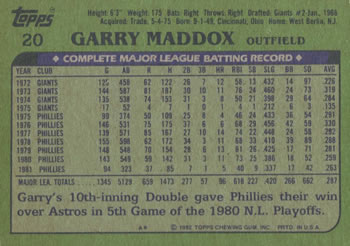
Card #20: Garry Maddox


Who Can It Be Now?
Garry Lee Maddox was born in Cincinnati, Ohio, on September 1, 1948, but graduated high school from San Pedro High School in California.  He was drafted only one time -- in the 2nd round of the 1968 January Draft by the San Francisco Giants.  Back in those days with all of the different drafts available to pick players, I start to wonder whether teams were really taking these selections seriously -- after all, Maddox was drafted 14 picks after Ken Stabler, for crying out loud.  Clearly the Giants were taking it seriously, though, selecting (and signing) George Foster in the third round.

Maddox played in the minors in 1968 and went to Vietnam after that, causing him to miss the 1969 and 1970 seasons. He came back and played 120 games in the California league at age 21.  He played a couple of weeks in the minors in 1972 at AAA and tore the cover off the ball -- 9 homers in 51 at bats with a 1.616 OPS tearing the cover off the ball -- and the Giants called him up.  Maddox never looked back and never went back to the minors.  

In 1973, Maddox had a great year -- 30 doubles, 10 triples, 11 homers, 76 RBI, 24 steals, and a slash line of .319/.350/.460.  Golden Gate Sports on SI.com's "Fansided" rated that season the 14th best season for center fielders in San Francisco in 2014.  While that may seem low, one must remember that it's easy to finish behind two Brett Butler seasons in his prime and 11 seasons of Willie Mays.

His 1974 was not as good, but he was still just 24 years old.  Instead of keeping him, the Giants let their impatience get the best of them and traded him to Philadelphia for Willie Montanez.  With a bit more patience, the Giants could have had an outfield of Maddox, Gary Matthews, and Bobby Bonds with George Foster and Dave Kingman waiting in the wings.  As it turned out, by 1978, all of them were gone from San Francisco.

Maddox caught the last out of the 1980 National League Championship in the 10th inning of the fifth game against the Houston Astros.  This happened after Maddox hit the game-winning two-run double in the top of the inning.  In response, his teammates carried him off the field on their shoulders:


The Phillies went on to win the World Series against the Royals, of course.  I wasn't a big fan because I really didn't like Pete Rose.  If you've read this blog -- you know, the Pete Rose Highlight card -- you'd know that already.

Maddox had the nickname of "The Secretary of Defense," a name pinned on him by Phillies broadcaster Harry Kalas, who also quipped "Two-thirds of the Earth is covered by water, [and] the other one-third is covered by Garry Maddox."  That quote is alternately attributed to Ralph Kiner, but it appears in just about every story talking about Maddox.

Maddox won 8 Gold Gloves during his career -- the last of which came in 1982, despite the fact that Maddox played only 119 games.  Indeed, those 8 Gold Gloves were won in 8 consecutive seasons from 1975 through 1982.  At the time Maddox retired, the only players who had more Gold Gloves were Roberto Clemente, Willie Mays, and Al Kaline.  Since then, Ken Griffey Jr., Andruw Jones, Ichiro Suzuki, and Torii Hunter have all passed him as well. 

Nonetheless, from the indications available through statistics -- whether the "old-school" kind or sabermetric devices -- Maddox deserved at least the first 7 of those.  By 1982, he did not rank near the top in any of the range categories, so perhaps the last one was earned on reputation.  

Maddox finished out his career in Philadelphia after the 1986 season.  This past winter, the folks at Phillies Nation rated Maddux as the #22 Phillies player of all time based on their contribution to the Phillies as a team, their individual and team achievements as a Phillie, and a combination of the traditional and analytic statistics from baseball.  

By the end of the 1987 season, Maddox was highlighted by Sports Illustrated for his immediate post-career financial acumen and planning -- an article in which he and his financial advisors at IMG placed his net worth at $3 million (which is $6.381,241.86 in today's dollars).  Today's players might scoff at that number, but for the 1980s -- especially in light of the collusion that took place in the 1987 and 1988 off-seasons -- that was doing pretty well.  The quote from that article that I most appreciate is this one from Maddox himself:
There are two kinds of nouveau riche athletes.  Those who spend to make up for everything they never had[, a]nd those who want to hold on to every penny. Being afraid I was going to lose my money motivated me to make sure I knew what was happening to it."
The Message
On July 1, 1982, Grandmaster Flash and the Furious Five released their single "The Message," a song which is credited with being the first prominent hip hop song "to provide a lyrical social commentary."  In that vein, then, this category will honor and highlight those players whose post-baseball careers have included important charitable work.

Garry Maddox today may be more well known by Philadelphia children for his Compete 360 initiative in Philadelphia's public schools.  Maddox hosts a barbecue challenge each year at Citizens Bank Park to support the organization.  The barbecue is in its 13th year now, and it will be held on August 9, 2014.  

Another charitable activity Maddox lends his name to is the Garry Maddox-Drew Katz Celebrity Bowling Classic -- which may or may not be coming back for a 29th year, as the website has not been updated.  Last year featured Mike Schmidt as a celebrity guest.

A Few Minutes with Tony L.
1982 me didn't pay all that much attention to Maddox since he played in the National League.  I recall watching that 1980 World Series and thinking that Maddox covered a lot of ground, but most of my recollection of that Series is dominated by how Pete Rose spiked the ball on the Veterans Stadium turf at the end of each inning.  I mean -- I was only 8 years old during that World Series, and I was cheering for the American League team, the Royals.

That said and from all indications, Garry Maddox has led a successful post-baseball career.  His investments in 1987 were going well, and he parlayed that into far more.  For example, he currently serves as the Principal and CEO of A. Pomerantz & Co., a workplace interior company in Chicago and Philadelphia.    Perhaps even more impressively, starting in 2003, he served a four-year term on the Philadelphia Federal Reserve Bank Committee.

To me, that is more impressive than the Gold Gloves.  He took the money he was paid -- which was good money but nothing like what players today receive -- and he turned it into a great life for himself and his family through his hard work, determination, and networking. Larry Bowa is quoted as saying that Maddox was "very intelligent and made a lot of contacts. He had a game plan for life after baseball."  

Rather than hopping on the "coach in the minor leagues/hope for a manager's position" gravy train, he used baseball to accomplish other goals in life. 

That is what makes Garry Maddox noteworthy.   

Saturday, March 29, 2014

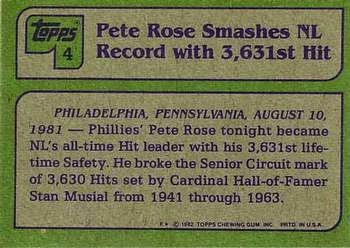
Card #4: Pete Rose Highlight


Who Can It Be Now?
Pete Rose spent his entire career being one of the most divisive characters of his time and perhaps of all time.  "Charlie Hustle" was Rookie of the Year in 1963, MVP in 1973, a 17-time all-star, and, of course, he broke the all-time career hits record once held by the All-Time most divisive character in baseball history, Ty Cobb.

Even so, Pete Rose also was and is an incurable narcissist who probably believed himself to be bigger than the rules of the game that absolutely, 100% prohibited players, coaches, manager, owners, trainers, bat boys, grounds crew, and ball girls from betting on baseball games.  The definition of Narcissism is someone who pursues gratification from vanity or an egotistic admiration of one's own physical or mental attributes that derive from arrogant pride.  Rose's entire personality is tied to his physical abilities and attributes from baseball, and to me that makes him a classic narcissist (disclaimer: I'm not a medical doctor or psychologist nor do I play one on TV).

Family Ties
Rose's son Pete Jr. played a grand total of 11 games for the 1997 Cincinnati Reds.  Junior honored his father on the first pitch of his first major league at-bat by crouching in Senior's trademark fashion.  Just as Pete Sr. spent time in jail (for tax evasion), Junior hit the cell block for distributing a drug called GBL which, if taken orally, is converted to GHB -- the date-rape drug.  According to Wikipedia, Junior said he gave it to his teammates to help them "relax."  Sure, Junior.  Keep talking.

A Few Minutes with Tony L.
Just as timely as ever with Opening Day coming up this weekend, the Pete Rose for Hall of Fame discussion has come back up.  Author James Reston, who wrote the book Collision at Home Plate about Rose and Bart Giamatti (that's Paul Giamatti's dad for you younger guys and gals), has changed his mind about Rose's banishment from baseball.  

The basic gist of his argument to me is essentially that Rose has suffered enough through 25 years of banishment.  Indeed, Reston even compares Giamatti's decision to banish Rose as similar to the Ayatollah Khomeini's fatwa against Salman Rushdie.  For what it's worth, Rushdie parlayed his fatwa into a four-year marriage to Padma Lakshmi, so it must not have been all bad.  

Okay, back to the topic at hand.  Should Pete Rose's banishment from the game be overturned to allow the sportswriters to vote on his Hall of Fame candidacy?  It's a tough question, but one on which I say no.  

The sadist in me wants to deny Rose the narcissist his reinstatement and possible enshrinement until after Rose dies -- just so he can't gloat and enjoy it.

The analytical side of me says that Rose broke clearly stated, clearly identified rules.  It is not like the steroid issue because while steroids were and are illegal, the best that could be said was the the players using steroids were violating a policy which had no punishment attached to it until 2005.  

Everyone in baseball knew what those guys were doing and condoned it.  

No one in baseball knew what Rose was doing, and everyone in baseball knew that betting on baseball would result in lifetime banishment on the first offense.  

So, my take in the end is Rose stays out unless and until we decide that betting on baseball is acceptable for active players and managers.