Showing posts with label Rabbit Is Rich. Show all posts

Monday, October 6, 2014

Card #116: Jim Wohlford


Who Can It Be Now?
James Eugene Wolford was born on February 28, 1951, in Visalia, California. Wohlford attended Mount Whitney High School in Visalia.  The Angels selected Wohlford with the 5th pick of the 11th round of the 1969 draft. 

According to an interview from March of 2014 posted on YouTube, the Angels offered Wohlford $16,000 to sign with them -- $8,000 as a bonus and $8,000 for school. Wohlford refused and instead enrolled for a semester at a junior college, College of the Sequoias, also in Visalia. The Kansas City Royals selected Wohlford in the 3rd round of the Secondary Phase of the 1970 January Draft as a draft-and-follow. During the spring season, Wohlford was a Juco All-American.  So, the Royals pushed to sign him.  Again according to that interview, the Royals promised Wohlford that they would promote him as aggressively through their farm system as they can. As a result, Wohlford signed with the Royals.

After he signed, the Royals assigned Wohlford to Billings, their Rookie League team in the Pioneer League, where Wohlford played shortstop, third base, and second base.  When Wohlford hit .308/.380/.398 with 32 SB in 250 plate appearances in 1970, the Royals pushed him to the California League. Wohlford showed he could handle that league as well, hitting .303/.364/.450 while playing middle infield. Thus, true to their word, the Royals skipped Wohlford over Double-A and assigned him in 1972 to Triple-A Omaha. 

Wohlford received his first major league callup in September of 1972. appearing mainly as a pinch runner and pinch hitter. Wohlford's problem with the Royals organization was the fact that he played middle infield, for the most part, and the team was fairly set up the middle with Cookie Rojas and the diminutive Freddie Patek. However, in May of 1972 when the Royals needed a bat off the bench, the call went to Wohlford. He stayed up with the big club until early July before being sent back to Triple-A for the last time in his developmental career.

More worrying than the existence of the then 34-year-old Cookie Rojas at second base was the appearance of another middle-infield prospect of the same age as Wohlford: Frank White. As Wohlford said in that interview on YouTube, Kansas City was pretty well set up the middle when White was added to the mix. So, Wohlford started playing outfield in order to get on the field and get playing time.

To a great extent, that worked. Wohlford appeared in a career-high 143 games in 1974 at the age of just 23 years old, and he was not overmatched. He hit .271/.327/.343 -- so, no power, but decent OBP for a league that got on base at a .323 clip. Wohlford was not a good base stealer, though, as he was successful on just 16 of 29 attempts -- just a 55.2% success rate -- and he did it while putting up a defensive WAR of -1.7 in left field. 

He found himself being platooned in 1975, perhaps as a direct result of his absolutely horrendous hitting against lefty pitchers that season -- putting up a reverse platoon split (as a righty hitter) that was massive. His OPS versus righties was .742 and versus lefties was .501 -- numbers aided by luck/bad luck showing by BABIP of .327 versus righties and .225 versus lefties.  Those numbers -- and the BABIP -- were nearly reversed in 1976. BABIP versus righties? .227. Lefties? .298.  Ah, the vagaries of sample sizes.

For a team looking to improve on a 90-win season in 1976, then, Wohlford became a convenient trading chit to get more pitching and to improve the team at catcher. Outfielders with an OPS below league average and running at .650 are pretty easy to find, and that made Wohlford expendable. As a result, during the 1976 Winter Meetings, the Royals sent Wohlford, Jamie Quirk, and, eventually, Bob McClure to the Milwaukee Brewers in exchange for pitcher Jim Colborn and catcher Darrell Porter.  

As he told the Milwaukee Brewers fan club newsletter in 2010, Wohlford found out he was a Brewer while listening to the radio at his job at Bumper to Bumper Auto Parts.  It's a different game these days. When he came to Milwaukee for the 1977 season, Wohlford came in and declared his intent: to start in centerfield for the Brewers. To do this, he would have to overcome Von Joshua and Gorman Thomas.  Manager Alex Grammas preferred the slap-hitting stylings of Jim Wohlford to the free-swinging, whifftastic power that Gorman Thomas brought to the team. Thus, out of the three, Thomas went to the minor leagues and fell entirely out of favor with the Brewers. Wohlford played left field mostly while Joshua started in center and young Sixto Lezcano was in right. 

The Brewers were terrible in 1977, though, and did not finish last only because the division had added Toronto in its first season. Tellingly, the Brewers finished with the fourth-fewest runs scored in the AL -- 93 runs below average -- and with the fifth-fewest homers. 

Bud Selig cleaned house in the front office, appointing Harry Dalton as the GM. Dalton brought Thomas back from Texas -- to whom he had been sold.  Joshua was released during spring training in 1978, and Wohlford went from playing in 129 games with 422 plate appearances to getting into just 46 games with 127 plate appearances. The result: the Brewers scored 165 more runs in 1978 (thanks to bringing in Thomas, Larry Hisle, Ben Oglivie, and Paul Molitor, among others).

The writing was on the wall for Wohlford's career in Milwaukee. Still, he had one more year left on his contract in 1979. That year was not much different from the previous year -- indeed, Wohlford's slash line numbers actually declined.  Manager George Bamberger preferred more of a set lineup and his starters (Thomas, Lezcano, and Oglivie) played the bulk of the games in the outfield. As a result, when Jim Wohlford filed for free agency, his agent told the Milwaukee Journal that, "They [the Brewers] haven't showed much interest in re-signing him."

Wolford signed with the San Francisco Giants for three years. In San Francisco, his role was pretty much the same as it had been in Milwaukee -- outfield caddy, pinch hitting, pinch running. By the time 1982 rolled around, Wohlford was 31 and entering his 11th season of major league duty. After the 1982 season, though, the Giants picked up Wohlford's two-year option before trading him to the Montreal Expos in exchange for Chip/Chris Smith -- he of 86 career plate appearances.

In Montreal, the usually light-hitting Wohlford had one season in 1984 where suddenly balls started flying out of the park...at least relatively speaking. In 228 plate appearances that year, Wohlford hit 5 of his career 21 homers and had a SLG that was over 100 points higher than his career SLG.  It was, in all respects, his best year in the majors, since he slashed at .300/.342/.451. In the wake of that season, Wohlford wanted to get a three-year contract worth approximately $1 million for the three years.  

Wohlford stayed with Montreal through the 1986 season. At that point, at the age of 35, the Expos decided to go another direction -- perhaps to give Razor Shines a chance? -- and Wohlford found himself without a team. He hooked on with the Cincinnati Reds in 1987 and played a bit at Triple-A. That was, though, the end of Wohlford's playing career.

Mustache Check: Not a whisker to be seen. As far as I can tell from his baseball cards and other photos available of him, Wohlford never did have a mustache or beard.

Rabbit Is Rich
Well, maybe. Wohlford is currently a financial advisor with Stifel in Visalia, where he moved back to after his career was over.  

A Few Minutes with Tony L.
Yeah, I don't have much in the way of tidbits or research that I could find. As a kid, of course, I remembered Wohlford playing for Milwaukee and seeing him on cards as a Brewer. He was a guy I recalled not thinking too much of as a player, but in the way that only a "Wisconsin-proud" kid of 8 years old could think, I hoped that Wohlford would never do anything to make the Brewers regret letting him go.  If you don't believe me about the "Wisconsin-proud" thing, though, just go ahead and insult the Wisconsin Badgers or troll the Green Bay Packers. Most fans can shake off trolling, either laughing at it or ignoring it. Packers/Badgers/Brewers fans take the bait, swallow the hook, then start sucking on the fishing line like it's spaghetti.

So, a couple of random factoids on Jim Wohlford:

  • Bill James's New Historical Baseball Abstract makes reference to Jim Wohlford when talking about Johnny Logan and Logan's penchant for malapropisms. Logan would order "pie a la mode with ice cream." As the excellent "Baseball in 1976" Blog points out, Wohlford, and not Yogi Berra, is actually the person who said, "Ninety percent of this game is half-mental." Wohlford even got a $50 check from Reader's Digest for the quote.
  • Wohlford and his wife Rae adopted two children -- Jason and Geneva. 
  • Jim is an avid user of Facebook and still cheers for the Royals and Giants. I guess in the 2014 Allen & Ginter insert set of Pastime's Pastimes, Jim would have the Pastime of Social Media Guru.
  • Wohlford advocates strongly for Pete Rose's inclusion in the Hall of Fame. He also believes steroid users should be kept out.
  • If you're interested in getting Wohlford's autograph, he is on PastPros.com. He'll even provide the card. So, for a 1974 Topps of him, it's $7. The 1975 & 1976 cards are $6, and the rest are $5.
  • Wohlford's high school retired his number in 2014.
Wohlford was never a star, but as he is quick to point out, he had a very long career for a bit player. 

Friday, September 5, 2014

Card #101: Mike Schmidt In Action


Who Can It Be Now?
It's still Mike Schmidt. In yesterday's post, I glossed over much of Schmidt's background other than his failure to be drafted directly out of high school due to his knees.  A book available at least partly through Google Books called Mike Schmidt: Philadelphia's Hall of Fame Third Baseman gives a bit more information about this told from the perspective of Phillies scout Tony Lucadello.

Lucadello claims that he started following Schmidt when Schmidt was a sophomore in high school. One of Lucadello's local bird dogs, a guy named Ed French, told Lucadello about Schmidt. Schmidt was called an excellent athlete and an above average prospect -- but he was also incredibly raw. In other words, he was a toolsy prospect according to Lucadello. 

Stopping there for a moment, one can see this a bit in Schmidt's minor league numbers, but playing college ball definitely refined Schmidt's talents. To an extent, Schmidt's minor league numbers show his rawness -- at least in his first season in the minors in Reading where Schmidt struck out nearly three times more than he walked. 

Going back to Schmidt's high school years now and to Lucadello's story. What I really don't understand about the story Lucadello tells is this: if Lucadello was impressed enough to "follow" Schmidt, why couldn't he convince the Phillies to take a chance on Schmidt straight out of high school? Perhaps it was, as Lucadello said, that other scouts dismissed Schmidt as "damaged goods" due to the injuries to his knees that Schmidt suffered playing football.

That said, one of Schmidt's high school coaches, Dave Palsgrove, talked about Schmidt's work ethic. Even in high school, Schmidt had issues making contact -- but if he did, he would hit it hard somewhere. Schmidt stayed after practices to get better at fielding popups and ground balls, and he would go to batting cages on his own to hit. Schmidt even got a scout for the California Angels, Buddy Bloebaum, to teach him to switch hit. 

Despite all that, only small schools were interested in Schmidt for baseball so Schmidt went to Ohio University on his/his parents' own dime to become an architect. Having worked in construction law for many years, I can tell you that Schmidt would have been a typical architect -- incredibly sure of himself and his own abilities and always quick to say that others should listen to him to learn.  Okay, that's snarky, but architects tend to be pretty narcissistic; Schmidt's confidence in himself as evidenced through both his interviews during his playing days and in his columns for the AP is typical for a more senior architect.

Okay, back to Schmidt and away from my amateur psychology.

Schmidt himself recognized that he developed as an athlete in college.  Again, from the book above:
I was about the fourth or fifth best baseball player in high school -- a .250 hitter, and if you don't hit .400 in high school, nobody knows you're alive. I was always the kid with potential, but even that potential was jeopardized by a couple of major injuries in high school. I was also a late bloomer when it came to confidence and aggressiveness. I don't think I was really willing to fight for myself until I got to college. Not that I wasn't cocky in high school about my athletic ability. I knew I had as much talent for sports as anyone -- I felt that whatever the season, I'd be the best athlete. But there were other players who had all the physical qualities I had and something else besides: they were meaner than I was, tougher mentally.
Schmidt was invited to walk on to the Ohio University baseball team. He sat as a freshman behind shortstop Rich McKinney (drafted by the White Sox in the first round of the 1968 Draft). Schmidt came to national prominence due to that College World Series run I mentioned yesterday. 

When I left off with Schmidt's career yesterday at 1982, I mentioned that I would finish his career today.  Well, Schmidt won one more MVP award in 1986 -- though WAR says that Mike Scott was at least 2 wins better than Schmidt and 1.6 wins better than anyone else in the league. the fact that Schmidt won the MVP at the age of 36 came probably because he led the league in homers and RBI that season.  1986 was also the first time in his entire career that he struck out less than 100 times in a full season (he struck out 71 times in 102 games in 1981).

But, when Schmidt's abilities started to slip, they went fast. He went from being the MVP in 1986 and putting up another strong season in 1987 to getting hurt in 1988. He was put on the Disabled List after playing both ends of a doubleheader on August 12, 1988, due to shoulder problems. He ended up visiting Dr. James Andrews in Birmingham in September and undergoing rotator cuff surgery. Andrews was quoted as saying that he found just a small pit in Schmidt's rotator cuff that needed to be repaired -- a slight tear.  

Schmidt came back in 1989, but it was evident quickly that he was not the same player. He started the season reasonably well -- hitting 5 homers in his first 17 games -- but then he really started to struggle. Over the final 25 games of his career, the Phillies performed poorly -- winning just 7 -- and the team's struggles mirrored Schmidt's.  He hit only one home run, he had just 12 hits in 80 at-bats and only 2 hits in his final 41 at-bats, and he was struggling to make good contact, slashing at .150/.278/.200. Topping it off, the normally sure-fielding Schmidt had made 8 errors at third and five in his final 21 games. As Schmidt himself put it in his retirement statement:
My skills to make the adjustments needed to hit, to make the routine play on defense and to run the bases aggressively have deteriorated. Realizing this, I have decided not to keep on playing, but to retire effectively immediately.
Mustache Check: It's still there.

The World According to Garp
Schmidt has co-authored three books. The first was a reasonably brief (191 pages) autobiography called Always on the Offense that was ghosted by Barbara Walder. His second book was an instructional book called The Mike Schmidt Study: Hitting Theory, Skills and Technique that he co-wrote with/had ghosted by Robert Ellis. 

Schmidt's final book was co-authored with/ghostwritten by one of the original founders of Rotisserie Baseball, Glenn Waggoner (who appears in the 2014 Topps Allen & Ginter set). This book is called Clearing the Bases: Juiced Players, Monster Salaries, Sham Records, and a Hall of Famer's Search for the Soul of Baseball.  To be honest, I'm hesitant to read this book since I fear it may sound an awful lot like Schmidt's "Get off MY lawn" sentiments that I went through yesterday. But, at least it's available for just $5.58 from Amazon.com!

Rabbit Is Rich
In both 1985 and 1987, Schmidt was the highest paid player in the National League, pulling in over $2.1 million in each of those years. In 1986, he was the third-highest paid player behind two members of the New York Mets -- George Foster (who played just 72 games that year for the Mets before they released him on August 7) and Gary Carter.

A Few Minutes with Tony L.
There is no question whatsoever that Mike Schmidt is a deserving member of the Baseball Hall of Fame. When he retired in 1989, Schmidt was behind only Hank Aaron, Babe Ruth, Willie Mays, Frank Robinson, Harmon Killebrew, and Reggie Jackson on the all-time home run list. 

During the past twenty-five years, Schmidt has been passed by Barry Bonds, Alex Rodriguez, Ken Griffey, Jim Thome, Sammy Sosa, Mark McGwire, and Rafael Palmeiro.  Out of those, only Griffey and Thome have not been linked definitively with steroid use. So, in the "probably clean" category, Schmidt is tenth. Of course, literally everyone who played major league baseball "might" have used PEDs of some sort -- whether it was greenies/amphetamines, cocaine (not that coke enhanced anyone's ability), steroids, or chocolate bars -- so that's where I'm leaving that discussion for now.

Schmidt was inducted into the Hall of Fame in 1995 by himself at the first time of asking. He received 96.5% of the vote. It's easy to ask this question, but what more could the guy have done to get inducted? I am guessing it is because he only had a career batting average of .267. 

I mean, this is probably the best third baseman ever to play the game -- Bill James said in his Revised Historical Baseball Abstract that Schmidt and George Brett are 1 and 2, with Eddie Mathews third and Wade Boggs fourth -- and I don't have any reason to disagree with James on that.

Yesterday, I mentioned Schmidt's complaining about autograph seekers stalking him on the streets during his playing days. I can understand that complaint, certainly -- I'm sure that he'd like to walk the streets without being mobbed. It may just come down, however, to the fact that he was not getting paid for his autograph.  Yes, more snarkiness from me, but it's tough not to be a bit snarky when you go to Fanatics.com and see the wide variety of autographed items that Schmidt has for sale -- balls for $160, incribed balls for $400, bats for $200, photos for $130 to $180, a variety of Topps cards for $110-140 a piece, etc.  

I don't begrudge him the right to make money off his signature at all, but it is a bit ironic that this is a guy who complains about little Johnny not being able to get autographs inexpensively.

Monday, August 25, 2014

Card #95: Ozzie Smith


Who Can It Be Now?
Osborne Earl Smith was born on December 26, 1954, in Mobile, Alabama. His family moved from Alabama to the now well-known South Central Los Angeles when he was 6 years old. According to his biography on Biography.com, he learned how to perform his trademark backflips as a kid by doing flips into piles of sawdust at a local lumberyard.

He attended Locke High School in Los Angeles, which at the time that Ozzie was in attendance had one heck of a baseball program.  In a 5-year span, Locke turned out two Hall of Famers -- Ozzie & his teammate Eddie Murray -- and four other major leaguers, including pitcher Larry Demery, Gary Alexander, pitcher Darrell Jackson, and Eddie's younger brother Rich. 

As was the case for Alexander, Ozzie was not drafted out of high school. But, where Alexander went to junior college, Ozzie received a partial scholarship and attended baseball powerhouse Cal Poly-San Luis Obispo. He was drafted for the first time in 1976 in the 7th round of the June Draft by the Detroit Tigers, but apparently he did not receive a sufficient contract offer to induce him to sign. As a result, he went back to school for his senior year and was drafted in the fourth round of the June Draft in 1977 by the San Diego Padres.

After Ozzie signed with the Padres, they assigned him to Walla Walla in the Northwest League, a Low-A league. He hit well there, got on base, and made consistent contact -- 12 strikeouts in 333 plate appearances is pretty consistent contact. He never again spent any time in the major leagues after 1977. 

Instead, he made the major league team directly out of spring training in 1978. The Padres had played Bill Almon at short the previous season and did not have a set third baseman. So, Ozzie's play allowed them to put Almon at third, push Tucker Ashford to the bench, and get better defensive play at shortstop. Ozzie played well enough to finish second in the 1978 Rookie of the Year race behind the Braves' Bob Horner -- even though both had fewer WAR than third-place finisher Don Robinson.

In Smith's four seasons with the Padres, the question was always whether Ozzie hit enough to justify playing him. His glove was never the issue, but a .260 OBP and a .262 SLG in 1979 made the case pretty clearly that Ozzie would have to rely on fielding to make his dollars initially. Even by 1980, however, Ozzie's glovework had gained him enough notoriety in baseball to earn him his first of thirteen consecutive Gold Gloves.  He took over the crown of best NL defensive shortstop from Dave Concepcion, and he did not give up the title until Jay Bell beat him out in 1993.

As I said, though, the real question was his bat. He was in the top 5 in outs made in 1978 (4th), 1979 (4th), 1980 (2nd), and 1981 (1st). Perhaps it was just that he was learning how to hit while in the major leagues, but his slash line in San Diego was pretty bad -- .231/.295/.278 and an OPS+ (a normalized rating where the average league hitter is 100) of 66. That's not good.  Despite that, his slick fielding led to his first selection to the All-Star team in 1981 as a back up to Dave Concepcion.

By the end of the 1981 season, however, circumstances aligned to end Ozzie's time in San Diego. The biggest issue was actually in St. Louis, where Whitey Herzog and his shortstop, Garry Templeton, had a major falling out -- as in, Herzog challenged Templeton to a fight after a game at Busch Stadium in 1981 when Templeton flipped off St. Louis fans. 

The other issue was what turned into a common theme throughout Ozzie's career -- an issue, by the way, which I had forgotten about and which often gets whitewashed out of discussions about Ozzie. That issue was Ozzie's salary demands. As this sarcastic article of "Christmas gifts" for athletes points out, Ozzie was complaining that he could not "make ends meet" on the salary he was making in 1981. 

This claim was nothing new. The year prior, in agitating for a better salary, Ozzie and his agent took out a classified ad in the San Diego newspaper in the "part-time help wanted" section. Ozzie even claimed that he might need to take a leave of absence over the summer of 1980 to take a temporary job.  In response to the ad, Joan Kroc replied, tongue-in-cheek, that her gardener Luis Torres could have used an assistant at $4.50 an hour. Indeed, as the news story mentions, he received offers to be a nude dancer at $500 a show and an offer to be a pizza delivery man for $3.25 an hour. He was making $72,500 that year (about $196,000 today).

To make up for this, Herzog offered Ozzie $450,000 a year. Herzog added that if Ozzie didn't like St. Louis, Whitey, or the Cardinals at the end of 1982, then he would release Ozzie. If Ozzie liked it, then they would offer him a 3-year deal. He got the three-year deal a
fter helping the Cardinals win the first of two 1980s World Series. Ozzie signed a 3-year, $3.6 million contract. 

During his time with the Cardinals, Ozzie became a better hitter as well. I cannot tell you whether that happened because Ozzie left the green grass of San Diego for the fake plastic grass of St. Louis, but those Whitey Herzog-managed teams of the 1980s relied nearly entirely on speed, defense, getting on base, and smart baserunning in terms of stealing bases. In many of those respects, the team was built around Ozzie even though Ozzie tended to hit near the bottom of the order. Ozzie had a slash line of .272/.350/.344 in St. Louis, stealing 433 bases and getting caught just 102 times.  He walked 876 times against just 423 strikeouts. He was an All-Star in every year with the Cardinals but one -- 1993 -- though he probably didn't deserve the last three since those were pretty much "goodbye, Ozzie, we love you!" votes from the fans.  

Off the field and outside of his continued caterwauling about money, he was an exemplary character. He won the Branch Rickey Award in 1994 for his exceptional community service. He won the Lou Gehrig Memorial Award in 1989 from Phi Delta Theta as the player who best exhibited the character and integrity of Lou Gehrig on the field and off. He was awarded the Roberto Clemente Award in 1995 for combining his good play and strong work in the community. I'm not sure how all those are necessarily different, but they are consistent in showing Ozzie's community work.

As Ozzie's career went on, he continued playing at a fairly consistently high level -- both offensively and defensively -- with St. Louis. His last three seasons were shortened by a strike, injuries, and manager's decision, however.  That last season of 1996 is worth looking at.

Smith got into a disagreement with manager Tony LaRussa, who was in his first year as Cardinals manager, in spring training of that year. Even as recently as February of 2014, Ozzie still seemed to carry a bit of a grudge against LaRussa for the way LaRussa handled the shortstop job that year. I mean, check out this quote: "I've always admired Joe Torre and Bobby Cox. The other guy ... uh, I never really knew him." Okay, Ozzie.

Midway through the 1996 season, Ozzie announced his retirement.  Ozzie reportedly thought about going to another team to extend his career, but instead he retired as a Cardinal and signed a personal services agreement with the Cardinals at that point.  Sitting behind Royce Clayton apparently told Ozzie that it was time to retire. So, he did.

Mustache Check: Yes, Ozzie is sporting whiskers.

Rabbit Is Rich
I'm belaboring the off-field stuff with Ozzie a bit, but I had completely forgotten how many times Ozzie appeared to be whining about money.  But, the real big contract was in 1986. After the 1986 season, Ozzie signed a contract which made him the highest-paid player in the National League for 1988 -- $90,000 more than Mike Schmidt and about $180,000 more than Gary Carter.

Trivial Pursuit
Ozzie Smith is the career leader in Defensive Wins Above Replacement at 43.4 (fully 4 wins better than Mark Belanger). He's also the career leader in most Gold Gloves at shortstop with 13, which is 2 better than Omar Vizquel. 

Finally, he has the most assists career among shortstops with 8375 -- 360 better than Luis Aparicio. For comparison, Derek Jeter has played 20 seasons at shortstop (1 more than Ozzie) and Jeter is more than 1800 behind Ozzie.  

Elvis Andrus has a very, very outside shot at catching Ozzie.  Andrus is 25 and has played 6 seasons already.  Andrus would have to keep up his current pace of assists until he reaches the age of 44 to catch Smith.

This Is Radio Clash
Ozzie Smith served as a Cardinals broadcaster from 1997 to 1999.  No word on whether he advertised for a part-time job in search of more money.

The World According to Garp
Ozzie has written two biographies -- Wizard in 1988 and Ozzie Smith: Road to Cooperstown in 2002 after his election to the Hall of Fame. He also wrote a Jerry-Remy-like book about the Cardinals mascot Fred called, Hello, Fredbird! in 2014.

A Few Minutes with Tony L.
Honestly, I expected this biography to be much more based around Ozzie's fielding exploits and his home run off Tom Niedenfuer back in 1987. I was struck, though, that the first several stories that came up about Ozzie from his playing days through the Google News archives were about his feuds with Tony LaRussa, his apparent exultation at Whitey Herzog being fired in 1990, and still more contract issues  in 1991 -- when the AP ran a story about how talks had broken down between Smith and the Cardinals and that he would leave after the 1992 season.  He didn't leave obviously, but he was always walking that line.

These days, Ozzie is pretty easy to find. He can be booked through Premiere Speakers Bureau -- the same group that serves as Jim Palmer's speakers' bureau. I can't tell you how much Ozzie charges, though -- the website says that "we are not able to provide this information on the website." But, Ozzie will fly first class from St. Louis to speak to your group, giving either his "Hall of Fame Speech" about perseverance and success or his "Conversation with Ozzie Smith," which is a "light hearted, anecdotal presentation with stories from his childhood as a little leaguer to the present day."

If you're interested in Ozzie for a lower price than his speakers' fee must be, then you can follow him on Twitter (@STLWizard). A quick review of his timeline there shows that he golfs. A lot. 

For kids, Ozzie Smith's Sports Academy is in Chesterfield Mall in the St. Louis area is there with batting cage rentals, sports lessons, and summer camps.

Finally, if you're a collector or fan of Ozzie's -- and I apologize to you if I made you upset with this write-up about him -- then feel free to go to Ozzie's personal website. You can listen to Jack Buck call the NLCS homer when you get there, and then you can go to his memorabilia page to buy a signed baseball for $125 (or $150 if you want it signed "Osborne Earl").

Ozzie was a fantastic defensive player who was slightly below average at the plate over his career. The fact that he made the Hall of Fame essentially for his defense tells you what you need to know about him. I believe that his enshrinement was deserved as well.  

I also believe that it will be a long time before we see a mostly defensive player enshrined again. Teams these days are more willing to live with defensive lapses at key defensive positions, it seems. Or, more to the point, teams are less willing to live with the players that Ozzie was when he first came up -- great fielding and light hitting.   

Thursday, July 31, 2014

Card #84: Rennie Stennett


Who Can It Be Now?
Rennie Antonio (Porte) Stennett was born on April 5, 1951, in Colon, Panama.  Stennett said in an interview last fall (and if you have the time, watch this video -- Stennett is an engaging guy) that he did not get to play all that much baseball in Panama because it was always raining.  Indeed, Stennett said he was a better basketball player than he was a baseball player and, further, that he had a scholarship offer to play basketball at Cal-Berkeley.  

But, Stennett recognized that basketball was unlikely to provide him with a professional sports career because, after all, he was not even 6 feet tall.  As a result, when the Pittsburgh Pirates made him an offer to play baseball, he grabbed it and signed with the Pirates at the age of 18 in 1969. 

Pittsburgh assigned Stennett to Gastonia in the Western Carolinas League.  At the age of 18 and playing against guys who averaged being three years older than him, Stennett hit .288/.320/.389 with 9 steals.  The next year, Pittsburgh sent him to the Carolina League at Salem, again in Single-A, where he hit even better against even older talent -- .327/.359/.426.  Yes, he did not walk all that much, but he went up there and made good contact.  That year earned him a single game with Triple-A Columbus at the end of the year.

The next season in spring training, Stennett was hitting against the big league club and just tearing the cover off the ball.  The way Stennett tells the story, the GM or player personnel director was watching him hit and asked someone standing nearby what league Stennett played in.  When the answer was "A ball", the response was, "not any more.  He's going to Triple-A." He went to Charleston in 1971 and hit even better than he did in Single-A -- .344/.395/.486 with 10 triples, 6 steals, and 26 walks in 353 plate appearances.

Prior to being assigned to Triple-A, Stennett was playing outfield.  When he got to Triple-A, however, he was working with Pablo Cruz, a lifetime minor leaguer from Santo Domingo in the Dominican Republic.  Cruz had seen Stennett play infield before, and told Stennett in Spanish that Stennett should go to the manager and ask to play second base.  He did that, and suddenly Stennett became a middle infielder.

His work in Triple-A in the first three months of the season earned him a call-up to Pittsburgh in July of 1971.  Stennett recalls that the reason he got his opportunity was that the team's regular keystone combination both had National Guard duty during that time of the Vietnam War, so the Pirates needed someone to fill in.  During that first season, Stennett started out pinch hitting a fair amount but then earned a regular spot at second base.  His batting average got as high as .413 on September 6 before a late season slump pushed him back down to .353/.377/.458 (he walked just 7 times) in 165 plate appearances.  While Stennett did not get to play in the 1971 World Series that the Pirates won, he was around a great team at the age of just 20 years old.

And that great team continued winning games and championships -- though usually failing in the NLCS.  The team won the NL East in 1972, 1974, and 1975, and each time the Pirates lost in the NLCS -- to Cincinnati, the Dodgers, and Cincinnati respectively.  Stennett frankly did not play all that well in those NLCS games -- just .196/.226/.196 in 54 plate appearances.  However, Stennett's emergence led the team to trade up-and-coming second base prospect Willie Randolph to the Yankees in 1975 in the big Doc Medich trade.

Things changed for the worse for Stennett in 1977, however.  He predicted in April of that year that he had not had his best year, and manager Chuck Tanner was pegging Stennett to be more of a team leader at the age of 26.  He was enjoying his best season in the major leagues -- .336/.376/.430, 28 SB (18 CS), 5 HR, 51 RBI -- until a fateful night on August 21, 1977 in Pittsburgh.  Stennett slid into second to break up a double play against the San Francisco Giants and came out of it with a dislocated ankle.

After the ankle injury, Stennett simply was never the same player again.  Multiple articles in 1978 and in 1979 about his ankle appeared.  He started getting upset about being asked about the ankle -- as anyone would -- but it hindered him.  He had an operation to set the ankle in 1977 and a second operation after the 1978 season to remove a pin (and a bone spur) from the ankle.  He still played most of 1979, but the Pirates tipped their hands as to what they planned to do moving forward in the 1979 post-season -- giving Stennett one at-bat against the Orioles and none against Cincinnati while Phil Garner played second base.

After the 1979 season, Stennett filed for free agency when the Pirates did not re-sign him. In stepped the San Francisco Giants, who made Stennett a Godfather offer -- a 5-year, $3-million contract ($650,000 a year when taking the $1-million bonus and deferred money into account).  But when he got to San Francisco, he was still the same flawed player that had emerged after the ankle surgeries in Pittsburgh -- no power, no speed, no average, and no walks make for a very bad baseball player.  

As a result, after spring training in 1982 and less than halfway in to the big contract, the Giants decided that they would rather pay Stennett not to play for them instead of paying him to take up a roster spot.  Stennett was released.  

He played for Reynosa in the Mexican League in 1982 after a brief tryout back in Pittsburgh, and then hooked on with the Montreal Expos for 1983.  He played in Triple-A for three months but quit when the Expos did not call him up to the big club after two months as they had promised.  The Expos offered him a player-coach role, but he refused that and moved to Florida (where his wife is from) to retire.

In 1989 at the age of 38, Stennett tried out with the Pirates in spring training.  He claimed in his interview with MLB.com that he hit .500 that spring -- I can't find stats for spring training from 25 years ago, so I can't verify that -- but that the Pirates still cut him.  He played in the senior league after that, but his MLB career was over after his appearance in 1981 with the Giants.

Mustache Check: It's there, it's real, and it's wonderful.

Nanu Nanu
This card is Stennett's last regular issue Topps card.  Stennett made it into all four major sets that year -- Donruss, Fleer, Topps, and O-Pee-Chee.  I qualified the statement about this being his last regular issue Topps card, however, because he appeared in the Premier (and perhaps only) Edition of Topps's Senior Baseball set as a member of the Gold Coast Suns in 1990.

I can't say that I have that card.  Maybe someone should blog it too.

Trivial Pursuit
Fans of 1970s baseball and 1970s baseball cards may recall his 1976 "Highlights" card, which relays a record that Stennett still holds to this day.  Indeed, he was the only player in the 20th century to collect 7 hits in a nine-inning game -- a 22-0 shellacking of the Chicago Cubs at Wrigley Field on September 16, 1975 in front of less than 5000 of the Cubs closest friends and relatives.  Stennett had 4 singles, two doubles, and a triple as the Pirates racked up 24 hits off the brothers Reuschel, Tom Dettore, Oscar Zamora, and Buddy Schultz.

In his next game, Stennett racked up 3 more hits to set a modern major league record of 10 hits over two games.  The last National League player to hit 9 before Stennett broke the record was none other than Stan Musial in 1948.

A lesser-known record -- but one that is unbreakable -- is one of which Stennett was only one part in nine.  On September 1, 1971, Manager Danny Murtaugh had Stennett hit leadoff. After Stennett, the rest of the lineup was Gene Clines, Roberto Clemente, Willie Stargell, Manny Sanguillen, Dave Cash, Al Oliver, Jackie Hernandez, and Dock Ellis.  It was the first time in major league baseball history that a team started an all-minority lineup.  And the Pirates won, 10-7.

A Few Minutes with Tony L.
Rennie Stennett to me has always been Mr. 7-for-7.  Early in my card-collecting life, I obtained one of his Topps 1976 Record Breaker cards, so he was always that guy for the rest of my childhood.  

To others in baseball -- at least in the early years of free agency -- Rennie Stennett was considered the biggest flop in free-agent history.  Indeed, that is exactly the headline on this story from the Pittsburgh Post-Gazette in July of 1983.  The story mentions that Stennett thought that his contract and its duration was big enough and long enough such that San Francisco recognized that it would take more time for him to get back to being the player he was in the 1970s.

In that story, Baltimore Orioles GM Hank Peters is quoted as saying:
There have been four or five free-agent signings that quickly come to mind when you think of the bad ones.  There was [Wayne] Garland. And, of course, [Don] Stanhouse and [Dave] Goltz. And [Bill] Travers has never done it again.  But Rennie Stennett was the very, very worst.  He'd had a broken ankle. He couldn't move as he once had. His range was gone. No one else wanted him.  The Giants were bidding against no one. Stennett's agent [Tom Reich] did a very, very good job of selling.
On one level, you see where the Giants are coming from.  They were sold a bill of goods, and that bill of goods was totally wrong.  

On the other hand, you also feel a bit for Stennett.  He really believed he would be given time to heal and regain his old self -- if it was there.  In that same story, Stennett is quoted at length about this issue:
I didn't realize the money business. I didn't realize everyone would be so conscious of it. The fans look at you through a telescope. I was a whipping boy. I needed a chance to play myself back. I needed time to learn how to do different things because of my ankle. But the managers [Dave Bristol and Frank Robinson] resented the money I got. I never did anything to them, but they resented me, especially Robinson. I wanted to prove I was worth it, but you can't do it in one year.  It was the worst experience of my life. I don't regret it, because it gave security to my family. I'm just sorry it turned out the way it did because of jealous people. The money, it changes a lot of people. They look at you different, and you can't say anything.  My name was in the papers every day, even when I didn't play.  Once I didn't play for a whole month.  It didn't matter.  Always it was Rennie, Rennie, Rennie.
Yeah, he got paid, but his peace of mind was shot.

Since he retired, he has been working with the Brazilian baseball team.  He also has held baseball camps for kids.  These days, though, he has three grandchildren and spends his days in complete retirement.  He's earned it.

Thursday, April 24, 2014

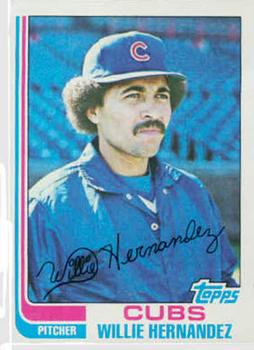
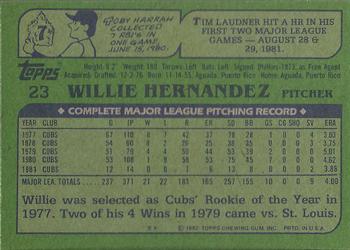
Card #23: Guillermo Hernandez


Who Can It Be Now?
While the card says "Willie", we will call him what he preferred to be called: Guillermo. Guillermo Hernandez Villanueva was born in Puerto Rico in 1954 in Aguada.  He attended high school in Puerto Rico as well prior to being signed as an amateur free agent by the Phillies in 1973.  Before 1990, players out of Puerto Rico were exempt from passing through the amateur draft and were able to be signed once they hit age 16.  Once 1990 came and the Puerto Ricans had to go through the draft, players from P.R. had to wait to sign until they completed high school.  This rule is blamed for the fact that baseball is a dying sport in the Commonwealth of Puerto Rico, as detailed in this 2012 New York Times article.

Hernandez signed at age 18 with the Phillies, but he did not pitch in their minor league system until the next year -- 1974.  Hernandez was a starter through his minor league career with the Phillies and enjoyed a very successful season at age 20, which he split between AA and AAA.  He posted a 14-6 record and a 3.11 ERA over the two levels, and his strikeouts actually increased in AAA over AA on a per-nine-inning basis.  He struggled somewhat at AAA at age 21 in 1976, but those struggles did not deter the Cubs from selecting him in the Rule 5 draft in December of 1976.  

He stayed in the major leagues with the Cubs until the 1981 season.  The Cubs sent him down to Iowa to take another crack at being a starter and to get work during the strike. Even though he was in his fifth season in the majors, Hernandez was still just 26 years old, so the work could not have hurt.

In reality and as his biography on the SABR website points out, the best thing that happened to Hernandez was playing winter ball after the 1982 season and, then, going to spring training with the Cubs in 1983.  In the winter league, former Baltimore Oriole Mike Cuellar taught Hernandez the screwball -- a pitch used to great effect by Fernando Valenzuela in 1981.  Then, in spring training, Hernandez worked with fellow Cub Fergie Jenkins and learned the cut fastball.  The cutter gave him a pitch to bust righty hitters inside, and it gave the perfect set up for the screwball.

The rest, as they say, is history.  Hernandez started using the cutter and the screwball some after the Cubs traded him to the Phillies in May of 1983.  The Phillies used Hernandez exclusively as a relief pitcher once they got him.  He appeared in three World Series games against the eventual champion Orioles that year, pitching four scoreless innings and allowing just two baserunners -- one on a walk and one hit batsman.

The next spring, Detroit saw Hernandez as the lefty reliever they needed to augment Aurelio Lopez -- Señor Smoke -- at the back of the bullpen and traded away up-and-coming outfielder Glenn Wilson to the Phillies (with John Wockenfuss) for Dave Bergman and Hernandez.  Sparky Anderson rode Hernandez hard -- having Hernandez appear in 80 of the Tigers 162 games, finishing 68 and saving 32 while pitching 140-1/3 innings.  Hernandez responded by striking out 112, walking just 44, and giving up only 96 hits.  For that season, Hernandez was both the AL Cy Young Award winner and the AL MVP in addition to being an all-star.  

After that 1984 season, Hernandez remained with the Tigers until the end of his career after the 1989 season.  He never approached the heights of his 1984 season -- and with that workload in relief, that should not come as any surprise -- and even became a lightning rod for Tigers fans' disapproval when something went wrong.  Even Sparky Anderson said that.  

Hernandez also gained some notoriety for showing up as a New York Yankee in 1995 as a replacement player during the spring training portion of the 1994-1995 lockout/strike. Hernandez apparently had been an agent and working for a steel manufacturing firm before coming back, but felt like he had not been given a fair chance to come back after elbow surgery in 1989.  Needless to say, when the regular players came back, Hernandez returned to Puerto Rico.

After baseball, a Toledo newspaper noted that Hernandez was spending his time five years ago as, "a cattle farm owner in the milk business in San Domingo[, Puerto Rico]." 

Rabbit Is Rich
John Updike won a Pulitzer Prize for Fiction in 1982 with his novel Rabbit Is Rich.  Here, the category will be used to talk about guys who at some point in their career famously held out or got a big, improved contract in some fashion -- and, more importantly, how it came about.

In Hernandez's case, our story comes from October of 1984.  At that point in time under baseball's collective bargaining agreement, a player could demand a trade by a certain point in the offseason from his current team.  If the player was not traded and did not withdraw the trade request -- read as: got a better contract from his new team -- then the player would become a free agent as of March 15.  

Hernandez was aware of this rule.  In the midst of the World Series, he demanded a trade. By doing so, he was seeking in essence to void the contract he signed with the Cubs prior to his two trades and work out an improved contract with Detroit.  The gambit worked, as he signed a five-year, $5.2 million contract with Detroit prior to the 1985 season.  It would turn out to be his final contract as a major league baseball player, as well.  And maybe, just maybe, demanding a trade in the middle of a World Series is why Tigers fans were quick to boo Hernandez when the opportunity presented itself.

A Few Minutes with Tony L.
Up until 1983, Hernandez was one of a number of guys toiling away in bullpens and in rotations around the major leagues whose faces and names would be little remembered today.  Hernandez, though, kept at it and picked up some new tools for his arsenal when he learned the screwball from Cuellar and the cutter from Jenkins.  

To be fair, my favorite Guillermo Hernandez story comes from the 1988 season.  Hernandez had a public feud of sorts with Mitch Albom, the smarmy self-important writer for the Detroit Free-Press who later wrote the sappy Tuesdays With Morrie.  Having watched Albom on ESPN's "The Sports Reporters" one too many times, I can honestly say that I would take Hernandez's side on this one no matter what happened.  

Anyway, Hernandez accused Albom of turning Detroit's fans against him and claimed that Albom called Hernandez "a crybaby" in stories during the 1987 season.  So, let's go to the wire story for the fun:
Hernandez, without saying a word, picked up a large bucket of ice water, poured it over Albom's head, then threw the bucket onto the floor and walked away, muttering.
Albom remained seated, but said: "You're a class act, Willie.  I wasn't even talking to you."
Maybe I'm taking out my dislike of ESPN on Albom a bit here, but this has to be my second favorite ice-water-on-a-reporter moment of all time after the time that Deion Sanders doused the self-important, self-righteous Tim McCarver with ice water in the early 1990s.