Showing posts with label Padres. Show all posts

Friday, January 15, 2021

Card #151: Dave Edwards


Who Can It Be Now?
David Leonard Edwards was born on February 24, 1954 in Los Angeles, California. Edwards was a product of the city of Los Angeles and attended the historic Thomas Jefferson High School, which produced such luminaries as Alvin Ailey, Ralph Bunche, Dexter Gordon, Art Farmer, and Etta James outside of sports and umpire Emmett Ashford, former Milwaukee Brave Lee Maye, and 5-time high jump national champion Otis Burrell.

Edwards was drafted in the 7th Round of the 1971 June Amateur Draft by the Minnesota Twins, and he was drafted as a catcher. I suppose he must have skipped a grade or started school early somehow since that meant that he was drafted in the year that he turned 17 years old. 

He spent four full seasons in rookie and A ball -- from 1971 through 1975 -- before getting promoted to AA Orlando in 1976. The Twins promoted him immediately in 1977 to AAA. He spent two seasons in AAA -- one in Tacoma followed by one in Toledo -- with fairly decent results (.764 OPS and a .341 OBP). 

As a result, Edwards was the one and only late season call up for the Twins in 1978 when rosters expanded in September. He made his debut against the White Sox and pitcher Ken Kravec, off whom Edwards got his first major league hit in his debut (a double). 

Calvin Griffith -- much like Charlie Finley -- viewed free agency as financial ruination, though Griffith was known for, as the Star Tribune put it in June of 2020, running the team "in a discount style." Coincidentally, in September of 1978 when Edwards was making his debut, Griffith was spouting off as only an old white racist owner could, stating that he moved the Twins to Minnesota because he "found out that you only had 15,000 blacks here. . . . We came here because you've got good, hardworking, white people here."

Quite the welcome committee. 

The offseason between 1978 and 1979 saw the Twins cheap out and traded one of their best players -- Dan Ford -- to the Angels for Danny Goodwin and Ron Jackson. The Sporting News on January 27, 1979, noted that the Twins intended to have Edwards split time with Willie Norwood in centerfield. 

That changed a couple of months later on February 5, 1979, when the cheapo Twins traded the great Rod Carew to the Angels in exchange for Dave Engle, Paul Hartzell, Brad Havens, and Ken Landreaux. Landreaux became the starter in center and Edwards became an extra outfielder. Even so, 1979 was his best year -- 257 plate appearances with an OPS of .711 (OPS+ of 89, making him just 11% worse than league average).

Talk in the offseason before the 1980 season had the Twins considering a left field platoon between Edwards and Rick Sofield. The Sporting News on March 29, 1980, ran a story outlining the differences between the two players. Sofield was gregarious -- a football stud who was convinced to spurn the Michigan Wolverines to go to the minor leagues -- while Edwards described himself as "enjoy[ing] listening" and always wanting to be a baseball player. 

This plan got tossed aside when Edwards suffered from an appendicitis in spring training. He fell out of the Twins plans and was traded to the Padres during the December 1980 winter meetings for reserve infielder Chuck Baker (who lasted all of 70 plate appearances in Minnesota). 

The Padres turned Edwards basically into a pinch hitter and fourth outfielder in 1981 and, in 1982, really nothing more than a late inning defensive replacement. He appeared in 71 games in 1982, but started only 12. The Padres released him after the 1982 season. He went on to play in Mexico for two years before calling it a career. 

Family Ties

Dave Edwards had two older brothers who were twins who played in the major leagues at the same time as Dave though at no point in time were all three in the majors at the same time. Mike Edwards beat Dave to the majors by a full season. He appeared in 317 games -- mostly with Oakland -- before leaving the U.S. to play in Mexico and Japan starting in 1982. Mike's twin Marshall Edwards will appear later in this set; Marshall was the Brewers' 5th OF for the 1982 World Series team -- even appearing in one game. Marshall debuted at the age of 28 in 1981 -- the year after Mike was let go by Oakland. 

Trivial Pursuit

In his 1980 interview in The Sporting News, Dave Edwards pointed out that, with Marshall's debut, the Edwardses were the first African-American family to have three brothers all appear in the major leagues. 

A Few Minutes with Tony

I honestly don't have much memory of Dave Edwards other than his ties to Marshall Edwards, of course. It appears that Edwards is pretty good about signing autographs through the mail, though, so maybe I'll take a stab at getting him to sign something. 

Anyone have any good Dave Edwards stories?


Tuesday, October 21, 2014

Card #120: Gary Lucas

After a week away for a trip for work, the 1982 Topps Blog is back!


Who Can It Be Now?
Gary Paul Lucas was born November 8, 1954, in Riverside, California. Lucas grew up there and attended Riverside Poly High School. 

He was not drafted directly out of high school, but he was selected in the 1st round of the regular phase of the January Draft in 1973 as a draft-and-follow juco player by the Cincinnati Reds.  He did not sign with the Reds prior to the June Draft in 1973, so the Reds selected him again in the first round of the secondary phase of the June draft. Once again, Lucas did not sign. Lucas completed his juco experience and enrolled at Chapman University in Orange, California. From there, he was selected by the San Diego Padres in the 19th Round of the June Regular Draft.

Lucas signed with the Padres and was sent to an age-appropriate Low-A ball team in Walla Walla, Washington. There, Lucas pitched pretty well -- 7-3 record, 3.10 ERA -- and earned a trip in 1977 to the California League. On its face, it appeared that he was hit around a bit in Reno that year with a 4.60 ERA in 176 innings but the reality was that he led the team in innings and, further, had an ERA that was a full run-and-a-half below the team ERA of 6.07.  

The Padres apparently realized the context of his numbers and promoted him to the Texas League in 1978. With Amarillo, Lucas once again had numbers and a record that looked less than impressive -- 8-17 record, 4.87 ERA in 159 innings. Once again, though, context was important -- the team went 44-89 and had a team ERA of 5.23 (and the league was at 4.91). Once again, Lucas earned another promotion. 

In 1979, then, Lucas found himself pitching for Hawaii. In a more normalized environment, his numbers facially improved tremendously. In 24 starts and 178 innings, he had a 2.78 ERA while giving up just 15 HR and 151 hits. Perhaps the team knew all along that Lucas was a good major league prospect since they kept promoting him, but that season in the PCL was Lucas's last in the minors until much later in his career.

Coming out of Spring Training, Lucas made the Padres as a starter/swingman.  Indeed, Lucas made the only 18 starts of his major league career during the 1980 season and was reasonably successful: 4-7 record with a 3.62 ERA (league ERA: 3.60) and a 1.235 WHIP (league: 1.321) in 109-1/3 innings. He only struck out 4.4 batters per 9 innings in a league that struck out 5.1 per 9, but why did the Padres move Lucas to the bullpen? The other two lefties to pitch 150 innings that season were "proven veterans" John Curtis and Randy Jones. and Bob Shirley also pitched 137 innings split between starting and relieving. 

Perhaps the real point was that Manager Jerry Coleman didn't know who he wanted in the starting rotation. Alternatively, the Padres may have been struggling with injuries to guys they were counting on to be starters, leading Coleman to chop and change his rotation regularly. Eleven different pitchers started at least one game for San Diego in 1980, eight pitchers started at least 10 games, but no one started more than 27. Indeed, of the pitchers with 10 or more starts, four of them also had at least one save!

Changes came after the 1981 season. The team traded closer Rollie Fingers, who had saved 23 games in 1980, in a 11-player deal to the St. Louis Cardinals. Dave Winfield left in free agency. The team got much younger (other than 35-year-old Rick Wise and 33-year-old John Curtis, the entire pitching staff was 28 or younger). As a result, at the age of 26, Lucas became the Padres closer for the 1981 season. 

The way Lucas was used in 1981 shows how roles have changed in the major leagues. Lucas led the National League in appearances with 57 and finished 40 games. He only saved 13 of those -- probably because the team was bad -- but, more surprisingly in the strike-shortened 1981 season, he pitched ninety innings all in relief that year.  In fairness, Lucas responded well -- putting up a 2.00 ERA (2.87 FIP), walking 36 (but 15 of those were intentional), giving up just 78 hits and striking out 53. It was a very good year, and those statistics earned him the card ending in zero for 1982.

Lucas remained the Padres closer for 1982 and 1983. After old Hondo -- Frank Howard -- put Lucas through the grinder in 1981, he was treated somewhat better by new manager Dick Williams in 1982. Lucas struggled in 1982 -- at least on the face of his win-loss record by finishing with 1 win against 10 losses.  Usually wins and losses are not the most meaningful stats, but if your putative closer is losing 10 games, it means he has struggled. Williams started platooning at closer in a way, using both Lucas (16 saves) and Luis DeLeon (15 saves) to close out games. 1983 was more of the same, though Lucas lost 8 times and won 5 -- he and DeLeon split 30 saves between them at 17 for Lucas and 13 for DeLeon.

After two consecutive 81-81 seasons, though, Padres brass decided that they needed to shake their roster up. Part of that shake-up was a three-team, six-player trade during the winter meetings in which the Padres sent Lucas to the Montreal Expos.  The Padres received Al Newman from the Expos and Fritzie Connally, Craig Lefferts, and Carmelo Martinez from the Cubs. The Expos also sent Scott Sanderson to the Cubs.  So, the only player that the Expos got for Al Newman and Scott Sanderson was Lucas.

So, Lucas left San Diego just as they were getting to be a good team and jumped on board a sinking Montreal team that already had Jeff Reardon and Bob James in its bullpen. As a result, Lucas moved more into a LOOGY-type role -- 55 appearances, 53 innings -- though in 1984 in the days of the five-man bullpen, LOOGYs really didn't exist.  Lucas spent two years with the Expos and pitched well once again -- an ERA under 3 in 120-2/3 innings over two years with 9 saves.

After the 1985 season, Lucas was traded to the Angels for a minor leaguer and pitcher Luis Sanchez (who would not pitch again in the major leagues).  Injuries limited Lucas to just 27 appearances in the regular season in 1986, and considering the car-crash that was his 1986 post-season, he probably wishes that he had not appeared in the ALCS against the Red Sox. Lucas pitched 2-1/3 innings and gave up 3 hits, a walk, and a hit batsman, leading to 3 earned runs being charged to his account (11.57 ERA). 

Indeed, one of the more infamous parts of the 1986 ALCS was the Dave Henderson home run off Donnie Moore (which in part led to Moore committing suicide). Lucas came into that game in relief of starter Mike Witt to face catcher Rich Gedman. On the one and only pitch that Lucas threw, Gedman was nicked on the forearm. Lucas was then removed from the game for Moore. Moore gave up the two-run home run that put the Red Sox ahead, and Lucas was left only with regrets. As he said in a 2010 interview, "I let a lot of people down. I let myself down. And to be quite honest, it never leaves you completely."

Lucas finished up his major league career in California in 1987. He pitched in the Giants farm system in 1988 but never received a call to come up to the major leagues. As he said later, he had some back problems at the end of his career that he could not overcome, and he hung up his spikes after the 1988 season.

Mustache Check: I can't tell if he has one here or not, but he has always had one during his career and has one on each of his other cards in 1982.  So I'm saying, "Mustache!"

The Message
To be honest, I don't have much for Gary Lucas. He's lived a pretty quiet post-career life. He's been a pitching coach for a long time in the minors. But why "The Message" for him? Because he turned down numerous opportunities to move up in the Twins organization so that he could keep his base of operations in one place throughout the past 15 years so that his daughters could grow up in one place. 

To me, that's "getting it."

A Few Minutes with Tony L.
Gary Lucas made no impression on me in the early 1980s. He was a National League player on the West Coast who pitched for a team that hardly got any publicity until 1984 -- and by that time he was gone.

As I said above, Lucas has spent most of the time since he retired in 1988 as a minor league pitching coach. He started his sojourn with San Jose in the California League in 1991. His wife is from the Midwest, so he asked to be located in the Midwest so that his wife and daughters could be around her family while he was on the road all the time. 

So, in 1992 through 1994, he was the pitching coach at Quad Cities. After a few years away, he went back to QC in 2000 through 2004, and moved to Beloit in 2005. He moved up to Double-A New Britain for a couple of seasons in 2006 and 2007, but asked to be back in the Midwest again after that. 

He then went back to Beloit from 2008 through 2012. When that team moved to Cedar Rapids for the 2013 season, he followed. He moved to the Florida State League to be the pitching coach under Doug Mientkiewicz for the 2014 season. That team finished 82-57, but somehow did not qualify for the playoffs.

Despite all that time with the team, the Twins announced on September 26, 2014 that Lucas and the Twins had parted ways. I am hopeful for Gary Lucas's sake that this parting of the ways was mutual and, further, that Lucas simply decided to get off the road entirely. It's possible, certainly, that the reason for the move is that Lucas wants to be back in the Midwest.  

We will see what happens.

Friday, June 20, 2014

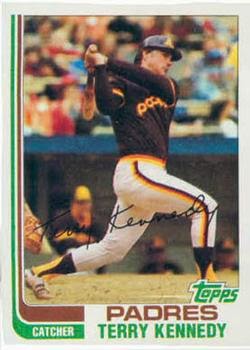
Card #65: Terry Kennedy


Who Can It Be Now?
Terrance Edward Kennedy was born on June 4, 1956, in Euclid, Ohio, and grew up in Mesa, Arizona.  He was the youngest child of five, and like many boys he idolized his father -- the late Bob Kennedy, who played in 16 seasons between 1939 and 1957.  

Kennedy was not drafted coming out of high school at St. Mary's High School in Phoenix.  He watched his best friend, Alan Wirth, get selected by the San Francisco Giants in the third round of the 1974 draft. Kennedy's problem was that he had not figured out how to play baseball in his own body.  As he told The Hardball Times, he grew about seven inches in 15 months between his junior and senior years of high school.  

So, his father, who at that time was the assistant General Manager of the St. Louis Cardinals, called the two guys whom he knew in the college ranks to get Terry a place to play.  Those two guys were former Cardinal Eddie Stanky at South Alabama and former Brave and Red (and future Mariners General Manager) Woody Woodward at Florida State University. 

Things worked out for Kennedy to attend FSU and, there, he was extremely successful -- he was a two-time All-American there and was named National Player of the Year in 1976. Indeed, he was inducted into the FSU Sports Hall of Fame in 1982 for his baseball prowess.

Coming off that successful college career, Kennedy was selected in the First Round of the 1977 June Draft with the sixth pick overall by the Cardinals (even though Kennedy's dad had, by this time, moved on to the Chicago Cubs to be their General Manager).  In a wire report story from 1977, Kennedy is quoted as saying that the Cardinals "were just about my first choice" and negotiated a contract quickly along with his agent -- his mother.  In that interview with The Hardball Times, however, he noted that it was his father -- the GM of the Cubs -- who negotiated the contract with the Cardinals.

Kennedy moved up the ranks in the Cardinals chain quickly, as one would expect a top-notch college player to do.  He battered the poor high school kids he faced during his 12 games at Johnson City in the Appalachian League to the tune of .590/.673/1.103 -- yes, a patriot OPS of 1.776.  He did not do as well in the Florida State League -- a league known to suppress hitting.  But, that did not deter the Cardinals from moving him up first to Double-A Arkansas in the Texas League and then to Triple-A Springfield in the American Association in 1978. Over those two stops, Kennedy hit 20 HR, drove in exactly 100 runs, and hit .309/.402/.495. 

He earned a late cup of coffee from the Cardinals in 1978 and did not hit well.  That, combined with the fact that the Cardinals already had another good hitting catcher by the name of Ted Simmons, meant that Kennedy started the 1979 season back in Triple A. As his previous results indicated he would, he continued to hit the ball well enough to show he deserved to be in the major leagues.  He got that opportunity in late June of 1979.  Simmons was placed on the disabled list, and Kennedy was called up to take his place on the roster. Kennedy split time with Steve Swisher while Simmons was out, and then Kennedy was sent back down when Simmons returned.

But that did not solve the logjam behind the plate for the Cardinals.  It wasn't like the Cards could move one of them to first base to clear thing up either -- not with All-Star and MVP Keith Hernandez manning that position.  The Cardinals made the best of it, though, during 1980.  Kennedy played 28 games in left field, 41 games behind the plate, and made 17 pinch hitting appearances, while Simmons spent 129 games behind the plate, 5 games in left, and 19 as a pinch hitter.

Apparently, though, Whitey Herzog wasn't particularly impressed with either catcher -- that, or other teams coveted these two catchers so much that he just had to trade them. That's because Herzog traded both Simmons and Kennedy during the 1980 winter meetings. Simmons went to the Milwaukee Brewers, while Kennedy was sent to the San Diego Padres. He was the centerpiece of the deal for the Padres, who also received John Littlefield, Al Olmstead, Kim Seaman, Steve Swisher and John Urrea in exchange for Rollie Fingers, Bob Shirley, Gene Tenace, and Bob Geren (who was the player to be named later in the trade).  

Freed from the shackles of being a backup catcher, Kennedy blossomed in San Diego.  He caught about 85% to 90% of the Padres games between 1981 and 1986.  He played in three All-Star games -- 1981, 1983 and 1985 -- and was named the catcher on the NL Silver Slugger team in 1983 when he hit 17 HR, drove in 98 runs, and hit .295/.328/.486. He also had some defensive chops -- leading the league twice in baserunners cut down attempting to steal -- though he also was among the lead leaders in most errors by a catcher in 1981 (1st), 1983 (4th), 1984 (2nd), and 1985 (5th).

After the 1986 season, though, the Padres found themselves with a surplus of catching. Hotshot prospect Benito Santiago had torn up the PCL and hit well in a cameo at the end of the year, while Kennedy was 31/turning 32 in June of 1987 and was about to make over $1 million in salary.  As a result, the Padres decided to trade Kennedy and pitcher Mark Williamson to the Baltimore Orioles for Storm Davis.  

With the O's, Kennedy enjoyed a very successful 1987 in which he hit 13 HR in the first half of the year and was named to the All-Star team.  He tailed off after the break, and then saw the Orioles sign reclamation project Mickey Tettleton at the beginning of April.  It probably didn't help that those Orioles were just awful either -- they lost 21 in a row to start the year, remember -- and Kennedy's playing time dwindled as Tettleton's increased.  

So, for the 1989 season, Kennedy found himself packing his bags again.  He was traded in a "challenge" trade of sorts, going to the San Francisco Giants in exchange for future major league manager and certified, card-carrying member of the Backup Catchers Union, Bob Melvin.  Kennedy did not play particularly well in 1989, but he did get a second unsuccessful trip to the World Series with the Giants.   He split time in 1989 with Kirt Manwaring, in 1990 with Gary Carter, and in 1991 with Steve Decker and Manwaring.  

He retired at the age of 36 after the 1991 season.  He stated that he was "pretty much done physically.  The catching had taken a tool on my legs and I couldn't generate much offense any more . . . At the end of '91 I knew it was time to go home."  So, he did.

Mustache? Nope, not even a stray wisp shows up on Kennedy's face on this card.

Family Ties
As I mentioned above, Terry's father Bob Kennedy played nearly two decades in the major leagues.  Bob broke in as a 19-year-old with the team of his youth -- the Chicago White Sox -- for whom he worked as a vendor at Comiskey Park, according to Baseball-Reference Bullpen.  Bob is an interesting character himself in that he spent a little over three years in the Naval Aviation and Marine Aviation programs during World War II and trained fellow major leaguer Ted Williams in flying.  

In addition to Bob Sr., Terry's brother Bob, Jr. also played in the St. Louis Cardinals organization (as the wire report about Terry getting drafted also noted).  Bob Jr. later became a scout for the Seattle Mariners, the Chicago Cubs, and the Houston Astros.

Trivial Pursuit
In Kennedy's playing career, he and his father hold the distinction of being the first father-son duo to both have World Series RBI.  I don't know if anyone else has achieved that distinction since.  

In his post-playing career, Kennedy holds the distinction of being the last man to manage Rickey Henderson as a player.  Kennedy managed the San Diego Surf Dogs in the independent Golden Baseball League in 2005 and 2006; Henderson was on the 2005 team.

A Few Minutes with Tony L.
Because he was a National Leaguer for most of his career, I don't recall having any negative feelings toward Kennedy at all.  In fact, since he was a catcher and I was a little league catcher, I tended to like him.  I liked him enough that I actually sent some cards to him for him to autograph in the mid-1980s, and he was kind enough to send all of them back autographed.

After Kennedy's playing career ended, he did what many ex-players do: stayed in baseball. He was named as the manager of the Cardinals Class-A St. Petersburg team on November 25, 1992.  From there, he managed Vermont for the Expos in 1994, in the Cubs organization for three years in 1997 through 1999, for the Dodgers for a season in 2004, for the San Diego Surf Dogs in 2005 and 2006, and then in the San Diego Padres system from 2009 through 2012.  

Outside of his baseball exploits, Kennedy is realtor for Keller Williams in Chandler, Arizona (and good Lord is that a bad realtor-lean-in photo on that site). His wife also is a realtor. While he did not finish his degree at FSU, he did eventually finish his bachelor's in business administration through the University of Phoenix on what he called the "25-year plan."

Finally, and again drawing from the excellent interview on The Hardball Times, Kennedy said he was/is working on a novel about former Chicago White Sox third-baseman and Black Sox conspirator Buck Weaver and Weaver's overlap with Terry's father Bob on the Chicago sandlots in the 1930s.  If it has been released, I have not been able to find it yet.  

I hope that Terry does write that book and, if not that book, at least a book recounting both his and his father's stories about being in baseball for as long as they both were.

Tuesday, April 29, 2014

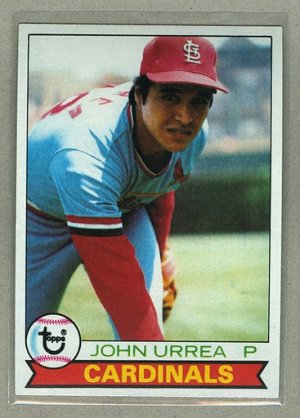
Card #28: John Urrea


Who Can It Be Now?
John Goody Urrea was born in Los Angeles, California, on February 9, 1955.  He went to Rio Hondo College, a junior college in Whittier, California, and it was from there that he was selected in the first round of the 1974 January Draft with the 14th overall pick by the Cardinals.  

He signed with the Cardinals, and appeared in 6 games in the Gulf Coast League (a rookie league) before moving up to St. Petersburg in the Florida State League in 1974 for one game.  As an article in The Evening Independent (St. Petersburg) written during his next far more extended trip to St. Petersburg in 1975 mentions, Urrea's 1974 season was cut short by a pulled muscle in his throwing arm.  Playing on the same Single-A team in 1975 with Urrea were future big leaguers Tito Landrum and Garry Templeton -- who was called up mid-season and replaced on the roster by future Phillies Manager Nick Leyva.

Urrea had an excellent 1975 season in the Florida State League -- though, in fairness, it was a league that favored pitchers -- so he moved up to the Texas League in 1976 and pitched pretty well there.  He was getting hit by batters with regularity, to be fair -- 10 hits per nine innings -- but his 11-8 record convinced the Cardinals to give him a shot in spring training in 1977.  

The 1977 season for Urrea was a fairy tale of sorts.  He pitched well -- a 3.16 ERA, 8.1 hits per 9 innings, and a K/BB ratio of 2.31 all speak to that.  He saved 4 games.  In fact, his first three appearances were saves, including the third game of the 1977 season against the Pirates.  After that game, then-Cardinals manager Vern Rapp said, "I don't want to be too predictable.  Eventually, we have to prove to other teams that there is more to our bullpen than just [Al] Hrabosky. . . . I'm not discrediting Hrabosky, either, but one man can't do the work all season.  You've got to establish your other relievers."  Quite a stark change to today's bullpen construction where everyone knows who everyone else's "closer" is, certainly.  

Later in the season, Urrea was moved to the starting rotation where he started twelve games and completed two of them, including a 3-0 shutout of the Atlanta Braves in July. Indeed, his first five decisions as a starter were wins as well.  All the usual happy stories started appearing in newspapers -- a headline in the Southeast Missourian over an AP story, for example, sang, "Success fails to spoil John Urrea."

Urrea's career went south after his initial success.  He slumped to a 5.38 ERA in 1978 -- even though his FIP was pretty much the same as his previous season.  The real problem he had was that his walk rate shot up after that first year in the majors, going from 2.3 BB/9 in 1977 to 4.3 BB/9 in 1978 and, from there, never lower than 5.1 BB/9.  This control issue caused his K/BB ratio to fall as well -- going to 1.3 K/BB in 1977 and, thereafter, never reaching 1.0 again.  So, at the end of July, the Cardinals sent Urrea down to Triple-A Springfield and called up Aurelio Lopez to replace him.

He got a cup of coffee in 1979, appearing in three late season games, and then was called up at the end of June in 1980.  He stayed in the majors for the rest of that year.  

 Whitey Herzog had become the field manager and general manager at the start of the 1980 season, and he began shaping the team in the image he wanted it to have.  Urrea was to be a part of that shaping, but as one of the guys exiting St. Louis.  As it was, at the winter meetings in December of 1980, Urrea was involved in one of the most incredible flurries of trades of at least the early 1980s.  On December 8, 1980, he was shipped to the San Diego Padres with Terry Kennedy, John Littlefield, Al Olmstead, Mike Phillips, Kim Seaman, and Steve Swisher in exchange for Rollie Fingers, Bob Shirley, Gene Tenace, and Bob Geren.  The very next day, Herzog traded Leon Durham, Ken Reitz, and Ty Waller to the Cubs for Bruce Sutter.  Not wanting to have two closers, apparently, Herzog took three days to find a trading partner for Fingers, sending Fingers, Pete Vuckovich, and Ted Simmons to the Milwaukee Brewers for David Green, Dave LaPoint, Sixto Lezcano, and Lary Sorensen.

The Padres were in full-on salary cutting/rebuilding mode; a review of their transactions from 1980 shows a team selling players, trading veterans, and releasing players left and right.  Urrea came to the Padres in this atmosphere at the age of 26 and pitched creditably, though he walked 1.6 batters per nine innings more than he struck out.  After that performance, the Padres released Urrea, and he never pitched in the major leagues again.

Nanu Nanu
This card is John Urrea's last appearance on a Topps baseball card and, as I mentioned above, Urrea did not pitch in 1982 or thereafter in the Majors.  

What happened to him?  Well, he pitched for both Veracruz and Poza Rica in the Mexican League in 1982.  Baseball-Reference loses him for a couple of years before Urrea resurfaces with the Mexico City Tigers in 1986 at the age of 31.

After that, it appears that he moved back home to the Los Angeles area -- Cerritos -- where I believe he still lives today.

A Few Minutes with Tony L.
Urrea was a guy whose card I would look at in 1982, 1992, 2002, or 2012 and say, "I must have 12 of this one."  He did not make an impression on me, though I definitely have his 1979 Topps card photo ingrained in my head for some reason.  


One interesting to me issue that came up while trying to find something about Urrea that I could write about was the Pittsburgh Post-Gazette article from which I took Vern Rapp's quotes about his bullpen use.  That same news story provides a throwback to the days 37 years ago -- or, for that matter, about 15 years ago -- when it seemed that sportswriters would or could only compare athletes to other athletes of a similar ethnic background.  

You may not realize it by his name, but Urrea is definitely a Mexican-American.  In fact, the name Urrea is famous from the Texas Revolution, as General Jose de Urrea was one of Santa Anna's top generals.  Under Urrea, Mexican forces never lost a battle.

That said, however, John Urrea is as American as any other person born in the US -- whether it was to immigrant parents or otherwise.  Yet, the Post-Gazette from 1977 first compares Urrea to golfer Lee Trevino, saying that Urrea bore a "slight resemblance" to Trevino.  Here's Trevino from about that time:


I guess that slight resemblance is that he had dark hair and dark eyes?  Now, in fairness to the 37-years-ago beat writer, perhaps Urrea looked more like Trevino then than he did five years later on the 1982 Topps card.  But when Urrea was first introduced in the story, he was described as "the Merry Mexican who last year pitched Class AA ball for the Cards' Arkansas farmclub in the Tecas [sic] League . . . ."  Urrea is then described as having "eyes that sparkle and dance with similar merriment [to Trevino's eyes]."  

I'm not a politically correct person by any stretch of the imagination, but seeing a story written in that way today is a jarring reminder of how far we have come in how we view people.  I am glad that we have progressed at least somewhat.