Showing posts with label In Action. Show all posts

Wednesday, September 24, 2014

Card #111: Carlton Fisk In Action


Who Can It Be Now?
It's still Carlton Ernest Fisk. This card always perplexed me as a youth because it was about the only card in the set that is properly displaying horizontally -- as above -- rather than vertically:

When we left off last week at the end of Fisk's Red Sox career and at the start of his White Sox career, I mentioned that the contract to which the White Sox and Fisk agreed looked like it had the potential to be an albatross around the White Sox's collective necks due to its length and Fisk's age.  

There is no doubt, though, that the contract turned out well for both Fisk and for the Sox. The five seasons on that initial contract were five of Fisk's most productive years. He averaged 125 games a season, 21 HR, 69 RBI, 10 SB, and slashed at .258/.332/.454. The most productive season of the five by WAR was 1983 (26 HR, 86 RBI, .289/.355/.518) -- a year in which Fisk finished third in the MVP race behind Cal Ripken and Eddie Murray and helped lead the White Sox to the ALCS where they lost to those Orioles.

After the 1985 season, Fisk signed back up with the White Sox for two seasons. He re-signed with the Sox for four more seasons before the 1988 season, re-signed for one year after the 1991 season, and then signed again in 1993. 

During his much of his White Sox career, however, Fisk had a rocky relationship with White Sox owner Jerry Reinsdorf. The issues may have started back in 1985, when the White Sox were trying to sign Fisk to a contract and then trade him to the New York Yankees. For the Sox to trade Fisk, they needed his permission, and he would not give it freely. Indeed, both he and Don Baylor (for whom Fisk was to be traded) wanted money to waive their no-trade clauses. That never happened, so the Sox were content to swap Ron Hassey and Britt Burns instead. Later, in January, Fisk simply re-signed with the White Sox since, after all, this was the era of collusion.

Despite all that, Fisk did not complain about the size of his contract. He felt that renegotiating a contract was a character flaw and that those guys wanting to renegotiate were crybabies. By his last two seasons in baseball, however, the White Sox had committed to starting Ron Karkovice. Fisk played only 62 games in 1992 (aged 44), and his hitting was commensurate with being a backup catcher -- .229/.313/.309.

Recognizing Fisk's decline, the White Sox organization wanted to protect itself -- and its future -- by signing Fisk to a minor-league deal for the 1993 season. Fisk balked at signing the deal because it was a minor-league contract, whereas the organization pointed out that that was a technicality so that the Sox would not have to use a 40-man roster spot on Fisk. The result: Jerry Reinsdorf took to the media. He was quoted as saying:
He's 45 years old; it's time he grew up. I'm sick and tired of him acting like a baby. He believes he has been mistreated, but nobody has ever been catered to here more than Carlton Fisk. He's a prima donna. He must think he's Michael Jackson.  
Here's a guy who doesn't like anybody and is always unhappy, yet no one ever writes it. Everyone is afraid of him. I don't know why.
Fisk wanted to hang around one more year at the age of 45 for at least one personal reason, though, so eventually he caved and signed a contract. The reason, of course, was that he wanted to set the record for most appearances at catcher. On June 22, 1993, he did that, making his 2,226th appearance behind the plate in his major league career. That game served as a going away party of sorts, as his White Sox teammates chipped in and bought him a motorcycle, which Bo Jackson drove onto the field for him. Fisk's wife Linda also received a diamond bracelet from the team, and the White Sox made a $25,000 donation to the Chicago Botanic Garden.

Then, a week later, the White Sox were in Cleveland to play the Indians when the decided that that was the time to release Fisk. As the AP wire story put it, that move was "long expected because of the 45-year-old's feud with management over his diminished playing time as he chased the ironman catching record." So, one game past Bob Boone, Fisk was done.

The hurt over his treatment in 1993 -- and possibly his New England background -- led Fisk to choose to be inducted into the Hall of Fame as a member of the Boston Red Sox.  He and the White Sox eventually patched things up, however -- first, retiring his number 72 (the reverse of the 27 he wore in Boston, which is also retired) in 1997, then erecting a statue outside Comiskey Park/U.S. Cellular Field of him in 2005. Finally, in 2008, the White Sox hired Fisk as a "team ambassador," a position in which Fisk still serves today.

Mustache Check: See, I let 5 days go by and I forget to cover this. Of course, it doesn't matter.

Family Ties 
In my haste last week to write the long tale of all of Carlton's athletic nieces and nephews, I neglected to mention Carlton's own daughter, Carlyn. She played volleyball at the University of Illinois-Chicago in the early 1990s even though she was just 5'7" tall.

Freeze-Frame
Carlton appeared in a 2009 documentary called The Lost Son of Havana about former Red Sox pitcher and teammate Luis Tiant. The documentary featured Tiant returning to Cuba after 46 years in exile.

A Few Minutes with Tony L.
It seems these second cards of Hall of Famers are more difficult to write than the first ones are. Or, at least they take longer.

So, today, two items. First, an interesting tidbit about Carlton Fisk's most famous TV moment.  Everyone knows the clip:


The interesting tidbit to me is that this homerun changed the way that TV covered sports wholly by happenstance.  As reported at The Sporting News in April of 2012, up to that time, the cameras focused on the ball and the game play. Player reactions were ignored. But everyone knows Fisk's reaction -- with him waving the ball fair -- because of a rat. The cameraman, Lou Gerard, tells this story:
There were some rats running around. With Fisk coming up, Harry Coyle, who was the director at the time, he told me, "Lou, you have to follow the ball if he hits it." I said, "Harry, I can't, I've got a rat on my leg that's as big as a cat. It's staring me in the face. I'm blocked by a piece of metal on my right." So he said, "What are we going to do?" I said, "How about if we stay with Fisk, see what happens?"
The second item is simply whether Carlton Fisk belongs in the Hall of Fame. Stories in 1993 -- such as this one from the Chicago Tribune -- took it as a fait accompli that Fisk was an automatic for induction when his time came around. 

Bill James's statistical measures for induction are not as convinced. The "Black Ink" measure of leading the league in categories results in Fisk getting just 1 point (average HOFer -- 27). The "Gray Ink" measure is similarly lukewarm, with Fisk totaling 54 points for finishing in the top 10 in offensive categories -- and the average HOFer is around 144 points. On the other hand, the James Hall of Fame Monitor puts Fisk at 120, with a likely HOFer at 100; the James Hall of Fame Standards has him at 49 (average HOFer is 50).  

JAWS is kinder to Fisk, in large part due to the fact that JAWS compares him to catchers. Fisk also was helped by some intangible measures -- retiring as the all-time leader in home runs among catchers (since passed by Mike Piazza) and as the all-time leader in games played at catcher (since passed by Ivan Rodriguez).

It's difficult to believe that Fisk came up just two years after Johnny Bench and 5 years before Gary Carter -- Fisk retired after both of them.  Fisk's numbers place him squarely third of those three in the conversation of "best ever" at the position.  Still, being third of the three best of all time -- perhaps now behind Ivan Rodriguez -- is nothing to sneeze at.

While I don't think it was ever a "no-brainer", I do believe that Carlton Fisk is a deserving member of the Hall of Fame.  It does not matter if I liked the guy or not -- he was an excellent, though irascible, player who always gave everything he had to win. He made his teams better -- and the stats prove this.

So, yes, Carlton Fisk is an easy HOFer.

Friday, September 5, 2014

Card #101: Mike Schmidt In Action


Who Can It Be Now?
It's still Mike Schmidt. In yesterday's post, I glossed over much of Schmidt's background other than his failure to be drafted directly out of high school due to his knees.  A book available at least partly through Google Books called Mike Schmidt: Philadelphia's Hall of Fame Third Baseman gives a bit more information about this told from the perspective of Phillies scout Tony Lucadello.

Lucadello claims that he started following Schmidt when Schmidt was a sophomore in high school. One of Lucadello's local bird dogs, a guy named Ed French, told Lucadello about Schmidt. Schmidt was called an excellent athlete and an above average prospect -- but he was also incredibly raw. In other words, he was a toolsy prospect according to Lucadello. 

Stopping there for a moment, one can see this a bit in Schmidt's minor league numbers, but playing college ball definitely refined Schmidt's talents. To an extent, Schmidt's minor league numbers show his rawness -- at least in his first season in the minors in Reading where Schmidt struck out nearly three times more than he walked. 

Going back to Schmidt's high school years now and to Lucadello's story. What I really don't understand about the story Lucadello tells is this: if Lucadello was impressed enough to "follow" Schmidt, why couldn't he convince the Phillies to take a chance on Schmidt straight out of high school? Perhaps it was, as Lucadello said, that other scouts dismissed Schmidt as "damaged goods" due to the injuries to his knees that Schmidt suffered playing football.

That said, one of Schmidt's high school coaches, Dave Palsgrove, talked about Schmidt's work ethic. Even in high school, Schmidt had issues making contact -- but if he did, he would hit it hard somewhere. Schmidt stayed after practices to get better at fielding popups and ground balls, and he would go to batting cages on his own to hit. Schmidt even got a scout for the California Angels, Buddy Bloebaum, to teach him to switch hit. 

Despite all that, only small schools were interested in Schmidt for baseball so Schmidt went to Ohio University on his/his parents' own dime to become an architect. Having worked in construction law for many years, I can tell you that Schmidt would have been a typical architect -- incredibly sure of himself and his own abilities and always quick to say that others should listen to him to learn.  Okay, that's snarky, but architects tend to be pretty narcissistic; Schmidt's confidence in himself as evidenced through both his interviews during his playing days and in his columns for the AP is typical for a more senior architect.

Okay, back to Schmidt and away from my amateur psychology.

Schmidt himself recognized that he developed as an athlete in college.  Again, from the book above:
I was about the fourth or fifth best baseball player in high school -- a .250 hitter, and if you don't hit .400 in high school, nobody knows you're alive. I was always the kid with potential, but even that potential was jeopardized by a couple of major injuries in high school. I was also a late bloomer when it came to confidence and aggressiveness. I don't think I was really willing to fight for myself until I got to college. Not that I wasn't cocky in high school about my athletic ability. I knew I had as much talent for sports as anyone -- I felt that whatever the season, I'd be the best athlete. But there were other players who had all the physical qualities I had and something else besides: they were meaner than I was, tougher mentally.
Schmidt was invited to walk on to the Ohio University baseball team. He sat as a freshman behind shortstop Rich McKinney (drafted by the White Sox in the first round of the 1968 Draft). Schmidt came to national prominence due to that College World Series run I mentioned yesterday. 

When I left off with Schmidt's career yesterday at 1982, I mentioned that I would finish his career today.  Well, Schmidt won one more MVP award in 1986 -- though WAR says that Mike Scott was at least 2 wins better than Schmidt and 1.6 wins better than anyone else in the league. the fact that Schmidt won the MVP at the age of 36 came probably because he led the league in homers and RBI that season.  1986 was also the first time in his entire career that he struck out less than 100 times in a full season (he struck out 71 times in 102 games in 1981).

But, when Schmidt's abilities started to slip, they went fast. He went from being the MVP in 1986 and putting up another strong season in 1987 to getting hurt in 1988. He was put on the Disabled List after playing both ends of a doubleheader on August 12, 1988, due to shoulder problems. He ended up visiting Dr. James Andrews in Birmingham in September and undergoing rotator cuff surgery. Andrews was quoted as saying that he found just a small pit in Schmidt's rotator cuff that needed to be repaired -- a slight tear.  

Schmidt came back in 1989, but it was evident quickly that he was not the same player. He started the season reasonably well -- hitting 5 homers in his first 17 games -- but then he really started to struggle. Over the final 25 games of his career, the Phillies performed poorly -- winning just 7 -- and the team's struggles mirrored Schmidt's.  He hit only one home run, he had just 12 hits in 80 at-bats and only 2 hits in his final 41 at-bats, and he was struggling to make good contact, slashing at .150/.278/.200. Topping it off, the normally sure-fielding Schmidt had made 8 errors at third and five in his final 21 games. As Schmidt himself put it in his retirement statement:
My skills to make the adjustments needed to hit, to make the routine play on defense and to run the bases aggressively have deteriorated. Realizing this, I have decided not to keep on playing, but to retire effectively immediately.
Mustache Check: It's still there.

The World According to Garp
Schmidt has co-authored three books. The first was a reasonably brief (191 pages) autobiography called Always on the Offense that was ghosted by Barbara Walder. His second book was an instructional book called The Mike Schmidt Study: Hitting Theory, Skills and Technique that he co-wrote with/had ghosted by Robert Ellis. 

Schmidt's final book was co-authored with/ghostwritten by one of the original founders of Rotisserie Baseball, Glenn Waggoner (who appears in the 2014 Topps Allen & Ginter set). This book is called Clearing the Bases: Juiced Players, Monster Salaries, Sham Records, and a Hall of Famer's Search for the Soul of Baseball.  To be honest, I'm hesitant to read this book since I fear it may sound an awful lot like Schmidt's "Get off MY lawn" sentiments that I went through yesterday. But, at least it's available for just $5.58 from Amazon.com!

Rabbit Is Rich
In both 1985 and 1987, Schmidt was the highest paid player in the National League, pulling in over $2.1 million in each of those years. In 1986, he was the third-highest paid player behind two members of the New York Mets -- George Foster (who played just 72 games that year for the Mets before they released him on August 7) and Gary Carter.

A Few Minutes with Tony L.
There is no question whatsoever that Mike Schmidt is a deserving member of the Baseball Hall of Fame. When he retired in 1989, Schmidt was behind only Hank Aaron, Babe Ruth, Willie Mays, Frank Robinson, Harmon Killebrew, and Reggie Jackson on the all-time home run list. 

During the past twenty-five years, Schmidt has been passed by Barry Bonds, Alex Rodriguez, Ken Griffey, Jim Thome, Sammy Sosa, Mark McGwire, and Rafael Palmeiro.  Out of those, only Griffey and Thome have not been linked definitively with steroid use. So, in the "probably clean" category, Schmidt is tenth. Of course, literally everyone who played major league baseball "might" have used PEDs of some sort -- whether it was greenies/amphetamines, cocaine (not that coke enhanced anyone's ability), steroids, or chocolate bars -- so that's where I'm leaving that discussion for now.

Schmidt was inducted into the Hall of Fame in 1995 by himself at the first time of asking. He received 96.5% of the vote. It's easy to ask this question, but what more could the guy have done to get inducted? I am guessing it is because he only had a career batting average of .267. 

I mean, this is probably the best third baseman ever to play the game -- Bill James said in his Revised Historical Baseball Abstract that Schmidt and George Brett are 1 and 2, with Eddie Mathews third and Wade Boggs fourth -- and I don't have any reason to disagree with James on that.

Yesterday, I mentioned Schmidt's complaining about autograph seekers stalking him on the streets during his playing days. I can understand that complaint, certainly -- I'm sure that he'd like to walk the streets without being mobbed. It may just come down, however, to the fact that he was not getting paid for his autograph.  Yes, more snarkiness from me, but it's tough not to be a bit snarky when you go to Fanatics.com and see the wide variety of autographed items that Schmidt has for sale -- balls for $160, incribed balls for $400, bats for $200, photos for $130 to $180, a variety of Topps cards for $110-140 a piece, etc.  

I don't begrudge him the right to make money off his signature at all, but it is a bit ironic that this is a guy who complains about little Johnny not being able to get autographs inexpensively.

Monday, July 28, 2014

Card #81: Jim Palmer In Action


Who Can It Be Now?
It's still Jim Palmer, this time "In Action".  The Action card highlights some of his career achievements in All-Star games, Championship Series, and World Series games and series.

Let's talk, instead, about his baseball cards for a moment.  Actually, one highlight in particular on what is called his "Official Biography" comes on page three of that website.  The first line there states, "In 1994, Jim was part of the Nabisco All-Star Legends, a consumer trading card program which was the largest and most successful in history."  

Being that this blog is a baseball card blog and, indeed, I collect baseball cards, that line piqued my interest.  I looked up that card set, and it's quite the set.  A blog called The Card Investor (which has not been updated since 2013) had a post in 2010 about the 1993 set which I found interesting.  

The Nabisco All-Star Legends cards were available from Nabisco in both 1993 and again in 1994 simply by sending in two proofs of purchase from Nabisco products and $5.  In return, you received an on-card autograph from one of Brooks Robinson, Catfish Hunter, Don Drysdale, Ernie Banks, Phil Niekro, or Willie Stargell in 1993 or from Bob Gibson, Jim Palmer, Frank Robinson, or Duke Snider in 1994.  Each card came with a certificate of authenticity, and, at least for 1993, the autographs were "limited" to 90,000 cards based on what Nabisco asked the Hall of Famers to sign.  

The Card Investor post notes that, midway through his efforts to complete his contract, Don Drysdale passed away suddenly.  That meant that his signed cards carry a premium due to those being limited to 25,000 total.  Catfish Hunter passed away in 1999 and Willie Stargell passed away in 2001, so their certified autographs are very limited in number.  A quick check of eBay on 7/28/2014 shows that these cards generally are not terribly expensive -- just $9.99 for a Jim Palmer, a Phil Niekro for $15.99, and even a Stargell for $26.99 at a BIN price.

If you are a Jim Palmer SuperCollector, the total number of cards that you would need to "complete" your Jim Palmer collection stands currently at 2866 according to The Trading Card Database.  For comparison's sake, that seems to mean that Palmer does not get as much attention from the card companies as guys like Robin Yount (TCDB total: 3753), Paul Molitor (card count: 4463), Bob Gibson (listed at 3301, though probably some mistakes in there) or Tom Seaver (Head Count: 4009) but a lot more attention than Phil Niekro (just 1285) or Robin Roberts (a spartan 687).  

I suppose those numbers are a function of the timing for Yount's and Molitor's careers -- picking up a lot more of the parallel-crazy 1990s versus Palmer's mostly 1970s career -- and a function of the fact that there are several other Orioles who simply engender more fan love than Palmer, such as Cal Ripken Jr. (card count: a massive 12,737) or Brooks Robinson (3117).  

Mustache Check: Nope, Palmer didn't grow a mustache for his action shot, unfortunately.

This Is Radio Clash
Palmer has been a television broadcaster for baseball for many, many years.  The minute that his baseball career ended -- and, indeed, for many years during his career, he served as a color commentator for ESPN, HTS, ABC, and local Orioles games.  His IMDB profile lists him as performing color commentary for the ALCS in 1978, 1980, 1982, 1984, and 1986; for the All-Star Games in 1984, 1986, 1988, 1993, and 1995; for the NLCS in 1988 and 1995; and for the World Series in 1981, 1985, and 1989.

Freeze-Frame
Palmer's Hollywood good-looks and charm and his broadcasting skills have gotten him many opportunities to appear in documentaries and in acting roles.  His most well-known acting role was playing a broadcaster in one of the funniest movies ever, The Naked Gun: From the Files of Police Squad!  According to his IMDB profile, Palmer has also appeared as himself in a number of series such as Veep, Commander in Chief, George Lopez, The Chuck Woolery Show, and The Pat Sajak Show (though those last two were talk shows and I'm pretty sure Palmer was flogging a book at that point).

Also, as many folks remember, Palmer served as the spokesperson for Jockey brand underwear for many years in the late 1970s and into the 1980s.  He replaced Phil Rizzuto as the on-camera spokesperson for The Money Store after Rizzuto stopped during the spots in the 1990s.  He got in the shower on camera and pitched Tegrin Dandruff Shampoo in 1983. He also pitched Brylcreem for a while.  Finally, as he aged, he picked up a print-ad spokesperson role for Cosamin DS Dietary Supplement for Joint Health...and all of us who remembered him as a pitcher suddenly felt much older.

A Few Minutes with Tony L.
When looking at newspaper articles about Palmer, the thing that tends to come through is that either a bunch of newspaper men are very jealous of Palmer's good looks and money, or else Jim Palmer is an incredibly narcissistic man.  One article written by a woman which appeared in newspapers around the country came out with the title, "From jock to Jockey: 'Hunk' speaks of self".

In that article, Palmer is quoted as describing his personal grooming habits as "fastidious," as preferring water to soda, wine, beer, or liquor, as rarely eating red meat, and as eating fruit for dessert.  The story quotes noted Washington Post columnist Thomas Boswell as writing that "some ballplayers snort coke. Palmer won't even drink one."  So, I guess if we add everything together, we can say that Palmer was a metrosexual even before being a metrosexual was a "thing."

Palmer's personal life comes up frequently in these articles as well.  I've found references to him being married to at least three different women -- his high school sweetheart Susan, whom he divorced in the mid-1980s, a photographer named Joni Pearlstone, whom Palmer married in late 1990 and apparently divorced during that decade, and a second Susan whom Palmer met in Palm Beach in 2000.

No matter what the year, though, Palmer is noted for his charitable work.  For instance, with his most recent wife Susan, Palmer has become involved with autism charities since Susan's son from another father is autistic.  The Palm Beach Daily News article linked above noted that Palmer was involved as a spokesperson for the Cystic Fibrosis Foundation both in Maryland and nationally since 1970.

A few other random notes which don't fit elsewhere:

  • Though he was adopted, Palmer has never expressed any interest in tracing his birth family in any way.
  • If you wish to hire Jim Palmer to speak at a corporate function, be advised that his speaking fee for a keynote address will run you $25,000 -- $32,500 if you are in Mountain or Pacific time -- and that he will require one first class plane ticket to come to your event.
  • Palmer's comeback in 1991 was an odd occurrence.  Here you have a guy already inducted into the Hall of Fame who wanted to try to pitch again at age 45. 
Finally, did Jim Palmer deserve to be called "the most overrated pitcher in baseball history"? I am not as good at the transposition of players onto different teams as some folks may be.  Certainly, as I mentioned yesterday, Palmer's ERA was always worse than his Fielding-independent-pitching performance -- which would seem to indicate that Palmer was among the luckiest pitchers around.  

But overrated? I guess that depends on where you rate him.

To me, he's about an average Hall of Fame pitcher.  That's still really damn good. Most of his comps in similarity scores are in the Hall of Fame as well.  The only three who are not are Mike Mussina and Jack Morris at numbers 5 and 6 respectively and Andy Pettitte at 10.  All four of these pitchers share the fact that they pitched for great teams with good run support and good support in the field and racked up a bunch of wins over many years.  Should those other three guys be in the Hall of Fame? I don't know, honestly.

Looking further, the pitcher to whom Palmer is closest in similarity score is Bob Gibson with a similarity score of 901. Next is Bob Feller, score of 889.  Then, it's Juan Marichal at 874. None of these guys are extremely similar to Palmer -- just similar enough.  

I don't think Palmer can be considered overrated as a Hall of Famer.  He's dead smack in the middle there.  The only overrating that happened is the over-90% of the ballots on which Palmer appeared in his election.  But seriously, did anyone watching Palmer pitch in the 1970s ever think, "ah, this guy isn't that good"?  

Average Hall of Famer means damn good pitcher to me.  That's all I can say.

Wednesday, May 14, 2014

Card #41: Dave Parker In Action


Who Can It Be Now?
It's still Dave Parker.  Perhaps it is a good question to pose to Topps as to why Dave Parker deserved "In Action" treatment -- or, for that matter, the question might be if there were any standards for the In Action subset.  It may have been just that Parker was one of the better hitters historically in the league, and that Topps had an "In Action" photo that it wanted to use.

Since I covered Parker's career in some detail yesterday, I won't rehash that information here.  One thing I want to cover, though, is that 1990 Pittsburgh story about how the City of Pittsburgh had turned on Parker in the early 1980s.

It wasn't a drug-driven act.  There was a lot of hatred for Parker around.  There was an article from Hal Bock of the AP, a well-respected journalist at the time, in July of 1980.  In the article, Bock notes that Pittsburgh really did not appreciate Parker and his big contract:
Here you are [Pittsburgh], blessed with one of the very best baseball players of our time in Dave Parker. But instead of sitting back and enjoying his home run swing, you boo him. Instead of marveling at his ability in the field, you throw things at him.  And instead of celebrating his considerable skills in this demanding, difficult game, you are driving him out of town.
Nice going, indeed. 
Pittsburgh likes to call itself the City of Champions.  But [the city] never really grew up from the mills and the blue collar, beer chaser image.  You live in a union town but you resent Dave Parker because he makes an outrageous salary, a salary which his own union and his own abilities have helped him achieve.
The article came in the wake of an incident on Willie Stargell Day when some yahoo threw a nine-volt radio battery at Parker and barely missed beaning him.  The article detailed further that it wasn't just Parker getting fat and playing badly -- this activity had started years earlier with Parker having his car vandalized and, later, having a bag of nuts and bolts thrown at him.

I guess I don't understand the anger, even in retrospect.

Certainly, by 1981, Parker had found cocaine and his results had suffered accordingly.  He got fat and out-of-shape after his knee injuries in 1980.  That seemingly led to an article from the Beaver County Times from August 18, 1981, by a sports staff writer there. The story's headline is "Dave Parker: A self-destructing fat cat."  It goes downhill from there.  The writer says that what Parker, 
really needs is a couple of months away from baseball.  He needs to spend one month at a fat farm and one month in a shrink's office getting his head together. 
That's the sad part of this story.  We're watching a great athlete destroy himself. Once the world's best baseball player and a nice guy to boot, Parker has let himself become an embarrassment to his team and the city of Pittsburgh.
His biggest problem is his weight.  His belly is as big as his head which, in the last few years, has become massive.  He's not the player he once was because of it.
Ouch. If the story stopped there, it would be bad enough and probably would have turned some of the people reading about Parker against him already (if that had not been done previously).  Then the writer points out that, frankly, Parker did not even bring anything positive to bear off the field either.
Parker's right.  It is personal.  The fans treat him badly because he asks for it. His personality practically screams, "Hate me.  I'm the biggest jerk in town."
What positive things does he do? He's always rubbed people the wrong way by boasting endlessly about how great he is.  He's always refused requests from the team to do promotions and public appearances.  And he's always played games with the media.
Even if true, the article borders on character assassination.  I can see why, in retrospect, that Parker was glad to get out of Pittsburgh. 

After he left Pittsburgh, though, Parker certainly egged on the fans there.  In a May 31, 1987 game, Parker was playing for the Cincinnati Reds against Pittsburgh in the old Three Rivers Stadium.  He connected on with a Doug Drabek pitch for tie-breaking home run. Parker knew it was a home run, and so did everyone else.  The fans started booing and, as the story says, "the louder the boos, the slower he ran."  

Parker took 26.96 seconds, according to one stopwatch, to take his leisurely stroll around the basepaths.

It appears that the 1989 Toronto Blue Jays had him covered on protecting baseball's "Unwritten Rules."  Oddly enough, though, both the Blue Jays own guys and noted baseball "protector" Peter Gammons seem to come down on the side of "hot dogging."  Blue Jays coach Mike Squires is quoted as saying that, "Back in the fifties and sixties, if you did that celebrating stuff to a Bob Gibson or a Don Drysdale, you risked having your head torn off.  But that was then, this is now, and more of our players were upset with Kelly [Gruber] for what he said than with Parker or [Rickey] Henderson."

Huh.  So baseball was more forgiving in 1989?  I wonder what Gerritt Cole would say about that.

Totally Gnarly
According to the PSA website, Dave Parker used a very heavy Louisville Slugger or Adirondack bat during his career.  They highlight the fact as well that, unlike many players both in the 1970s and 1980s and now, Parker used very little pine tar on his bat.  His number 39 would appear often -- but not always -- on the bat's knob.

A Few Minutes with Tony L.
Yesterday I talked about whether Parker should be in the Hall of Fame.  If you missed it, my general response is that his career numbers fall short of the types of numbers necessary for induction into the Hall.  I closed my thoughts by saying, "So, I just can't see it happening. Then again, I couldn't see Jim Rice getting in either."

Unbeknownst to me when I wrote that yesterday, Sports Illustrated's Joe Posnanski thought the same thing. He compared Rice and Parker.  In that comparison, we start with the fact that both won their respective 1978 MVP award.  Rice was top 5 in MVP voting 6 times versus Parker's 5.  Both started 4 All-Star games.  Rice was a notoriously indifferent fielder and never won a Gold Glove, while Parker won three.

The comparison goes from there.  It's not saying whether Parker or Rice was more deserving, just that it was difficult to understand why Jim Rice made it to the Hall of Fame and Parker never got over 25% of the vote, generally.

Parker was considered again for induction into the Hall of Fame this past year by the "Expansion Era" ballot.  He was up along with Dave Concepcion, Steve Garvey, Tommy John, Dan Quisenberry, and Ted Simmons.  None of those guys were inducted into the Hall of Fame this past year.  I was actually intrigued by who was on that panel: Rod Carew, Carlton Fisk, Whitey Herzog, Tommy Lasorda, Joe Morgan, Paul Molitor, Phil Niekro, and Frank Robinson represented the on-field side of the discussion.   

I cringe at the thought of the idea of Joe Morgan making decisions on judging who should be inducted.

Friday, April 4, 2014

Card #10: Ron Guidry In Action


Who Can It Be Now?
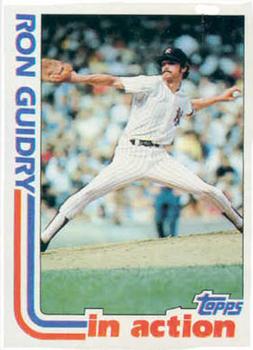
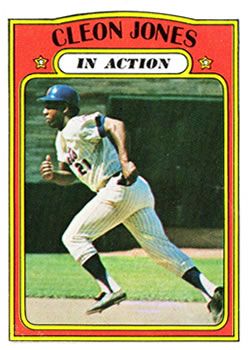
It's still Ron Guidry, just like Card #9.  Ten years after the concept debuted in 1972, Topps brought back the "In Action" subset.  In 1972, the idea was novel.  Before that time, nearly every Topps card was a posed photo, though a few action shots did appear from time to time for World Series subsets.  

Let's use the first "in action" card numerically from 1972 -- Cleon Jones -- to demonstrate:

Here's Cleon's base card:

Here's Cleon's "In Action" card:

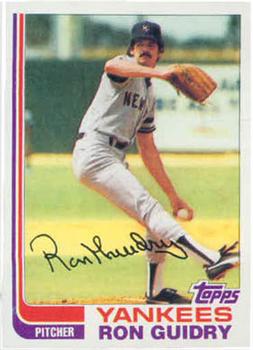
Now, if Topps in 1982 had gone with a portrait for the base cards for guys appearing "in action," it would have been a reasonably cool subset.  But, let me remind you of Guidry's base card:

In other words, this "In Action" shot adds nothing here.

Trivial Pursuit
Since we had the homespun Cajun Guidry story about his rabbit stew yesterday, let's today list some random facts about Guidry and his career:
  • The infamous George Brett "Pine Tar" game started on July 24, 1983 and ended on August 18, 1983.  Guidry played center field (and Don Mattingly played second base) for the final out in the top of the ninth inning on August 18.  His spot in the order came up in the bottom of the ninth, but Billy Martin sent Oscar Gamble up to hit for Guidry instead.
  • The Pine Tar Game was the second time that Martin had inserted Guidry into center field for an inning.  On September 28, 1979, in a meaningless game at the end of the season -- the Yankees were 14.5 games behind the Orioles and their opponents, the hapless expansion Blue Jays, were a whopping 50.5 game behind -- Martin put Guidry in for the ninth inning.
  • Guidry did not get to make a putout or even field a chance in either game.
  • As is the case for many teams, spring training is a time when the old-timers come out to the park and serve as "instructors" -- or at least interested observers.  It's not rare. But, when one great player serves effectively as a chauffeur, it can make for a good book -- such as this one: Driving Mr. Yogi: Yogi Berra, Ron Guidry, and Baseball's Greatest Gift.
A Few Moments With Tony L.
While Guidry was generally an excellent pitcher and was a Yankee to the bone, I can honestly say that I did not hate him in 1982.  This comes in large part from the fact that he did not pitch very well against the Brewers.  

In those days before the Rockies and Marlins joined the National League, baseball employed what it called a "balanced" schedule.  This meant that you played 13 games against the six teams in your division (78 games) and 12 games (84 total) against the seven teams in the other division.  So, you were almost as likely to have a rivalry against a team in the other division -- and trust me, Brewers v. White Sox and Brewers v. Twins games sometimes had a real edge...perhaps as a carry over from the NFL rivalries, but that edge between the fans was real and palpable.

Getting back to Guidry, the fact was that the Brewers faced Guidry just 26 times (24 starts) in his career.  This compares to the 25 times -- all starts -- that Guidry faced the Rangers and the 30 games -- again all starts -- that Guidry faced the Twins.  In addition, Guidry's record against the Brewers was not great:  10-8, 3.54 ERA overall.  

Add in the fact that Guidry pitched less in Milwaukee County Stadium than he did in any other stadium, and he pitched very poorly there:  1-3 record, 5.05 ERA.  In 7 starts and 2 relief appearances, Guidry threw 46-1/3 innings and gave up 57 hits -- 7 homers -- and 26 earned runs.  

Going back to yesterday's Hall of Fame discussion and looking at the park-specific statistics, it is pretty obvious that Guidry pitched to Yankee Stadium's dimensions -- with the huge outfield and deep power alley in left-center.  

While I am not saying that Guidry was a one-trick pony, I think a review of his stats give the picture that his career is not all that different than the ones enjoyed by hitters like Dante Bichette in Colorado: you cannot leave out the fact that Guidry's home park was extremely favorable to him and, therefore, you can discount his career statistics to an extent.  Add in the fact that he was never durable over his career -- which brought down his career numbers -- and you have a guy who was very, very good but not one of the all-time greats.