Has it really been a week since I posted? Travel, work, and other life events have conspired to limit me this month. I'll keep on it, though.
Who Can It Be Now?
Danny Kay Goodwin was born on September 2, 1953, in St. Louis, Missouri. His family moved to Oakland, California, for several years before returning to the Midwest to Peoria, Illinois.
In Peoria, Goodwin became a local legend while attending Peoria Central High School. The local legend came with a prodigious home run he hit during his senior year of high school, the story of which is told at Hardball Times. He lettered for four years in baseball and played varsity basketball as well. He was named to the all-conference baseball team three times. In his senior year in 1971, Goodwin was named to the Topps High School All-American team as its Catcher.
As it stood in 1971, the sort-of local Chicago White Sox had the first overall draft pick in the June Amateur Draft. They did not hesitate to select the Peoria product with their pick, turning down the opportunity to select Frank Tanana, Jim Rice, and Rick Rhoden (all first round picks) and, also, two of the best third-basemen ever to play the game -- George Brett and Mike Schmidt -- who were selected in the second round.
A funny thing happened, though, on the way to the big leagues for Goodwin: he turned down the money-- a less-than-impressive $60,000 (about $350,000 today) -- on offer from the White Sox. Goodwin, though, came from a well-educated family, as his father was an agricultural chemist with a master's degree who worked for the government and his mother was a grade school counselor. His family had instilled in him the value of a college education. As he told the AP in 1971, "The bonus is important, of course, but my parents and I also consider a college education very important. If I sign a professional contract, I'd like to make certain some arrangement can be made for a part-time educational program."
Whether it was a lack of money or a desire for an education, Goodwin turned down the White Sox. Instead, he enrolled at Southern University -- a historically black college in Baton Rouge, Louisiana -- without ever visiting the school before his first day of classes.
At Southern, he again was a star -- with a .394 AVG, 20 HR, and 166 RBI -- on his way to being named as the College Baseball Player of the Year for 1975 by The Sporting News. Surprisingly, Goodwin was never selected in any of the secondary drafts for players who had been drafted before, nor was he drafted after his junior year of college. He chose to keep himself ineligible for all of those drafts and stayed in school for all four years of his college eligibility.
Once he graduated, though, and on the heels of his stellar senior season, the California Angels made Goodwin the first overall pick of the 1975 June Amateur Draft. It seemed as though Goodwin could not miss, after all. The Angels assigned Goodwin to Double-A El Paso immediately after he signed, and Goodwin did well enough there to get a call-up to Anaheim before the end of the season. Even before he got to El Paso, however, he suffered a shoulder injury -- working his arm too hard in his first baseball in two months. This shoulder injury hampered Goodwin throughout his career.
Yet, though he made it to the majors for a cup of coffee in 1975, he would not surface again in the big leagues until 1977. Indeed, Goodwin would appear in just 63 games over three different seasons for the Angels, who realized that he had the throwing arm of a designated hitter and the bat of a backup catcher and never let him play the field.
As a result, the Angels made a difficult decision: to cut their losses and pawn Goodwin's untapped potential off on another team while trying to make a run at the World Series in 1979. As a result, Goodwin and Ron Jackson were traded to the Minnesota Twins in exchange for Dan Ford.
Goodwin's arm troubles sapped him of any hope of being a catcher, and his footwork and agility did not lend themselves to being a first baseman. So, he was a designated hitter who did not hit for power in his limited opportunities in the major leagues. Yes, in notorious hitters' ballparks -- like El Paso in 1978, when the 24-year-old Goodwin went back to Double-A and beat the hell out of pitchers who averaged being over a year younger than him (.360/.469/.637 in 449 plate appearances) with 25 HR and 89 RBI, or in Ogden in 1979 in Triple-A (.349/.434/.608 in 435 plate appearances; team numbers: .288/.371/.412) -- Goodwin still looked like a future superstar.
The reality was that Goodwin was a limited player without a position. His 1979 season with the Twins was his most productive as a major leaguer -- .289/.335/497 with 5 homers in 172 plate appearances. It was also the season in which he had his biggest opportunity to play, playing every day after July 20 for the Twins.
1980 was far less successful. Goodwin made the Twins out of Spring Training. On a team with Ron Jackson at first playing 131 games and with the surprise of 35-year-old Jose Morales hitting .303 in nearly 100 games, Goodwin's opportunities were limited to just 134 plate appearances. Goodwin did not seize on the opportunities he was given, either -- hitting just .200/.301/.270 with 1 HR in those trips to the plate.
And 1981 was not much better at the plate for him -- .225/.298/.318 in 169 plate appearances. Yes, he played a higher percentage of the Twins games, but all that earned him at the age of was his unconditional release from the Twins on November 27, 1981. By this point, the Twins had 21-year-old Kent Hrbek ready to play -- or at least ready for an opportunity to play -- and the team wanted to give their minor league youth a chance. That 1982 Twins team was bad, but it formed the basis for the 1987 World Series team (after adding HOF OF Kirby Puckett, of course).
Goodwin latched on with the Oakland A's for 57 plate appearances and 17 games in 1982, splitting time between Oakland and Triple-A Tacoma. He kept plugging away at Tacoma through 1985 and hit very well there. But all that proved was that he probably was a Quad-A player -- not good enough for the majors, too good for the minors. After a 1986 season in which he put up an unimpressive .231/.292/.414 in Japan for Nankai, Goodwin called it quits on his playing career.
Mustache Check: Goodwin is sporting one hell of an impressive mustache on this card.
Trivial Pursuit
It is low-hanging fruit, but Danny Goodwin still holds the distinction of being the only player to have been chosen twice with the first overall pick in the June Draft.
Orange You Smart
As I mentioned, Goodwin finished up his degree at Southern before he was drafted. In his post-baseball life, Goodwin has earned three master's degrees. He has a Master of Science in Project Management (Construction) from Southern Polytechnic State University in Marietta, Georgia, which he earned in 2001 (more on that later).
Then, from 2002 to 2005, while working for a construction management company, he earned his Master of Business Administration from Kennesaw State University's Michael J. Coles College of Business.
Finally, from 2009 to 2011, he earned his second Master of Science degree from SPSU, this time in Information Technology.
Nanu Nanu
This 1982 Topps card of Goodwin is his final appearance on a major release baseball card during his playing career. Oddly, despite being the #1 overall selection twice, he did not appear in the 1985 Topps "First Draft Pick" subset.
Of course, he appeared in the TCMA Tacoma sets for his time in Triple-A in 1982, 1983, 1984, and 1985. He also appeared in the 1986 Takara Nankai Hawks set while playing in Japan.
A Few Minutes with Tony L.
Danny Goodwin was not a player whose presence or lack of presence on the playing field was something I noticed back in 1982. I probably had no idea about the trivia bit about him either at that point.
Before he went back to school, Goodwin served as the Director of Community Relations and as President of the Atlanta Braves Foundation for all of the 1990s. He then worked for the City of Atlanta for a couple of years during the time he was in school at SPSU for the first time.
Now, it's entirely possible that I have met Danny Goodwin and not known him for being a former major league baseball player. Back in the early 2000s, the law firm at which I was working had lawyers teaching construction law to the project management students at SPSU. I was one of the lawyers who taught there, so I might have had him in the class.
Frankly, I couldn't tell you who any of those people were in the class, nor do I recall at this point whether we were teaching in 2001. I seem to recall that the timeframe was a bit later, but it's a little hazy right now. Also, I don't recall ever getting a class roster to use -- the more senior attorneys who graded papers and tests handled those. So, I might have taught Goodwin about some arcane issue in construction law, such as performance bonds or materialman's liens or bankruptcy. I don't know.
After Goodwin finished that first master's degree, he went to work for almost 3-1/2 years for a company called Boyken International, which has since been purchased by another company called Hill International. Boyken International provided construction management services as well as supporting construction claims. In my work with my second Atlanta law firm, we employed Boyken International to serve as our experts for a large series of cases relating to a particular project in Florida for approximately 10 years -- from 2002 through 2012.
I recall having meetings at Boyken with some of their experts as early as early 2005. Danny left there in August of 2005. So, I might have met him then too.
These days, Danny has his own company called First Choice Management Services, LLC. It appears to be a catch-all type company for him -- it provides construction and claims analysis, community relations services, non-profit and fundraising assistance, information technology services, and small business marketing and finance.
Those sound like the types of areas in which Danny Goodwin has master's degrees.
Perhaps I need to meet him soon. I do have a couple of LinkedIn contacts who are connected to Danny...
Who Can It Be Now?
Bradley David Havens was born on November 17, 1959 (according to Baseball Reference; The Baseball Cube says Havens was born 11/17/1958), in Highland Park, Michigan. He grew up in the Detroit area and played baseball for Kimball High School in Royal Oak, Michigan.
According to an unsourced but incredibly detailed blog post about Havens, Havens "watched the Detroit Tigers play at Tiger Stadium hundreds, if not thousands[,] of times as a child and teen." Not to pick nits, but the top-end of that math is probably off. Even if Havens watched every single game at Tiger Stadium from the day he was born until the end of the 1977 season, he would have topped out at 1458 games (and that doesn't try to take into account the few games that were cancelled for strikes in the early 1970s or rainouts that were never made up). But hyperbole is a better story.
Anyway, that website is probably correct in saying that Havens was an All-State pitcher in Michigan in 1977 as a senior. That was the year that Havens was selected in the 8th Round of the June Amateur Draft by the California Angels.
Havens did not play minor league baseball until 1978, however. It's unclear why he did not play in 1977 -- probably because he signed too late, if I were guessing -- but the Angels sent him to Single-A Quad Cities in the Midwest League, a full-season league, for his professional debut in 1978. At Quad Cities, he pitched well -- 200 innings, 171 hits allowed, a 2.66 ERA (based on 59 earned runs...though he gave up a total of 80 runs), 74 BB, 197 Ks -- all good, solid numbers for a kid fresh out of high school. Maybe the 200 innings was a bit much, but there's no indication that it caused any arm problems.
Before the 1979 season, however, Havens left the Angels organization. He was one of the pieces sent to Minnesota (along with catcher Dave Engle, pitcher Paul Hartzell, and OF Ken Landreaux) in exchange for eventual Hall of Famer Rod Carew. The Twins had tried to force the Angels into trading them Carney Lansford, but the Angels refused to include Lansford after his 1978 season.
In the Twins organization in 1979, Havens split time between Single-A Wisconsin Rapids and Double-A Orlando. He got lit up like a Roman candle in Orlando -- 7.28 ERA, 128 hits allowed in 94 innings, 50 walks against 63 strikeouts -- so the Twins sent him back to the Single-A California League with Visalia in 1980. Frankly, assuming that he was born in 1959, he had plenty of time even at that point -- he was still nearly 2 years younger than his competition in Visalia. There, he put up a good record of 14-9 and a 3.32 ERA (but 18 unearned runs) in 195 innings. His walks went back down and his strikeouts went back up, which is what you would expect for a good pitching prospect.
In 1981, Havens started the year in Double-A Orlando. He pitched pretty well -- 3.53 ERA in 74 innings (with 9 unearned runs) and with good walk and strikeout ratios. He was called up to the major leagues on June 5, 1981 for his major league debut. It had to be an intimidating experience -- he debuted by pitching a half an hour from where he grew up, against the Detroit Tigers -- his childhood team. He was facing the Tigers ace, Jack Morris, on top of everything else.
Yet, he was not overawed -- despite being credited with the loss, he only gave up two hits, though one of them was a solo homerun to shortstop Alan Trammell. The news story about the game mentioned that he was "obviously pumped up at the prospect of pitching before a Polish Night crowd of 23,133. . . ." I mean, those crazy Poles...but, more saliently, he showered and left the stadium before the game ended with his father. Havens pitched one more game -- another loss to Detroit, this time in Minnesota -- before the strike shut down work for a couple of months.
When play resumed Havens pitched creditably -- getting his ERA as low as 2.74 by September 20 before getting rocked his last three starts of the season to finish with a 3-6 record, a 3.58 ERA in 78 innings with 24 walks allowed (with 6 of those in his final two starts) and 43 strikeouts. This performance gained him a point in the rookie of the year voting -- good enough to tie him with his teammate Gary Ward for 9th overall in the voting -- but far behind winner Dave Righetti.
Thus, at the age of 22 in 1982, Havens skipped over Triple-A and pitched the entire year in Minnesota. He did okay -- a 10-14 record for a team that finished 60-102 and with a 4.31 ERA for a team that finished with a 4.72 team ERA isn't a bad result.
Theoretically, then, he came into the 1983 season as the putative ace of a staff that was led in 1982 by the now-recently deceased Bobby Castillo. Indeed, Havens was the Opening Day starter for the Twins in 1983 -- once again pitching against the Detroit Tigers. To say things went poorly for Havens in 1983 is akin to saying that things went poorly for Custer at Little Big Horn.
The first start was a disaster. The Tigers sent 10 men to the plate in the first inning, though it could have been worse in that the inning ended when Tom Brookens was thrown out in a rundown at third bases to end the inning. He made it into the second inning, and was yanked after getting just four outs. TV announcer Pat Hughes -- who later joined the Milwaukee Brewers as Bob Uecker's straight man/color commentator -- was calling his first game of his career at the age of 27. He misremembered the game story, but the story he tells is nonetheless wonderful gallows humor from Twins manager Billy Gardner:
My major league debut was opening day, Twins-Tigers, April 1983, at the Metrodome. I'm twenty-seven, doing TV, excited till Detroit scores six runs in the first, young starter Brad Havens giving up a three-run homer to Larry Herndon to the football press box in right-centerfield. Later, I'm having a beer in the press lounge when Twins skipper Billy Gardner sits down and starts sipping. I say, "Havens left after only two-thirds of an inning. One good thing, Billy, is that he threw only thirty pitches. You could probably bring him back in a couple of days to pitch again." He took a sip, smiled, and said: "You're right, I could." Pause. "But why in the world would I want to?"
By the time the Twins finally sent Havens to Triple-A, he had racked up 80-1/3 innings in which he gave up 110 hits, 11 homeruns, 38 walks (against 40 strikeouts) and 73 earned runs for a massive 8.18 ERA. His 8 earned-run season debut didn't help matters, but it was not an isolated incident -- he allowed four or more earned runs in 11 of his 16 appearances.
In many regardings, 1983 exposed Havens for being the limited Quad-A pitcher that he turned out to be. It also started a four-year series of moves in which he changed teams 4 different times by being released three times and being traded twice. The Twins tired of Havens's ineffectiveness and sent him to the Baltimore Orioles at the end of spring training in 1985 in exchange for pitcher Mark Brown. Havens spent his final full season in the majors with the Orioles in 1986. Otherwise, he shuttled back and forth to Triple-A, the very definition of a replacement level pitcher.
In 1987, Havens was shipped out to Los Angeles with John Shelby as part of the Dodgers dumping Tom Niedenfuer for giving up a homer to Ozzie Smith. At first, things went reasonably well. But, by 1988, Havens was the butt of Tommy Lasorda's jokes. Lasorda left Fernando Valenzuela in a game in mid-April for 151 pitches. The Bill Plaschke story from the LA Times (no word on whether Plaschke was wearing argyle) had the following exchange:
When asked if he had to leave Valenzuela in [the game], Dodger Manager Tom Lasorda said: "Absolutely. Who should have I brought in? [Brad] Havens?"
File that one under, "call your agent immediately." The Dodgers designated Havens for assignment a few weeks later. Havens rejected the trip back to Albuquerque and was released on May 13, 1988.
Being left handed, though, Havens was able to catch on with the Cleveland Indians. He pitched in 28 games there in 1988 and 7 games in 1989 before the Indians released him -- once again on May 13, but this time in 1989. Despite lackluster results, Havens got yet another chance.
This final chance was with his hometown Tigers. They saw 13 games and 22-2/3 innings of work and decided that they, too, could live without the cosmic stylings of Brad Havens, and they released him at the end of the season. This time, however, enough VHS videotape of Havens getting taken deep by people had worked its way around the league, and he did not get another chance.
Mustache Check: I'm not sure that the 21-year-old blond Havens physically could grow a mustache at the time this photo was taken. So no mustache.
Trivial Pursuit
If I thought Steve Henderson was bereft of interesting side information, I had no idea of what was in store with Havens. So, here's what I got: Havens was pitching (for Detroit, not for Pittsburgh, ESPN) on July 23, 1989 when he gave up a walk-off hit-by-pitch against the California Angels. It took until April 12, 2014, for the Angels to win again on a walk-off hit-by-pitch.
Seriously, that's it.
A Few Minutes with Tony L.
Facing Havens in the 1980s was not a difficult thing for batters. Opponents hit .272/.341/.438 against Havens over the course of his career. That's not very good when you are looking at league averages roughly around .263/.324/.400 for the AL and, for his two NL season, around .255/.320/.380. He actually did slightly better against Milwaukee than his career numbers would suggest, but I don't remember him for that.
Other websites have tried to find Havens. For example, the Minneapolis Star-Tribune tried, and the best they came up with was that Havens has returned home to suburban Detroit and that his name is tied to two companies -- Brad Havens Baseball Clinics, Inc. and Major League Gutters & Windows. From what I could tell, that first company is no longer an active corporation, having been dissolved by the Michigan Secretary of State's office for the failure to pay the annual registration fees.
What I have been able to discern is that Havens has for some time now been serving as an assistant coach at the high schools back home in Royal Oak, Michigan. For example, Coach Joel Hoover at this website references that he was instructed by Havens when Hoover was still 17 years old and at least 17 years ago. That would be about the right timing for Hoover's retirement from major league baseball after playing in Detroit.
The other, even clearer context clue is from a story that I cannot access but which has a short excerpt saved at Topix.com. The Daily Press & Argus from Novi, Michigan, had a story on June 5 with a photo of "Brighton assistant coach" Brad Havens having pitched 8 years in the majors. Havens does not appear by name on any of the Brighton High School baseball photos, but I have to think that that is him. There are enough references from the archives on Google from that newspaper to make me fairly certain about that.
I just don't care enough to pay any money to get to the Novi, Michigan, newspaper articles.
Who Can It Be Now?
Richard Michael Sofield was born December 16, 1956, in Cheyenne, Wyoming. By the time Sofield was in high school, though, he was living in Morristown, New Jersey -- more on that later. He graduated from Morristown High School, and was the Minnesota Twins #1 pick in the June 1975 draft.
That first round was not a demonstration in good scouting, though -- the best player by career wins above replacement in that round was Rick Cerone, who had 8.1. Five catchers were selected, and Sofield was one of four shortstops. I throw stones at the scouting there because teams could have selected Lee Smith (round 2), Carney Lansford (round 3), Don Robinson (round 3), Jason Thompson (round 4), or the guy on Card #39, Lou Whitaker (round 5).
Sofield really had only one good minor league season -- the 1977 season at Single-A Viasalia in the California League in which he hit 27 homers, drove in 107 runs, stole 10 bases, and had a slash line of .328/.421/.623. Over 1978 and 1979, though, the Twins kept moving Sofield back and forth between Triple-A Toledo and Double-A Orlando -- mainly because his performance in Triple-A was not very good.
Despite not really ever mastering Triple-A, he made the Twins directly out of spring training in 1979. He struggled initially and was sent to the minor leagues in mid-May. He even found himself back in Double-A for a while before a September call-up. During that call-up, he had a hot 13 games -- going 14-35 (.400 BA) with 5 walks (.475 OBP) and 4 doubles (.514 SLG). His strong finish to the season in a bunch of meaningless games brought his overall numbers for the year up quickly to what looked like a breakout -- a .301 batting average, after all, looks good even if it was in only 93 at-bats.
Coming into 1980, then, the Twins were convinced that their 23-year-old former first round pick would be one of their starting outfielders. Gene Mauch plugged Sofield into the lineup 131 times in all three outfield positions. The results were underwhelming -- only a .287 OBP and a .374 SLG. Together, these numbers put Sofield squarely at 75% of the league average for OPS -- not exactly what you are looking for from a corner outfielder.
If 1980 was underwhelming, then 1981 was a disaster for Sofield. He had to go 3-for-6 in his final game of the season to raise his batting average twenty points to finish at .176. He spent time back in Triple-A Toledo, and didn't hit there either -- just .208/.329/.278 in 22 games with 20 total bases in that time.
1982 was no better; indeed, Sofield never got the opportunity to hang his jersey in a major league clubhouse again as a player after 1981. Sofield struggled at Triple-A Toledo in 1982, and the Twins gave up on him. He had a 15-game cameo in Denver with the Texas Rangers Triple-A team, but, discouraged, Sofield left baseball as a player in 1982.
Nanu Nanu
You are looking at Sofield's one and only card for 1982 -- neither Donruss nor Fleer deemed Sofield worthy of treatment on cardboard for the 1982 season. He did appear in the TCMA Toledo Mud Hens team set, though. But, Card #42 was Sofield's last Topps card appearance. The only appearance on a card for Sofield since 1982 was on a 2001 minor-league card on which Sofield appeared as the manager of the Las Vegas 51s.
I Ran (So Far Away)
I needed a category name for something that Sofield did in his career, and this song by A Flock of Seagulls -- which, quite honestly, is one of my favorite new-wave songs of the 1980s -- is as good a title as any for it. "It" is changing sports to try another one.
Sofield left baseball after 1982. He recognized that his career was not going in the right direction and that he likely would not make the major leagues again. So, at the age of 25, he enrolled at the University of South Carolina to play football. As an All-State quarterback in the state of New Jersey, Sofield had been recruited by the University of Michigan directly out of high school. He chose baseball instead.
He was not the first guy to do this, and later Heisman Trophy winner Chris Weinke proved that Sofield would not be the last guy to do it.
Unfortunately for Sofield, after going through spring practice and summer drills in 1983 with the Gamecocks, he was ruled ineligible by the NCAA because he had enrolled briefly at the University of Minnesota during his baseball career to take a few classes. So, since he was at South Carolina already, he completed his degree and, at the same time, served as an assistant baseball coach.
A Few Minutes with Tony L.
Rick Sofield made no impression on my 10-year-old brain in 1982, or in any other year quite honestly. That's not to say that Sofield hasn't had an eventful career and life.
Let's go back to his high school days for a moment. Pretend that you are a good student and great baseball player, and your coach sends you and two teammates to a sporting goods store on a Monday at lunch time to get some bats for the team. Now, that probably wouldn't happen today, but in the 1970s, you could buy baseball bats at the hardware store -- so stick with me here.
You get back to your high school and you see absolute chaos on campus -- your fellow students are carrying two-by-fours and balusters from nearby porches of houses next to the school and you see some of your friends leaving the school with blood streaming down their faces.
That's exactly the scenario that Rick Sofield walked into in the May of his junior year of high school. Morristown High School in Morristown, New Jersey, was in the midst of a race riot. Sofield and his black teammate Sonny Holt fought their way upstream to their coach's office and were told that a race riot was in progress. and that they should, "Get the hell out of here!" They did.
The riots started, according to police records, when some white teens hassled some younger black children at a church carnival on a Thursday evening. Fighting involving both groups continued over the weekend so that, when school opened on Monday, tensions were high and, as the news story linked above puts it, "many students had scores to settle."
Eventually, Sofield and his baseball and football teammates brought the city back together by winning -- both were #1 in New Jersey that year. Sofield himself in 2009 challenged the idea that these fights were even race riots:
I never saw a racial element at the high school. That's part of what made us so intimidating. We won the state championship in football alter that year, and we were ranked No. 1 in baseball, too. And it was basically the same guys on both teams, black and white. Could we have won if we fought amongst ourselves? That's why people feared us. They would come to our school and get dressed in the locker rooms and they were scared to walk the walls. They thought they were in Harlem. We found it funny.
Since his career as a player, Sofield stayed in baseball as a coach and manager both at the college level with South Carolina and, later, as the first coach in the history of the University of South Carolina at Beaufort (pronounced "Byoo-fort"), and in the professional ranks with the Rockies and Pirates organizations. His life-long friendship with Clint Hurdle led to Sofield being named as the first base coach for the Pittsburgh Pirates -- a position he still holds today.
Who Can it Be Now?
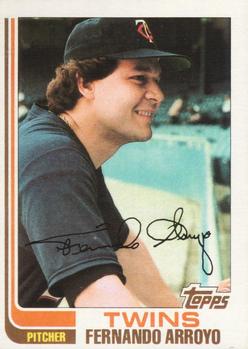
Fernando Arroyo was born March 21, 1952 in Sacramento, California. The Detroit Tigers drafted him straight out of Luther Burbank High School in Sacramento in the 10th Round of the 1970 June Draft. Without a doubt, he was the second best player drafted in that round, as the Reds picked Ray Knight 6 picks earlier.
Arroyo signed with Detroit and began working his way through the Tiger Minor League system. He spent 2 years at AA and a full season at AAA in 1974 before appearing in 14 games in 1975 with Detroit. 1976 and 1977 were atypical -- he spent the entire year in AAA in 1976 and the entire year in the majors in 1977.
Otherwise, Arroyo was one of those guys who was the first to get sent down when a roster spot was needed for someone but also of being the first guy called up when someone went down. In other words, Arroyo was essentially a replacement level player -- never good enough to stick for good in the major but never bad enough -- before 1982 -- to get cut.
Arroyo was traded in December of 1979 to the Minnesota Twins. He kept up his yo-yo act between AAA and the majors for a couple of seasons, and then spent the entirety of 1981 on the major league roster -- one can speculate that the 1981 players' strike cost the Twins the opportunity to send Arroyo back down to AAA again.
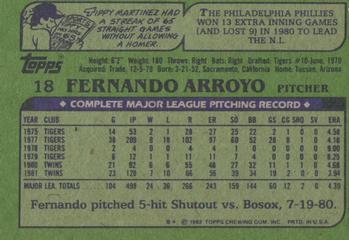
1982 was the last time that Arroyo appeared on a baseball card as a player. Oddly enough, he appears twice in the 1982 Topps set -- on this card and then again on the "Team Leaders" checklist for his 3.94 ERA in 1981...a fact which pretty much underlines the absurdity of that concept.
Arroyo's big problem is that he was an extreme soft tosser. In his career, he only walked 2.7 batters per nine innings -- that's not too bad. On the flip side, he only struck out 2.9 batters per nine innings. That's awful. He also gave up nearly 10 hits per nine innings as well. Pitchers do not have long or successful careers when they can't strike guys out.
Don't You Want Me?
We've seen the "Everybody Wants You" tag used before for a player who was traded for during 1982. Here's the flip side -- a player whose team (or multiple teams) cut him during 1982.
After looking at the transaction log, perhaps I should rename this category Fernando after Arroyo and that 1976 Abba song. 1982 was a tough year to be Fernando Arroyo in terms of remaining employed. After pitching just 13-2/3 innings during the first six weeks of the season (at a 5.25 ERA, mind you) -- well, to be fair, all of the innings were before April 22 -- the Twins decided that they no longer needed their returning ERA leader and released him on May 18.
A week later, Arroyo signed with the Oakland Athletics. They put Arroyo on the mound for 4 appearances in AAA Tacoma and in Oakland for 22-1/3 innings. In those 22-1/3 innings, Arroyo posted a 5.24 ERA. That apparently was not what Oakland had in mind when they signed him, so they release him on July 27 -- about two months later.
Perhaps needing someone to fill out a staff in AAA, the Chicago White Sox signed Arroyo and had him pitch in AAA Edmonton for the rest of the year. Arroyo pitched for the Sox's AAA affiliate again the next two years -- this time in Denver. Before the 1984 season, the Sox cut him, resigned him, and then let him move to Mexico to pitch for the Yucatan Leones.
Arroyo's final appearance in the majors was his only one after 1982 -- and it came in a mid-August game in 1986. He came in, faced three batters, and walked all three of them. That was the end for him.
He went on to be a pitching coach in the minors for Detroit, Florida, and Oakland and even went along with Jerry Royster for two seasons of being a pitching coach in the Taiwan Major League. As with many major league baseball players, he eventually was inducted into his local baseball Hall of Fame in 2013.
A Few Minutes with Tony L.
I probably could not have picked Fernando Arroyo out of a police lineup in 1982. Or today, for that matter. He only faced the Brewers one time in 1982, pitching 2 innings for Oakland. For his career, Milwaukee teed off on him (as they did to a lot of pitchers in the late 1970s and early 1980s), hitting .296/.330/.495 with 9 homers in 201 plate appearances.
One of the interesting (to me) things that this blog is allowing me to do is find out what the players have done with their post-major-league/post-1982-Topps lives. Some players are more interesting than others, obviously; I mean, Steve Carlton being certifiably crazy is a great story. Arroyo's life appears to have been pretty mundane by comparison -- I mean, being a pitching coach in Taiwan (without any demonstrated or claimed Chinese language skills) is pretty cool, but it's not like there are any stories about anything crazy happening to Arroyo over there.
So, all I've got is this: Arroyo is now the President and CEO of ARMTRAK LLC in Vero Beach, Florida, according to his LinkedIn page. Armtrack is a product that Arroyo invented to help pitchers to avoid arm injuries and develop the proper throwing motion. Hopefully it works and is successful.
Good luck, Mr. Arroyo -- and tell us some stories about Taiwan!