Programming Note: Yes, I'm back. Finally. Here's the thing, though -- life has gotten incredibly busy for me. So much so that I do not have the time to write up the big career stories that I was writing. Instead, going forward, the posts will look more like this one -- a much shorter "Who Can It Be Now?" along with whatever category posts I have and maybe a paragraph wrap-up with my thoughts.
Who Can It Be Now? William Hayward Wilson -- Mookie -- was born on February 9, 1956, in Bamberg, South Carolina. He became a South Carolina Gamecock eventually, spending his junior year in Columbia. His junior year was good enough to make him the Mets second round pick (42nd overall) in 1977. If you know one thing about Mookie Wilson's career, you know that he was the guy who tapped the dribbler in the tenth inning of Game 6 of the 1986 World Series -- the dribbler that went through Bill Buckner's legs and scored the winning run. Wilson was one of only a few holdovers on that '86 team from the early 1980s Mets -- most of which were not very good teams. Mookie spent parts of ten seasons in Flushing, and, indeed, stands 15th at present in career wins above replacement among all New York Mets players -- just behind Howard Johnson and just ahead of David Cone's Mets years. After he left the Mets, he finished his career off with three seasons in Toronto. His career came to a close after the 1991 American League Championship Series in which the Jays lost to the eventual World Series Champions, the Minnesota Twins. Mustache Check: Mookie is definitely whiskered. Family Ties In a convoluted and potentially uncomfortable family tie, Mookie's stepson is former major leaguer Preston Wilson. Mookie is also Preston's uncle, because Preston's natural father was Mookie's brother Robert. Mookie also had two other brothers who played minor league baseball. Younger brother John Wilson was the Mets 17th round pick in the 1982 January Draft -- which pretty much guarantees that John was not regarded highly despite impressive speed in the minor leagues. The youngest of the three Wilson brothers to play professionally was Phil Wilson, who was a fifth round pick of the Minnesota Twins in 1984. Phil had trouble making enough contact to get past Triple-A. Freeze-Frame Mookie Wilson parlayed his fame in the 1986 World Series into a TV appearance. He joined Keith Hernandez, Mark Ingram (the Dolphins and Giants WR who fathered the running back who attended Alabama), Sean Landeta, Pee-wee Herman, Jeremy Irons, Madeline Kahn, Itzhak Perlman, Paul Simon, and Rhea Perlman, among others, in singing "Put Down the Duckie" in a 1988 "All-Star Musical Special" of the same name for Sesame Street.
The World According to Garp In April of last year, Mookie released a book called "Mookie: Life, Baseball, and the '86 Mets." If you are a Mets fan, or if you like good baseball books, this may be one to pick up. The book has been reviewed 21 times on Amazon, and it has received 17 5-star reviews and 4 4-star reviews. A Few Minutes With Tony L. Mookie's distinctive nickname made him well-known to all fans of baseball in the 1980s. A number of the reviews of his book mention how much Mookie loved baseball -- playing the game and being around it. It should come as no surprise, then, that he has spent a great deal of his post-playing career as a coach for his New York Mets. He was unhappy to be named as a club ambassador last spring, however, because it was a role he received after being pushed out of his on-field role. Indeed, this link has excerpts from his book in which he said that he had "basically become a hood ornament for the Mets" after his demotion from being an on-field staff member in 2011.
Who Can It Be Now? Edward Francis Lynch (whose Baseball Reference website address is an unfortunate "lynched01.shtml") was born on February 25, 1956 in Brooklyn, New York to parents who soon after his birth moved to Miami, Florida. Lynch spent his formative years in Miami, attending Christopher Columbus High School there (other major leaguers to attend that school: Orestes Destrade, Jorge Fabregas, Izzy Molina, Rob Murphy, and Jon Jay). Lynch was not drafted out of high school. He earned a scholarship from the University of South Carolina in basketball, playing forward on the reserve team. Based entirely on individual testimonials about Lynch on the Ultimate Mets website, it appears that his nickname at USC(east) (as we trolls in the SEC World call Gamecock U.) was "Bus." Bus earned his way in athletics by being a pitcher at USC(e). Despite his 6'6" frame, Lynch was not a power pitcher and as a result was not drafted until the 9th pick of the 22nd round of the 1977 June Draft. Lynch signed shortly after being drafted, and he was assigned to the Gulf Coast League in 1977. He pitched decently in his 13 appearances (6 starts), leading the Rangers to move him up in 1978 first to Asheville in the Western Carolinas League. He pitched far better in Asheville than in Florida, leading the Rangers to promote him to Tulsa in the Texas League. It was in Tulsa where he really opened eyes, albeit in a 7-start stint. In 54 innings in a league with a league ERA of 4.22, Lynch went 4-3 with a 2.67 ERA (with the caveat that 9 of his 25 runs allowed were unearned). He walked just 14 batters and struck out 44 to give him his highest ever K/9. All of these numbers were better than the league averages, leading the Rangers to promote Lynch to Tucson in the PCL -- another notorious hitters' paradise. Lynch did not fare as well on pure numbers, but in comparison to league averages, he was solid. Yet, the Rangers chose instead to send Lynch to the New York Mets as the player-to-be-named-later in exchange for 38 games of Willie Montanez in 1979. For the 1980 season, the Mets kept Lynch at Tidewater in the International League. Lynch responded well, putting up probably his best minor-league season -- 13-6 record and 3.15 ERA (12 unearned runs out of 69 allowed) with 91 Ks and 42 BB in 163 innings. That year earned Lynch a call-up at the end of August in 1980 -- a debut which included his first major league start -- and win -- against the Chicago Cubs, a team that would figure prominently in his career. Lynch split the 1981 season between Triple-A Tidewater and Shea Stadium. He started 13 games for the Mets and 15 games for the Tides. It may be my supposition, but I am guessing that the Mets sent Lynch to Triple-A prior to the strike to keep him pitching and keep him on track for his development. Lynch pitched better (and luckier) for the Mets after the strike (2.38 ERA; .204 BA against) than before the strike (3.95 ERA; .339 BA against). 1982 was Lynch's first Topps card and his first complete season as a major leaguer. He served in a swingman's role during that season -- starting 12 games, finishing 11, and saving 2 with a 4-8 record. His career with the Mets followed a bit of an odd progression from 1982 through 1985. In both of the even years (1982 and 1984), Lynch was a swingman and relieved more than he started. In the odd years (1983 and 1985), Lynch was a member of the rotation for the most part -- relieving in just 5 games over the course of those two seasons combined. When 1986 rolled around, everyone in New York felt that the Mets were going to have a special season. Having missed out on the NL East title in 1985 to the St. Louis Cardinals by three games and with a starting rotation of Gooden, Darling, Ojeda, Fernandez, and Aguilera all bringing heat, it was easy to see why people had that feeling. Lynch pitched just one game during that season for the Mets -- on April 12. Shortly thereafter, he was placed on the 21-day disabled list with damaged cartilage in his left knee and underwent surgery to repair the knee. By the time he was healthy again, he was a member of the Chicago Cubs. He found himself the odd-man-out of the Mets bullpen and rotation, and the Mets decided they wanted two minor leaguers more than they wanted to figure out who would have to be sent down or released to make room for Lynch. The move broke Lynch's heart. He was quoted as saying, "it was like living with a family all year, then getting kicked out on Christmas Eve." At least, according to some sources, the family that kicked him out still sent him gifts: the Mets voted Lynch a full World Series share despite his pitching just one game. Lynch's pitching career in Chicago lasted only through 1987. Lynch tried to catch on in spring training in 1988 with the Boston Red Sox -- a tryout marked by an absolute moonshot getting hit off him by Kent Hrbek, apparently -- but he did not make the team. He ended up signing with the independent Miami Marlins in the Florida State League, where he pitched well enough to get a look in Triple-A from the Giants. He did not get called up, however, and 1988 was the end of his active playing career. Mustache Check: Ed's face is as smooth as a baby's bottom. Cleaner, though. Orange You Smart After his playing career was over, Lynch attended law school at the University of Miami. He completed his law degree, but he never practiced law. Instead, he was hired by Joe McIlvaine in 1992 to serve as the Padres director of player development. A Few Minutes with Tony L. I think most people know Ed Lynch today more for being the general manager of the Chicago Cubs from October of 1994 to midway through the 2000 season. Lynch became the GM in Chicago on the same day that current Brewers GM Doug Melvin got the Rangers' GM position. Unlike Melvin, however, Lynch never has received another opportunity to be a GM. So, I posit this question: should Lynch have gotten another chance? Looking solely at wins and losses during Lynch's time as GM, the Cubs made it to the playoffs just once -- as the wild card in 1998. The Cubs had finished 12.5 games behind the division winning Houston Astros and 1 game ahead of Wild Card runner up San Francisco (thanks to beating the Giants in a 1-game play-in game). The Cubs had to face an Atlanta Braves team that finished 106-56 and which sported a team ERA nearly a full 1.25 lower than that enjoyed by the Cubs. Add in the fact that the Braves' team OPS was 24 point higher -- effectively equal -- and the outcome of a Braves sweep looks about right. Other than that season, the Cubs under Lynch finished 73-71 (1995 strike-shortened season), 76-86, 68-94, 67-95, and 39-53 (as of the date Lynch was fired). That 90-win season -- which, by the Pythagorean Win-Loss method, overshot the Cubs expected result based on runs scored and allowed by 5 wins -- was a bit flukish. Outside of wins and losses, what important roster moves did Lynch make? 1994-1995 offseason: Traded a minor leaguer and a pitcher named Derek Wallace to the Royals for Brian McRae. McRae played in two-and-a-half seasons for the Cubs, patrolling center field and hitting reasonably well. Definite WIN for Lynch. 1995 season: - cut Glenallen Hill out of spring training. Hill signed with the Giants and hit 24 HR in 1995. BAD move. Also signed Howard Johnson off the scrap heap. Hojo hit .211 with 10 HR in Colorado the previous year. 206 AB that could have gone somewhere else. BAD - traded two minor leaguers and Mike Morgan to St. Louis for Todd Zeile. Zeile left after the 1995 season in free agency. PUSH - traded catcher Rick Wilkins to the Astros for catcher Scott Servais and OF Luis Gonzalez. Gonzalez hit 22 HR in 223 games for the Cubs at the ages of 27 and 28, making his 57 HR output in 2001 at age 33 look a little off. Servais stayed a cub through 1998. The fact that Servais became the Cubs starting catcher is a minor WIN for Lynch. But, why not make a move to build the farm system? 1995-1996 offseason & 1996 season Other than screwing around on the fringes of the roster with guys like Jaime Navarro, Dave Magadan, Felix Fermin, and Tanyon Sturtze, Lynch did nothing important with the roster other than getting Ryne Sandberg to come back and play. 1996-1997 offseason & 1997 season - August 8, 1997: traded Brian McRae, Mel Rojas, and Turk Wendell to the Mets for Lance Johnson, Mark Clark, and Manny Alexander. Not a great trade for Lynch. McRae was nearly done due to injuries, and Rojas was a shadow of his former self, but Lance Johnson was an older version of McRae if you took away McRae's ability to hit for power. That is not to mention the fact that Wendell stayed with the Mets as an effective reliever from 1997 through 2001. LOSS for Lynch. 1997-1998 offseason & 1998 season - Traded Doug Glanville to the Phillies for Mickey Morandini on 12/23/97. Pretty much a LOSS even though Morandini played well during the 1998 fluke season -- .380 OBP good, .385 SLG not so good. Glanville had several - got Mike Morgan back for the stretch drive from the Twins in exchange for minor league P Scott Downs. Morgan posted a 7.15 ERA (8.96 FIP) in 22-2/3 innings for the Cubs down that "stretch." 1998-1999 offseason & 1999 season - Traded OF Brant Brown to the Pirates for Jon Lieber. WIN, due to a 20-win season in 2001 for Lieber. - Traded minor league P Kyle Lohse and P Jason Ryan to the Twins for the skeletal remains of Rick Aguilera's career and Scott Downs. It's tough to call this anything more than a PUSH. If you view the trade as Ryan for Aguilera and Lohse for Downs, well, Downs was closer to the majors by two years than Lohse. Of course, this trade wouldn't have had to be made if not for trading Downs away for Mike Morgan a few months earlier. - traded Jose Hernandez and Terry Mulholland to the Braves on July 31 for Joey Nation, Micah Bowie, and Ruben Quevedo. LOSS, even as a dump trade. Bowie got 11 starts to put up a 9.96 ERA, Nation made two starts in 2000 with a 6.94 ERA, and Quevedo made 21 appearances in 200 with an airliner ERA -- 7.47. Wow. Terrible scouting, Cubs. - signed catcher Joe Girardi as a free agent on a three-year deal. LOSS. Girardi was an All-Star in 2000 inexplicably, but giving a three-year, $5.5 million contract to a 35-year-old catcher is just plain dumb. TOTALLING IT UP A lot of these trades taken in a vacuum look decent. As one correspondent wrote to Baseball Prospectus back in 2000:
I think people are missing the point about Ed Lynch's failure as Cubs GM, which is a complicated thing. First, when you evaluate Lynch's moves one by one, it's actually a really good picture. In the vast majority of his deals, you can say that he got a good return. As for Matt Karchner for Jon Garland and signing Joe Girardi to a three-year contract, sure, those were serious blunders, but how many GMs can you name who don't have similar blemishes on their records.
Still, Lynch was a bad GM, but it really boils down to "the vision thing." Sure, he was able to turn Brant Brown into Jon Lieber, but he never seemed to make moves with any sort of coherent plan, either in the short term or the long term.
Isn't that the biggest problem for GMs in any respect? In any case, Lynch has never gotten another opportunity to show he could have done better and now, at the age of 58, it seems unlikely he will ever get another chance. At least he didn't decide to practice law.
Who Can It Be Now? Robert Michael Bailor was born on July 10, 1951 in Connellsville, Pennsylvania. (The excellent SABR Biography about Bailor and the Earl McRae biography from the Montreal Gazette provides the background information here.) Bailor was born to a third-generation Polish immigrant family whose name was changed from Bialkowski to Bailor. Bob's father, also named Bob, was a train engineer for his entire life -- completing a three-generation family tradition of working for the railroad companies in Connellsville. Connellsville was also the hometown of Notre Dame and Chicago Bears football legend Johnny Lujack, and that fact gave town kids hope that a Polish kid with athletic talent could get out of the Southeastern Pennsylvania mountains and make something of himself. Bob Jr. was brought up by his family with a baseball bat and glove in hand. He learned to hunt and fish at an early age as well. Bailor's father told the story in 1977 of how little Buzz (as he was called in Connellsville) loved baseball so much that he wanted to play catch in the snow with his dad. Bob's dad's words oozed parental pride from the pages of the Montreal Gazette profile: "Y'see, this is the first time it's happened to a baseball player. We've had our football stars, Jim Braxton and Bo Scott? Right from Connellsville. But this is the first time a baseball player has gone from Connellsville to the majors. Why, the old ball patches are going to be crawlin' with kids this spring." Bailor starred in basketball for his hometown Geibel High School, and he played baseball for American Legion teams in the area during that time as well. That's right -- he did not play high school baseball because his school did not have a team. After he graduated high school in 1969 and to avoid going to Vietnam due to his low draft number, Bailor enrolled at California State College near Pittsburgh and, not having been drafted by baseball with the same vigor as Uncle Sam's draft (that would be, at all), Bailor resigned himself to a life without baseball as an occupation. But, his American Legion manager, August Herman Welsh, arranged for him to play on a tournament team for a tournament that Welsh knew would draw a Baltimore Orioles scout. Welsh's friend was the scout, and Welsh hoped that Bailor would impress the scout enough to get a contract. That's exactly what happened, and Bailor signed with the Orioles as an undrafted free agent. After signing, Bailor slowly and steadily rose up through the Orioles system. He tried his hand at pitching in his first season in the Appalachian League with Bluefield, and that went horribly, horribly wrong -- 1 inning, 7 hits, 2 walks, 8 earned runs, and 1 strikeout for a 72 ERA -- but his hitting was pretty good. He never hit for power at any point in the minor leagues, but his batting average was always around .290 and his OBP hovered steadily around .350. His 1973 season was cut very short by a severe hamstring pull, however, and that year may have been pivotal for his later development as well. Because of that injury, Bailor may have missed out on a 1974 call-up to the big club. As Bailor told The Pittsburgh Press in 1977, 1973 was, "[a] pivotal year. Baltimore was going to need a utilityman the next season. Tim Nordbrook . . . had a good year, and he got the job." Bailor got his first taste of major league action in 1975 with the Baltimore Orioles in a September call-up. His family was rightfully proud, as the Montreal Gazette article described:
As soon as the season ended, he went back home to Connellsville, happier than he had ever been in his life, convinced the dream of a lifetime was close. His mother stuck a color photograph of him in his Oriole uniform on the refrigerator door and his dad wore an Oriole cap when taking his train down to Cumberland.
That winter, after three months of baseball inactivity, he was called and asked to report to Venezuela to play second base for Magallanes. He was inserted immediately into the lineup at an unfamiliar position and ended up injuring his shoulder -- an inflamed rotator cuff, according to Dr. Robert Kerlan, to whom Bailor was referred by his teammate Jim Palmer. The shoulder issue effectively ended his Orioles career. While he made the Orioles roster in 1976, he was unable to play in the field. Add in the fact that the Orioles had an infield with Bobby Grich, Mark Belanger, and Brooks Robinson, and you have the reason that, along with the shoulder issue, the Orioles chose to leave Bailor exposed in the 1976 Expansion Draft. The Seattle Mariners picked Ruppert Jones as their first expansion pick. The Blue Jays then selected Bob Bailor, making Bailor the first ever Toronto Blue Jay major league player. Bailor became an instant fan favorite for the Blue Jays. He went on an early season hitting tear, batting .381 in late May and trailing only all-time great Rod Carew, who was flirting with .400 that year. Bailor ended up having his best season in the majors in his rookie year. In 122 games (523 plate appearances), Bailor went up to the plate swinging and making contact. He slashed at .310/.335/.403, walking just 17 times and striking out a meager 26 times. He stole 15 bases, hit 5 triples, and hit 5 of his career 9 HR in 1977. He did all that while appearing in 54 games at shortstop, 15 games in leftfield, 47 games in centerfield, and 2 games in right field. Bailor's versatility kept him employed in major league baseball, serving both as a curse and as a godsend. The only positions at which he did not appear in the major leagues were first base (being 5'11" tall apparently led managers not to put him there) and catcher -- and he hit all the other positions including pitcher (3 games) during the 1979 season alone for Toronto. In his biography for the Fayette County (PA) Sports Hall of Fame, Bailor is quoted as saying that he ended up using his versatility was probably the reason why the Blue Jays selected him:
I think the big reason Toronto took me in the expansion draft was because I could play everywhere. I started out playing shortstop with them, but then when they started building the foundation and getting a new player - well, then I'd move somewhere else - third base and second, centerfield, all over the place. Well, finally they got good and they traded me.
Bailor became a New York Met, traded to the Mets for pitcher Roy Lee Jackson and stayed in New York for three years, where once again he played all over the diamond and hit about .265 with no power and a little speed -- stealing 20 bases in 1982 and 18 in 1983. His versatility led to all kinds of compliments from his then-manager, former Brewers manager George Bamberger, who called Bailor "a regular [who] doesn't have one position. He plays wherever I need him." For his part, Bailor would have preferred one position: "My dad told me the more positions you can play, the better. But it has its drawbacks, too. You never get a starting position." The small town boy in Manhattan felt out of place but his next move did not make his world get much smaller -- making his way to Los Angeles as the player-to-be-named-later in a trade that involved Sid Fernandez going to the Mets in exchange for Carlos Diaz. When asked around that time about being the utilityman going to the Dodgers, Bailor quipped in response: "I hate to use the term 'utility player.' It sounds like a guy who changes light bulbs." If Bailor felt out of place in Manhattan, he felt like a TV star going to Los Angeles. Well, maybe a TV character, as he said in 2010: "Once again, I went from New York City to LA. I felt like Jed Clampett going out there." Bailor stayed for two seasons with the Dodgers until the owners' decision to go to a 24-man roster cost him his job. He was the last cut from the Dodgers in 1986, and Tommy Lasorda called around to try to find him a major league job. Finding only Triple-A assignments, Bailor decided to call it a career. Mustache Check: Being a member of the utility man's brigade must have meant that Bailor kept clean-shaven as a union rule of sorts. No mustache here. Trivial Pursuit Bailor's .310 AVG in 1977 for the expansion Blue Jays was at that time the highest batting average for any player on a first-year expansion team. I think it is still a record for the highest rookie batting average on a first-year expansion team, but it is not the highest average for any player on a first-year expansion team any more. In 1993 in the thin air and expansive outfield in Colorado, Andres Galarraga hit .370. A Few Minutes with Tony L. Bailor registered in my consciousness as a kid only to the extent that he was an original Blue Jay. For whatever reason, I remembered him for his 1979 season when he appeared regularly in the Toronto outfield in right field and, therefore, I always classify him as an outfielder mentally. Also for whatever reason, I have a memory of him playing well against Milwaukee. The numbers don't necessarily support that or deny that -- I mean, he was just about at his own career averages as a player against the Brewers, and it's not like he hit one of his 9 career homers against Milwaukee. He did walk 8 times against the Brew Crew against only 1 strikeout, so perhaps I remember Bob Uecker making some line about how tough Bailor was to get out. Since his retirement from baseball, Bailor was around baseball for a little while before getting away from the game entirely. When the Blue Jays traded him, Pat Gillick told Bailor that "if any when [Bailor] decided to retire as an active player, we would certainly welcome him back in an on-field position." After taking a year away from baseball after his Dodgers experience "mostly fishing and water-skiing in Utah", Bailor accepted a position managing the Dunedin Blue Jays in the Florida State League. He moved up to Syracuse in 1988 and spent four years as the Chiefs' manager. When the Jays made a managerial change in 1989, he interviewed for the job that went to Cito Gaston. Bailor then moved up to the big-league club as the first-base coach in 1992 through 1995, where he won two World Series rings. When the Jays fired Gaston after the 1995 season, they fired all of his coaches along with him. Bailor looked for a job for a little while, but then decided to retire. He and his wife -- a flight attendant for American Airlines whom he met in Los Angeles -- make their home in Palm Harbor, Florida. Bailor still hunts and fishes in his old hometown and he still has a home there. Bailor is small town through and through. Indeed, as he said in 2010, "if it were up to me, I would probably be in Connellsville full time." He's a splendid contrast to his fellow Pennsylvanian, Doc Medich.
Who Can It Be Now? Michael Lee Cubbage was born on July 21, 1950, in Charlottesville, Virginia. Charlottesville is home to The University of Virginia, or as its alumni -- a group which includes Mike Cubbage -- call it alternatively, it is Mr. Jefferson's University or simply "The University." In an excellent, hour-long interview with Twins Trivia, Cubbage explained that he moved around some early in his life while his father worked for a construction company but that the family moved back to Charlottesville so that he would have stability in his school life. Cubbage was drafted initially by the Washington Senators in the 6th Round of the June 1968 draft, but instead went to UVA. After 3 years at UVA on a baseball scholarship, Cubbage was drafted again by the Senators in the 2nd round of the 1971 June Secondary Draft. Because he was drafted by the Senators previously, the rules at the time required Cubbage to give the Senators permission to draft him again in the Secondary Draft. He gave permission because, as he said in the interview above, he knew that the Senators needed players and he figured he would have the ability to move up quickly in the system. Cubbage signed a contract that summer and was assigned to the New York-Penn League affiliate by the Senators. For Cubbage's minor league career coming up to the majors, he could always hit for a good average and with great plate discipline. He never struck out more than he walked in any of his minor league seasons, and, outside of a .281 AVG in 1972 in the Carolina League, he never hit lower than .312. Of course, this second iteration of the Senators moved to Texas after the 1971 season and became the Rangers. Cubbage broke camp straight out of spring training with the Rangers in 1974 but played only sparingly that April; at one point, Cubbage went 14 days without playing and twice went 14 days without getting an at-bat. The Rangers sent him down to the minors at the end of May in 1974, recalling him only late in that season. Despite getting to play in the last series of the season, he finished 1974 with a big donut -- he went 0-for-15 that year with four strikeouts and no walks. In 1975, Cubbage finally got called up and given a chance by then-manager Billy Martin to play after Martin saw Cubbage and fellow youngster Roy Smalley play in the Instructional League. After two more hitless at bats, Cubbage finally got his first major league hit off Bill Singer of the California Angels -- and did he ever make that hit count: Cubbage's first major league hit was a grand slam home run. Despite the slam, the Rangers still lost 12-11 in extra innings. The 1976 season dawned with the Rangers under the management of Frank Lucchesi. Lucchesi didn't play Cubbage hardly at all in the first two-and-a-half months of the season, giving Cubbage only 39 plate appearances and preferring instead youngster Roy Howell -- another lefty-hitting third-baseman. So, the Rangers traded Cubbage to the other former Washington Senators -- the Minnesota Twins -- at the June 15 trading deadline along with Jim Gideon, Roy Smalley, and Bill Singer (the one who gave up Cubbage's grand slam) in exchange for Bert Blyleven and Danny Thompson. The Twins gave Cubbage a chance to play regularly, and Cubbage put up numbers that one would expect from his minor league numbers. Cubbage never had much power and hit only 34 homers in his career. As the game started changing in the early 1980s, opportunities for a light-hitting third-baseman dried up. After the 1980 season, Cubbage said that the Twins showed very little interest in resigning him. As a result, Cubbage signed with the Mets and served mainly as a pinch hitter -- playing only 12 games in the field out of his 67 appearances for the Mets. His final hit in 1981 for the Mets -- and, as it turned out, his final hit ever in the major leagues -- was a pinch-hit home run off Jeff Reardon in the 8th inning of the final game of the 1981 season. The Mets released Cubbage after spring training in the 1982 season. He played in Tidewater that season before ending his playing career at the age of 32. Nanu Nanu The 1982 Topps set was Cubbage's last appearance as an active player on a Topps Baseball card. After 1982, Cubbage appeared regularly on minor-league baseball cards and, by 1990, as a coach in the major leagues on baseball cards (including Topps). Family Ties Cubbage did not have any children that played major league or minor league baseball. However, he had a cousin who was a major leaguer. His first cousin was Larry Haney, a card-carrying member of the backup catchers union who finished his career as a Milwaukee Brewer. Haney stayed with the Brewers as a coach for many years and, in fact, is still a senior special assistant to the General Manager with the Brewers. Of course, Larry's son Chris is also Mike Cubbage's first cousin, just once removed. A Few Minutes with Tony L. Cubbage was a guy I remember from baseball cards only as a member of the Twins. Cubbage got behind John Castino in the organization's pecking order, so the Twins moved on and went with Castino. After his retirement after the 1982 season, Cubbage became a baseball lifer. He managed in the Mets minor league system for several years in the 1980s before becoming the Mets third-base coach in 1990. A story online at The Hook (a free weekly from Charlottesville) noted that the time that Cubbage spent as a Mets coach -- 1990-1996 -- coincided closely with the time that steroid dealer/clubhouse attendant Kirk Radomski. Cubbage said he "wasn't surprised" that a lot of Mets players were on the list, adding that he should have "put two and two together" with guys hitting all the home runs in the late 1990s. At that point in his career, Cubbage was an Astros coach. He later went to the Boston Red Sox. For both the Mets andRed Sox, Cubbage served as an interim manager: in 1991 for the Mets after Bud Harrelson was fired and in 2001 for the Red Sox after Joe Kerrigan was fired. For the past several years, Cubbage has served as a scout in Virginia for the Tampa Bay Rays. As the story about him from 2013 notes in the photo caption, Cubbage never held a full-time job outside of baseball. It's good work if you can get it.
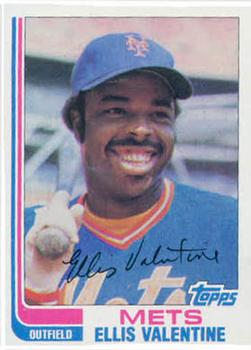
Who Can It Be Now? Ellis Clarence Valentine was born in Helena, Arkansas, in 1954, and graduated high school from Crenshaw High School in Los Angeles -- a school which produced Darryl Strawberry, Akbar and Kabeer Gbaja-Biamila, Ice-T, Milwaukee Bucks legend Marques Johnson, and UConn basketball coach Kevin Ollie, among others. Valentine was the first of those guys from Crenshaw to make a name for himself, which makes sense since the school did not open until 1968. Noted journalist Jeff Pearlman -- in the news again recently for the fifteenth anniversary of his writing that John Rocker interview in Sports Illustrated -- interviewed Valentine on his website. Valentine came from a good family. His dad worked for the City of Los Angeles as a trash man, and his mother had her own beauty salon. Valentine himself admitted in his interview with Pearlman that he, "took a lot of things for granted, growing up. And a lot of it didn't come to a head until it all came crashing down after my career was over." Valentine was chosen by Montreal in the June 1972 draft in the second round with the 29th pick overall. Guys drafted before him in the first round included Chet Lemon, Scott McGregor, Dick Ruthven, and Rick Manning, among others. Valentine made it to the major leagues for the first time in 1975 at the age of 21 for a cup of coffee, then spent half a season at AAA in 1976 before making it to the majors for good with the Expos in 1976. In the seasons in which he turned 23 and 24 -- 1977 and 1978 -- Valentine put up back-to-back seasons of 25 HR, 76 RBI, and 13 SB. In 1977, he made the All-Star team for the one time in his career. In 1978, he won a Gold Glove -- likely based in many respects on his incredible, NL-leading 25 baserunner kills (because, after all, he still committed 10 errors that year). Things were going well for Valentine until 1980. On May 30, 1980, on a Friday night in Busch Stadium in St. Louis, Valentine came to bat in the top of the sixth inning against reliever Roy Thomas. Thomas had come on in relief of Jim Kaat, who had been hammered by the Expos to the tune of 6 runs in 4 innings. With two outs and no one on base, a fastball rode up and in on Valentine and broke his cheekbone in six places. When he came back, he needed to protect his jaw and cheek from further damage. He began wearing part of a football facemask to protect himself. His 1981 Topps card is proof:
Frankly, after the injury, Valentine was not the same player, and he said exactly that in his Pearlman interview: "I wasn't the same hitter any longer. I wasn't the same athlete any longer. I'd become a different person because of it. I prayed over it, and I realized getting hit in the jaw wasn't fun. From a guy who throws the ball over 90-plus miles per hour."
In May of 1981, Valentine was traded to the Mets for Jeff Reardon and Dan Norman. He wasn't hitting well, and he was going to the plate and hacking like crazy. I mean, when a guy walks 11 times in 261 plate appearances, that's hack-tastic. 1982 was worse -- 5 walks in 350 plate appearances. He had more sacrifice flies -- 7 -- and grounded into more double plays -- 11 -- than he did walks. At age 28, he was nearly washed up rather than reaching his peak.
Valentine signed with the Angels for the 1983 season and played a part-time role with them. He didn't play anywhere except for one game in AAA in 1984, and then hooked on with the Rangers for a year. At age 31, he was done with baseball.
Pass the Dutchie
Valentine's life -- both in baseball and, more importantly, after baseball -- has been marked by his relationship with drugs and drug abuse. In that excellent interview with Jeff Pearlman, Valentine said that his worst years for drugs were actually the years in the late 1970s -- his best years in baseball:
But mostly the later part of my years in Montreal, that's when it was really becoming a problem. I'd always dabbled around with a few things in high school, like most other kids. That was the era--we'd smoke a little pot, drink a little wine, play a little rock and roll. But when I got to Montreal things grew. They escalated. I made more money, and you do more things, blah, blah. It got a little out of control. The year my injury happened in 1980--that was the season I really started to intervene on that.
It's a good thing that he did, because for the past 25 years, he has worked in substance abuse counseling and behavioral intervention. My final quote from the Pearlman interview sums this up:
I've had two real jobs in my life. I've been a baseball player and I've been a counselor. I love this. I have more joy from this, because when you're involved with another person and you help another person change his life, it's just something to it. I could hit home runs. That was fine. That was for me, and for the team, and that whole stuff. But I really didn't even know how to be a teammate at the time. I was just a kid.
Freeze-Frame Ellis Valentine appeared in a 1978 episode of Fantasy Island called "Superstar/Salem" with George Brett, Ken Brett, Steve Garvey, Tommy Lasorda, and Fred Lynn -- and, also, Gary Burghoff (Radar O'Reilly on M*A*S*H) and Leslie Nielsen. Here's a non-speaking clip for Ellis:
And a speaking clip:
A Few Minutes with Tony L. In searching for material for this post, I can honestly say that this is the first time that I have had far too much material to use or incorporate into the article. I mean, for Gary Alexander, we had to resort to a Facebook page to see that he likes taking cruises and is a firefighter. For Valentine, though, there are a ton of resources. There is that in-depth interview with Jeff Pearlman I referenced many times above. Of these first players, though, Valentine is the first to have embraced fully the social media age in which we live:
He has his own website through which you can purchase the right to get him to sign autographs at $12 each (which is probably half of what you would pay at a show for him).
He is on LinkedIn, itself a fun trip to see all the former baseball players whose current jobs and resumes can be seen there -- and you can see how many people it will take for you to get introduced to him as well!
He is very active on Twitter, posting a photo of himself over the weekend with Goose Gossage.
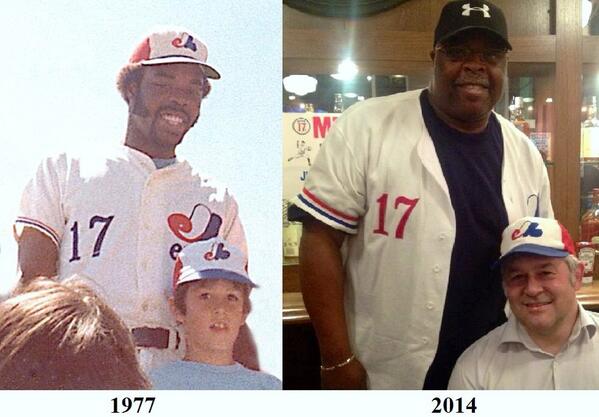
He has also been very active and in the news recently because of Jonah Keri's new book about the Montreal Expos called Up, Up, and Away. He appeared in Montreal for the book's release. In doing that, he recreated photos that were taken in the 1970s in Montreal:
Valentine even got a special gift back from the man whose father housed Valentine in the 197os -- the bat that Valentine used to hit the first ever home run in Olympic Stadium. That story contains the interesting trivia that Valentine not only hit the first Olympic Stadium homer, but he also hit the last homer in the Expos former home, Jarry Park.
Like I said, there was a lot of material.
Ellis Valentine is a guy who was a pretty big star for a little while about whom people inevitably ask the "What if" questions -- what if he didn't get hit in the cheek? What if he didn't become addicted to cocaine? What if his legs weren't destroyed by the Olympic Stadium AstroTurf?
The answer to those questions very well might have been that we as humans would have lost out on getting the best that Ellis Valentine had to offer. Because, in the end, he's done a lot more for society since baseball than he likely would have done had baseball continued being his profession.
Thank you, Mr. Valentine, for turning your negatives into positives for those who need the help.