Showing posts with label Mustache. Show all posts

Friday, January 15, 2021

Card #151: Dave Edwards


Who Can It Be Now?
David Leonard Edwards was born on February 24, 1954 in Los Angeles, California. Edwards was a product of the city of Los Angeles and attended the historic Thomas Jefferson High School, which produced such luminaries as Alvin Ailey, Ralph Bunche, Dexter Gordon, Art Farmer, and Etta James outside of sports and umpire Emmett Ashford, former Milwaukee Brave Lee Maye, and 5-time high jump national champion Otis Burrell.

Edwards was drafted in the 7th Round of the 1971 June Amateur Draft by the Minnesota Twins, and he was drafted as a catcher. I suppose he must have skipped a grade or started school early somehow since that meant that he was drafted in the year that he turned 17 years old. 

He spent four full seasons in rookie and A ball -- from 1971 through 1975 -- before getting promoted to AA Orlando in 1976. The Twins promoted him immediately in 1977 to AAA. He spent two seasons in AAA -- one in Tacoma followed by one in Toledo -- with fairly decent results (.764 OPS and a .341 OBP). 

As a result, Edwards was the one and only late season call up for the Twins in 1978 when rosters expanded in September. He made his debut against the White Sox and pitcher Ken Kravec, off whom Edwards got his first major league hit in his debut (a double). 

Calvin Griffith -- much like Charlie Finley -- viewed free agency as financial ruination, though Griffith was known for, as the Star Tribune put it in June of 2020, running the team "in a discount style." Coincidentally, in September of 1978 when Edwards was making his debut, Griffith was spouting off as only an old white racist owner could, stating that he moved the Twins to Minnesota because he "found out that you only had 15,000 blacks here. . . . We came here because you've got good, hardworking, white people here."

Quite the welcome committee. 

The offseason between 1978 and 1979 saw the Twins cheap out and traded one of their best players -- Dan Ford -- to the Angels for Danny Goodwin and Ron Jackson. The Sporting News on January 27, 1979, noted that the Twins intended to have Edwards split time with Willie Norwood in centerfield. 

That changed a couple of months later on February 5, 1979, when the cheapo Twins traded the great Rod Carew to the Angels in exchange for Dave Engle, Paul Hartzell, Brad Havens, and Ken Landreaux. Landreaux became the starter in center and Edwards became an extra outfielder. Even so, 1979 was his best year -- 257 plate appearances with an OPS of .711 (OPS+ of 89, making him just 11% worse than league average).

Talk in the offseason before the 1980 season had the Twins considering a left field platoon between Edwards and Rick Sofield. The Sporting News on March 29, 1980, ran a story outlining the differences between the two players. Sofield was gregarious -- a football stud who was convinced to spurn the Michigan Wolverines to go to the minor leagues -- while Edwards described himself as "enjoy[ing] listening" and always wanting to be a baseball player. 

This plan got tossed aside when Edwards suffered from an appendicitis in spring training. He fell out of the Twins plans and was traded to the Padres during the December 1980 winter meetings for reserve infielder Chuck Baker (who lasted all of 70 plate appearances in Minnesota). 

The Padres turned Edwards basically into a pinch hitter and fourth outfielder in 1981 and, in 1982, really nothing more than a late inning defensive replacement. He appeared in 71 games in 1982, but started only 12. The Padres released him after the 1982 season. He went on to play in Mexico for two years before calling it a career. 

Family Ties

Dave Edwards had two older brothers who were twins who played in the major leagues at the same time as Dave though at no point in time were all three in the majors at the same time. Mike Edwards beat Dave to the majors by a full season. He appeared in 317 games -- mostly with Oakland -- before leaving the U.S. to play in Mexico and Japan starting in 1982. Mike's twin Marshall Edwards will appear later in this set; Marshall was the Brewers' 5th OF for the 1982 World Series team -- even appearing in one game. Marshall debuted at the age of 28 in 1981 -- the year after Mike was let go by Oakland. 

Trivial Pursuit

In his 1980 interview in The Sporting News, Dave Edwards pointed out that, with Marshall's debut, the Edwardses were the first African-American family to have three brothers all appear in the major leagues. 

A Few Minutes with Tony

I honestly don't have much memory of Dave Edwards other than his ties to Marshall Edwards, of course. It appears that Edwards is pretty good about signing autographs through the mail, though, so maybe I'll take a stab at getting him to sign something. 

Anyone have any good Dave Edwards stories?


Wednesday, May 13, 2015

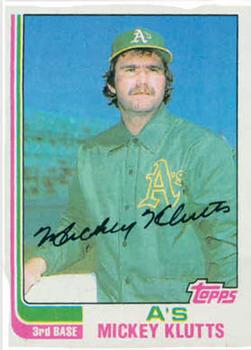
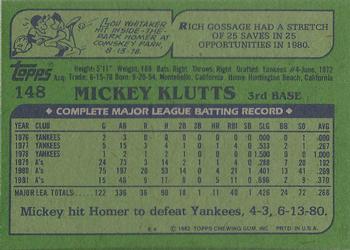
Card #148: Mickey Klutts

Who Can It Be Now?
Gene Ellis Klutts was born on September 20, 1954, in Montebello, California.  The New York Yankees selected him in the fourth round of the 1972 June Draft straight out of El Rancho High School in Pico Rivera, California.  

Klutts signed immediately and, as a 17-year-old, played for Johnson City in the Appalachian League.  Even as a young player, though, Klutts was destined to be a utilityman.  The Yankees played him at 2B, shortstop, and 3B as he worked his way up through the system. 

He played more short than third, but he never really seemed to be the Yankee's top choice for either position.  With Graig Nettles at third, of course, shortstop became where he would be more likely to play.  His opportunity appeared to be coming in 1977, though. He had debuted in New York at 21 in 1976, and incumbent Fred Stanley did not appear to be an impediment to Klutts stepping into the starting role.  Then, on a play at second in the spring of 1976, Klutts made a tag at second and pulled his hand away in pain. 

The Yankees told reporters that Klutts had a "jammed-sprain."  The reality was that he had a broken finger, but the Yankees apparently were not convinced Klutts could be a starter and were negotiating to trade for Bucky Dent with the White Sox.  They feared the price for Dent would increase if the White Sox were aware of Klutts's injury, so out came that Yankee version of news-speak.  Dent became the Yankees' starting shortstop and broke Red Sox hearts in 1978; Klutts went on to be the co-MVP of the International League in 1976.

As it turned out, Klutts never got the chance to play in New York -- coming to bat just 24 times over three seasons before being traded at the trade deadline in 1978 to the Oakland A's for Gary Thomasson.  

Injuries hampered his career as well, lending credence to nominative determinism (the theory that a person's name can have a significant role in determining key aspects of job, profession, or even character).  According to Baseball Library, Klutts was disabled "at least ten times" and "suffered one injury when he ran into a tarp." One article in 1978 mentioned that he went on the DL when he broke his left thumb "while warming up relief pitcher Ken Clay in the bullpen . . . ."  The title of that article? "What a Klutts!"

Klutts spent most of four seasons with the A's before they too decided at the end of the 1982 season that Klutts was not the answer to their third-base needs.  In fairness, Klutts was never the starter -- he only kept the position warm for real players like Carney Lansford. After 1982, Klutts signed with the Toronto Blue Jays.  He received 45 plate appearances there before his major league career ended.

Mustache Check:  Yes, indeed.  Gene has a mustache.

A Few Minutes with Tony L.
Other than his incredibly memorable name and all the jokes that went with it, I knew and thought very little of Mickey Klutts as a kid.  I mean, look at his stats -- does that appear to be the stat line of a guy who made an impression on opposing teams' fans? Not particularly, I'd say.  

I found an old blog that may or may not have a basis in reality about how Gene Klutts got to be known as Mickey.  The theory here was that the Yankees touted him as Mickey in order to draw parallels to Mickey Mantle. They wanted to teach Klutts to switch hit, supposedly, and then become the center fielder.  Now, I don't know how much credence to put into this story, but I have no other information as to how "Gene Ellis" became "Mickey".  

I also haven't the foggiest idea what Klutts has done since retirement. He apparently is a pretty good TTM signer, since I've seen a number of autographs of his online. He lives in Lake Isabella, California, according to "Contact Any Celebrity.com" (and, not to be too disparaging, but if Klutts is on that site, they may not be kidding by saying you can contact ANY celebrity).  And, despite featuring for just 20 at bats in New York over three seasons, he still comes back and is invited back to the Bronx for those Yankee Old-Timers games.

Anyone else have anything to share?

Monday, May 11, 2015

Card #147: Denny Walling

Who Can It Be Now?
Dennis Martin Walling was born on April 17, 1954 in Neptune, New Jersey. He attended community college in New Jersey before attending a second community college...er, Clemson University in South Carolina. 

He was drafted initially after his junior college days in the 8th round by the San Francisco Giants in 1974.  He did not sign and went to Clemson for a year where his efforts and ability made him the first pick overall in the 1975 June Secondary Draft by the Oakland Athletics. After signing with the A's, he went straight to the major leagues, going 1-for-8 in limited duty in September of 1975 for the AL West Champions.

Perhaps due to their "win-now" mentality, or maybe Walling just wasn't what they thought he was when they drafted him, but the A's gave Walling a grand total of 19 plate appearances over two year before trading him with cash to the Houston Astros at the trade deadline in 1977 for Willie Crawford.  

Crawford played the rest of 1977 with the A's, played two years in Mexico, and was out of baseball.  In comparison, Walling became a long-time Astro pinch-hitter for those Houston clubs of the late 1970s through the mid-1980s.  He averaged less than three plate appearances per game played for Houston (1072 G, 2929 PA) over eleven-and-a-half seasons (not counting his 3 game cameo in 1992 at the very end of his career).

Walling was never much of a power hitter, and he hit just 49 homers in his entire career. Some of that had to do with the cavernous Astrodome, certainly, but Walling was a guy who would come to bat and be willing to take a walk or, often, get the bat on the ball.  He struck out in less than 10% of his plate appearances in his career.

During the 1988 season, Walling was traded to the St. Louis Cardinals for Bob Forsch. Apparently, the teams wanted to swap a hitter near the end of his career for a pitcher near the end of his career.  Walling stuck in St. Louis as a bat off the bench through 1990, played in Texas a little in 1991, then hung up his spikes after the 3-game, 3-plate appearance performance in Houston in 1992.

Mustache Check: Mr. Ginger, oh your mustache has grown. Don't you know that you're the only one to say, OK.  (Figure out that reference...)

Family Ties
According to the Baseball-Reference.com Bullpen, Denny Walling's older brother Gregory Walling played 47 games for Covington in the Appalachian League in 1967 in the Astros system. He walked a lot, but Gregory's .225/.363/.265 slash line did not convince the Astros to keep him beyond that one season.

A Few Minutes with Tony L.
Yes, I am going to resurrect this blog a bit.  I miss the history aspects of it.  

I remember Denny Walling from watching the postseason in the early 1980s and again in 1986.  Walling struggled mightily against the Mets in the National League Championship Series in 1986 -- .158/.158/.211 in 19 AB -- but he was far from the only one who struggled. Of players with more than 10 at bats for the Astros, only Craig Reynolds -- 4 for 12 -- hit better than .300.  Walling ended up picking up four at-bats in the epic game 6 of that NLCS -- the one that went 16 innings and finished with the Astros coming up one run short in their rally to tie the game again after the Mets scored 3 in the top of the 16th off Aurelio Lopez and Jeff Calhoun.

Since his retirement as a player, Walling has been a coach. He spent time with the Oakland A's and New York Mets when old pal Art Howe was the manager.  After that and from 2007 to 2014, Walling was a hitting instructor in the Orioles system -- first as a roving instructor, and then as the Triple-A Norfolk Tides batting coach from 2012 through 2014.  After the 2014 season, Walling -- now 60 years old -- decided to retire.

Sunday, February 8, 2015

Card #146: Mike Griffin


Who Can It Be Now?
Michael Leroy Griffin was born on June 26, 1957, in Colusa, California.  Griffin was the third-round pick in the 1976 June draft of the Texas Rangers out of Woodland High School in Woodland, California.

After two years in the Rangers system, Griffin was part of a 9-player trade in November of 1978 in which he, Juan Beniquez, Paul Mirabella, and Dave Righetti were traded to the New York Yankees in return for Mike Heath, Dave Rajsich, Larry McCall, Domingo Ramos, Sparky Lyle, and cash. The next year -- 1979 -- Griffin made his major league debut with the Yankees.

Getting traded and moving around was a big part of Griffin's career. He was traded again in 1981 as the player to be named later (along with Doug Bird and $400,000) going to the Cubs in exchange for Rick Reuschel. Bird and Griffin pitched back-to-back 1-run games against the Dodgers in August of 1981, leading to some typical Tommy LaSorda hyperbole: "Who are those guys? Christy Mathewson and Walter Johnson?"

No, Tommy. No they are not.

Griffin's stay in Chicago did not last long -- only to the end of spring training in 1982 -- at which point he was traded to the Expos for Dan Briggs.  Griffin never appeared in the major leagues for the Expos, and at the end of August was traded again. This time, he went to San Diego in exchange for future White Sox and Mets manager Jerry Manuel.  

Griffin bounced around the minors for a few years after that -- going to the Rangers system in 1983, to Kansas City's system after 1984, and then to Baltimore after 1986. He made 23 appearances as an Oriole in 1987 for a team in sharp decline and did not pitch very well. 

He was back on the streets as a free agent after the 1988 season, but then the Cincinnati Reds gave him one last shot at the big leagues. He pitched 4-1/3 innings in 3 appearances in 1989, and that was the end of his big-league career.

Mustache Check 
Yes.  It's ginger bristles, but it counts.

Everybody Wants You
To get traded twice in the 1982 season, Griffin had to be wanted by two different teams as well. Because otherwise there's nothing, Griffin is a Wanted Man.

A Few Minutes with Tony L.
The only thing I remember about Mike Griffin was this card. As a ten-year-old, I don't think I'd ever seen as many freckles on any one person as appear on Griffin in this photo. As a pitcher, though, he is as memorable as the remnants of a drunken night after 20 shots.  In other words, "he did what?"

Since his retirement as an active player, Griffin has spent most of his time as a minor-league pitching coach. Starting in 1993 with Triple-A Indianapolis, Griffin spent several years in the Cincinnati Reds system as a pitching coach. After leaving the Reds system, Griffin hooked on with the Boston Red Sox in 1999. Griffin coached for 9 seasons (1999-2007) in the Red Sox system before joining the Baltimore Orioles organization. After spending 2008 in Double-A Bowie, Griffin has become a fixture as the pitching coach for Baltimore's Triple-A team, the Norfolk Tides, in the International League and coached there through 2014.

Saturday, January 31, 2015

Card #144: Fred Breining


Who Can It Be Now?
Fred Lawrence Breining was born on November 15, 1955 in San Francisco, California. He grew up in the City of San Francisco and attended high school there.  He then matriculated at the College of San Mateo, a community college in San Mateo. The Pittsburgh Pirates drafted him in the third round of the 1974 January Draft (Regular Phase) and Breining signed shortly thereafter.

Breining's career stalled out in the Pittsburgh system, and it appeared as though he had plateaued and reached his level in 1978 in Triple-A. He got rocked for a 6.38 ERA in 55 innings at Columbus that year, and things were not looking good for him. But, in 1979, Breining was a throw-in in a trade between Pittsburgh and San Francisco. Breining went back to his hometown club (along with pitchers Al Holland and Ed Whitson) in exchange for the one star in the trade -- Bill Madlock -- along with Lenny Randle and one of the Dave Robertses.  That trade at the end of June of 1979 seemed to revitalize Breining, leading to his call-up in 1980.

Just 25 in 1981 despite 7 years of professional baseball under his belt, Breining looked to be a legitimate major league pitcher (despite a FIP that was 1.25 runs per nine innings higher than his ERA). He backed that up in 1982 with a stellar season -- 11-6 record, 3.08 ERA (3.00 FIP) and 2 complete games in 9 starts. He moved to the rotation in 1983 and racked up 202-2/3 innings over 32 starts with an 11-12 record and a 3.82 ERA.

The real controversy in his career came in late 1983 and early 1984. Breining was traded early in spring training to Montreal for Al Oliver. When he arrived for spring training, his shoulder was tender to the touch. Breining said his shoulder was hurt the previous September, and the Giants claimed they knew nothing about it. Eventually, the Giants sent a second pitcher, Andy McGaffigan, to Montreal to make up for the issue.  That didn't help Breining's career -- he pitched 6-2/3 innings for the Expos in 1984 and never pitched in the major leagues again.

Mustache Check: It's a wispy mustache more appropriate for a teen, but there is definitely one there.

The Verdict
The Great Recession of 2008 to, well, probably around 2013 or so caused a lot of people financial harm. Many folks were so far underwater on their mortgages that, try though they might, they were unable to refinance their homes and lost the house. Still others got close to that precipice of foreclosure but attempted to stave it off with lawsuits.

It is into this final category that Fred Breining appears to fall. Breining and his wife appear to have tried to refinance their home, gotten the runaround from their various mortgage companies, and, then, only got a denial for refinancing and had to resort to court. This court order from July 2014 granted the finance company's motion to dismiss, but gave Breining and his wife leave to amend their pleading. I'm not sure how it's played out, but I feel for them.

A Few Minutes with Tony L.
Breining never pitched in the AL and pitched only for a few years in the majors, so I can't say that I recall him at all. In fact, if you pressed me on who the guy in the picture is, I would have guessed Mike LaCoss due to the gnarly glasses Breining has on here.

It appears that Breining has spent most of his post-baseball career serving as a private pitching coach and attempting to be an inventor. A quick look at his LinkedIn page shows that he has been giving private pitching lessons for the last 26 years in California. Indeed, Fred's page mentions that he had 7 students drafted in the 2010 to 2012 drafts.

That said, I don't know that he really understands Twitter at all.

Tuesday, January 27, 2015

Card #143: Mookie Wilson

Programming Note: Yes, I'm back. Finally. Here's the thing, though -- life has gotten incredibly busy for me. So much so that I do not have the time to write up the big career stories that I was writing. Instead, going forward, the posts will look more like this one -- a much shorter "Who Can It Be Now?" along with whatever category posts I have and maybe a paragraph wrap-up with my thoughts.


Who Can It Be Now?
William Hayward Wilson -- Mookie -- was born on February 9, 1956, in Bamberg, South Carolina. He became a South Carolina Gamecock eventually, spending his junior year in Columbia. His junior year was good enough to make him the Mets second round pick (42nd overall) in 1977.

If you know one thing about Mookie Wilson's career, you know that he was the guy who tapped the dribbler in the tenth inning of Game 6 of the 1986 World Series -- the dribbler that went through Bill Buckner's legs and scored the winning run. Wilson was one of only a few holdovers on that '86 team from the early 1980s Mets -- most of which were not very good teams.  

Mookie spent parts of ten seasons in Flushing, and, indeed, stands 15th at present in career wins above replacement among all New York Mets players -- just behind Howard Johnson and just ahead of David Cone's Mets years. After he left the Mets, he finished his career off with three seasons in Toronto. His career came to a close after the 1991 American League Championship Series in which the Jays lost to the eventual World Series Champions, the Minnesota Twins.

Mustache Check: Mookie is definitely whiskered.

Family Ties
In a convoluted and potentially uncomfortable family tie, Mookie's stepson is former major leaguer Preston Wilson. Mookie is also Preston's uncle, because Preston's natural father was Mookie's brother Robert.  

Mookie also had two other brothers who played minor league baseball.  Younger brother John Wilson was the Mets 17th round pick in the 1982 January Draft -- which pretty much guarantees that John was not regarded highly despite impressive speed in the minor leagues. 

The youngest of the three Wilson brothers to play professionally was Phil Wilson, who was a fifth round pick of the Minnesota Twins in 1984. Phil had trouble making enough contact to get past Triple-A.

Freeze-Frame
Mookie Wilson parlayed his fame in the 1986 World Series into a TV appearance. He joined Keith Hernandez, Mark Ingram (the Dolphins and Giants WR who fathered the running back who attended Alabama), Sean Landeta, Pee-wee Herman, Jeremy Irons, Madeline Kahn, Itzhak Perlman, Paul Simon, and Rhea Perlman, among others, in singing "Put Down the Duckie" in a 1988 "All-Star Musical Special" of the same name for Sesame Street.

The World According to Garp
In April of last year, Mookie released a book called "Mookie: Life, Baseball, and the '86 Mets." If you are a Mets fan, or if you like good baseball books, this may be one to pick up. The book has been reviewed 21 times on Amazon, and it has received 17 5-star reviews and 4 4-star reviews.  

A Few Minutes With Tony L.
Mookie's distinctive nickname made him well-known to all fans of baseball in the 1980s. A number of the reviews of his book mention how much Mookie loved baseball -- playing the game and being around it.  

It should come as no surprise, then, that he has spent a great deal of his post-playing career as a coach for his New York Mets. He was unhappy to be named as a club ambassador last spring, however, because it was a role he received after being pushed out of his on-field role. Indeed, this link has excerpts from his book in which he said that he had "basically become a hood ornament for the Mets" after his demotion from being an on-field staff member in 2011. 

Monday, December 8, 2014

Card #141: Cleveland Indians Future Stars


Who Can It Be Now?
We have three players on this card who had varying degrees of success as major leaguers and in their post-playing careers. 

1. Christopher Michael Bando was born on February 4, 1956, in Cleveland, Ohio. Bando was not drafted directly out of high school in Cleveland, and chose instead to attend Arizona State University to play baseball. While at Arizona State, he made news for hitting a home run in the championship game that won the Sun Devils the 1977 College World Series. 

That led the Milwaukee Brewers to select Bando with the 541st pick of the 1977 draft (22nd round, 3rd pick of the round). Okay, I say that his CWS heroics led to the pick, but the reality was probably closer to nepotism: the Brewers signed Chris's older brother Sal as a free agent prior to the 1977 season. Apparently, though, the money on offer from Milwaukee was not sufficient to sway Chris to sign, so he went back to ASU for another season.

During his senior year of 1978, he hit .415/.508/.744 with 17 HR and 102 RBI in 258 at bats (along with 49 walks). That season propelled him into the second round of the 1978 draft, where the Cleveland Indians selected him with the 36th pick overall (10th pick of the round). He signed was assigned to Double-A Chattanooga (Southern League) where he stayed through 1980. After a good year in Triple-A Charleston in 1981, the Indians gave him a shot at the big leagues at the age of 25 once the strike ended.

Bando did not hit all that well right away, and he had both Ron Hassey and Bo Diaz in front of him. The Indians traded Diaz to the Phillies to open up a spot for Bando to be the righty hitter in a platoon with Hassey in 1982. He scuffled at the plate in his limited playing time until 1984, when he slashed at .291/.377/.505 and hit 12 HR in 260 plate appearances at the age of 28.

The problem, though, was 1985. All of his good work was undone and then some. In 199 plate appearances, Bando "hit" .139/.234/.173, good enough for an OPS of .407. In other words, terrible. He was sent back down to Triple-A to right the ship. He came back in 1986 and enjoyed the most playing time he would see in his major league career -- 92 games, 290 plate appearances (.268/.325/.327) -- but, the power he showed in 1984 was nowhere to be found. 

He filled a similar role with similar plate appearances in 1987 with even worse results -- .218/.260/.332. Thus, when he struggled mightily in 1988, the Indians decided to release him in August. He appeared in one game in 1988 without a plate appearance for the Detroit Tigers, who cut him after the season. He signed on for 1989 with the Oakland A's, and, after 1 game, 2 at bats, 1 hit, and 1 RBI for the A's, his playing career ended.

Mustache Check: Chris was a good, clean-shaven, All-American Bando.

2.  Thomas Martin Brennan was born on October 30, 1952, in Chicago. He attended Leo High School in Chicago (part of the Chicago Catholic League which counts a number of major league alumni in its ranks). Undrafted out of high school, Brennan stayed close to home and matriculated at Lewis University in Romeoville, Illinois. Brennan then led Lewis to the Division II College World Series in 1974. The Indians took notice and drafted him 4th overall in the first round of the 1974 draft -- one spot ahead of where the Atlanta Braves selected Dale Murphy.

Cleveland being Cleveland and Brennan being a college star, the Indians pushed Brennan to Triple-A Oklahoma City immediately after he signed. Bad idea. In 50 innings, Brennan allowed 46 hits and 56 walks (38 earned runs, 42 runs) in 13 starts, good enough for a 6.84 ERA. In 1975, the Indians tried the same thing, and Brennan was even worse -- 122 innings, 149 hits, 98 walks (52 strikeouts), leading to 103 runs (96 earned) and 21 HR allowed to boot...leading to a 7.08 ERA.

It took Brennan until 1981 -- at the age of 28 -- to finally reach the majors.  By that point, he had spent all or parts of 7 seasons at Triple-A in Oklahoma City, Toledo, Portland, Tacoma, and Charleston. He got his chance in the major leagues in September of 1981, and he pitched fairly well -- 48-1/3 innings with an ERA of 3.17 in 7 appearances.

That led to his only complete season in the major leagues in 1982, in which he appeared in 30 games (14 starts) with 92-2/3 innings pitched. He gave up a lot of hits -- 112 -- but he controlled his walks extremely well (just 10). Along the way, he earned the nickname The Gray Flamingo for how his windup featured a pause in his delivery when he was perched on one leg.

Yet, he would find himself splitting 1983 between Triple-A and Cleveland and, after the season, traded to the Chicago White Sox for a player to be named later that would not be named until 18 months later. He made four appearances with his hometown club in 1984, and they let him go. He signed with the Dodgers for 1985. But after a 7.39 ERA (despite a 3.47 FIP), he was out of the majors after 1985. He spent one final Triple-A season where he started out -- Oklahoma City -- in the Rangers organization before his career came to an end.

Mustache Check: Brennan saved the Indians from the ignominy of not having a mustachioed prospect fit for sharing in 1982.

3. Von Francis Hayes was born on August 31, 1958, in Stockton, California.  He attended St. Mary's High School in Stockton. but he was not selected by any major league team out of high school. He then enrolled at St. Mary's College of California in Moraga, California. His play there led the Indians to select him in the 7th round of the 1979 June Draft

Hayes did not play in the Indians system until 1980, however, when he hit .329/.405/.500 in Single-A Waterloo with 15 HR, 90 RBI, and 51 steals in 59 attempts. That showing was enough to get him promoted directly to Triple-A Charleston in 1981 where he once again hit well: .314/.401/.474  with 10 HR and 34 steals in 41 attempts. Hayes only played in minor league rehab assignments after 1981.

He actually made the major league roster directly out of spring training in 1981 and appeared in the 9th inning of a 7-1 win against Texas as a defensive replacement for Jorge Orta. Hayes came back to the majors when the strike ended and notched his first major league hit in his second major at bat -- a single off Brewers starter Jim Slaton on August 11, 1981, in a game Milwaukee won 6-1. 

In 1982, Hayes started regularly for the Indians -- mostly in right field but also making appearances in left, in center, at first, and at third, though he came up through the minors as a third baseman. At the age of 23, he hit .250/.310/.389 with 14 HR and 32 SB in 45 attempts. But, the Indians decided to cash in on Hayes's talent by using Hayes as a trading chit to rebuild their own farm system. So, on December 9, 1982, the Indians sent Hayes to the Phillies in return for pitcher Jay Baller, catcher Jerry Willard, outfielder George Vukovich, and infielders Manny Trillo and Julio Franco.

Through the trade, Von Hayes got the nickname "Five-for-One." Phillies fans never warmed to Hayes. As the Philadelphia Inquirer sportswriter Paul Hagen put it in 1991:
Hayes had an oil-and-water relationship with the crusty Veterans Stadium boobirds almost from the moment he came to Philadelphia as the one in a controversial five-for-one trade at the winter meetings in Honolulu nine years ago today. He was smooth and elegant and that didn't play in South Philly, where the fans like players with a little dirt under their fingernails.
Or, as NBC Philadelphia stated, "[t]he Phillies thought they were getting a five-tool player who could complement superstar third baseman Mike Schmidt. Instead they got an average outfielder who would make only one All-Star game in nine seasons in Phillies baby blue."

Hayes was traded from Philadelphia to California at the end of the 1991 season in exchange for pitcher Kyle Abbott and outfielder (and future Phillies GM) Ruben Amaro, Jr. He spent one season with the Angels, and that was the end of his career.

Mustache Check: Von Hayes was silky smooth in the field and in terms of his facial hair.

Family Ties
Chris Bando's brother Sal Bando is the far better known of the Bando brothers, having played for the Kansas City/Oakland A's and the Milwaukee Brewers from 1966 through 1981. Since Sal does not appear in the 1982 Topps set (only in Donruss and Fleer), let me use this opportunity to say that I'm still bitter about Sal and Bud Selig not resigning Paul Molitor in 1992.

Chris's son Ben Bando played with Arizona State (5 games) in 2006. Another son, Phil Bando, played 8 games in the Anaheim Angels system in 2009 after being drafted in the 45th round of the 2009 draft.

Goody Two Shoes
Another Chris Bando fact is that he is a baseball coach for San Diego Christian College in California. His coach's page mentions that his "lifelong accomplishments in competitive baseball along with his focus on building whole person growth for the glory of God is an asset to SDCC Hawks." Or, as his LinkedIn page puts it, the goal of his career is to "glorify God through the arena of baseball, by teaching sound baseball fundamentals, sound doctrine and a faithful commitment to the local church."

Freeze-Frame
Tom Brennan appeared in the movie "Rookie of the Year" as the home plate umpire in the final scene of the movie, according to a story reprinted in full on this website from a newspaper called The Southtown Star. IMDB improperly credits a different Tom Brannan with the role.

A Few Minutes with Tony L.
Obviously, Von Hayes had the most successful career of these three guys. I would question including Brennan as a "future star" since he was already 28 years old when he appeared on this card. Topps tended to show players that had appeared in the majors already on these cards, though, so making a call as to who should have appeared on this card in his place is tricky. Maybe Mike Fischlin or Jerry Dybzinski? In other words, when the Indians traded Von Hayes, they did it out of necessity -- they needed more younger talent.

I mentioned above that Chris Bando is coach at SDCC. He's been in baseball in one capacity or another since he retired from playing. His first year out of playing he was the manager of one of the best minor league teams in Brewers history according to Reviewing The Brew: the 1990 Stockton Ports. He remained in the Brewers system as a manager through 1995 when he joined the big-league team as third-base coach. He did that two years under Phil Garner, then served as bench coach in 1998. He was reassigned to be a scout in 1999, and then was shown the door after the 1999 season when brother Sal was also kicked to the curb. Chris then joined up with the Indians organization until 2005, when the Arizona Diamondbacks hired him as a scout. Since then, he's managed twice in independent leagues and, as I said, in college.

Tom Brennan moved back to Illinois after his playing days ended and, according to his minimal LinkedIn biography, he works as a facility manager at "a local community bank." Since it appears he has been with the same bank for nearly 15 years, this Chicago Sun-Times article puts him at Standard Bank and Trust in Hickory Hills, Illinois. He also volunteers as a youth pitching coach around Chicago's South Side.

Von Hayes has also done some managing in his post-playing career in the Diamondbacks organization and in independent baseball. He also coached at his alma mater, St. Mary's College in between selling boats and moving from Florida to Illinois and back again. Based on his LinkedIn profile -- and we went three-for-three for this card -- he is a Partner in First Source HR/Employco, a company which he describes as "a professional employer organization that offers payroll services, competitive workers' compensation rates, human resource services, employee benefits and much more."

Just don't call him Five-for-One.

Friday, December 5, 2014

Card #140: Ron LeFlore


Who Can It Be Now?
Ronald LeFlore was born on June 16, 1948, in Detroit, Michigan. He was the son of an auto worker who found himself on the street early. This was not because his family could not provide for him -- he just chose to veer away from the straight and narrow. He claimed that, at age 11, he was stealing around $1,000 out of a supermarket cash register using a stick with gum on the end of it to pull dollar bills out of a cashier's box. 

LeFlore told People magazine that at the age of 15, a People magazine article says that he was involved with prostitution, shoplifting, and con games. At age 16, according to LeFlore, he was snorting heroin. LeFlore said that he and some buddies needed money for drugs, so, at the age of 17, they held up a check-cashing service in particular. They were caught and sent to jail.

If there is one thing that baseball fans know about Ron LeFlore, it is that he was "scouted" or "discovered" in the Jackson State Penitentiary in Michigan by Billy Martin. LeFlore never played baseball before his incarceration on an armed-robbery conviction, but when you have 5-to-15 years to spend behind bars, I imagine you might try a few sports that you hadn't played before too.

Prison officials convinced Martin to watch LeFlore and give him a tryout. Sufficiently impressed, the Tigers signed LeFlore the day he was paroled in July of 1973 and assigned him to Single-A Clinton -- a town of around 20,000 people on the Mississippi River about 45 minutes away from the Quad Cities. That must have been culture shock to LeFlore. He only spent 32 games there in 1973 before the season ended. The next year, LeFlore was assigned to Lakeland in the Florida State League. There, his speed was on display -- 42 steals in 46 attempts -- and he hit very well too: .339/.398/.451.  After just 93 games in Lakeland, the Tigers promoted him first to Triple-A Evansville for 9 games and then right to the major leagues with Detroit.

When he was first called up to the major leagues in 1974, LeFlore's story preceded him. In fact, that People article about him recounted all of the facts above. The story put LeFlore's age at 22 years old. The only problem was that LeFlore had lied about his age to the Tigers. I know -- shocking that a convicted felon in prison for robbery with a chance to get out and make gobs of money playing a game would lie about something.  He told the Tigers first that he was born in 1952. Later, his story changed to being born in 1950. Only in 1976 did all the facts come out to confirm that he was born in 1948.

As the facts developed later, yes, he was arrested at age 17. That was for "attempted safe-breaking." That arrest happened in 1965, however, and not 1970 as he had claimed initially. He went to jail in January of 1966, was paroled in July of 1967, re-arrested in May of 1968 for a parole violation, paroled a second time in September of 1969, and then, in January of 1970, he was, in fact, arrested for armed robbery of a bar on Detroit's East Side.

The response to these facts from the Tigers was that they really did not care how old LeFlore was and that their only concern was whether he could play baseball. By the time these facts came to light, LeFlore had already played in 195 games for the Tigers and stolen 51 bases (against 29 CS...a terrible percentage). In those days of overlooking OBP, LeFlore's was not what you would want from a leadoff man -- .302 over 863 plate appearances.  

To be fair, though, LeFlore was still learning the game (if his stories about not having played baseball before prison were true). Indeed, in 1976, LeFlore's story became even more heartwarming, if your heart can be warmed by a former armed robber becoming an All-Star. In 1976, America's hearts could be, leading to LeFlore starting the All-Star Game (with teammate Mark Fidrych starting the game for the American League). 

That 1976 season was probably his best as a major league baseball player. While he couldn't field his position very well, he hit well -- .316/.376/.410 -- and stole 58 bases in 78 attempts. The whole thing was straight out of Hollywood, it seemed -- so much so that CBS couldn't help itself and made the story into a TV movie called "One In A Million: The Ron LeFlore Story" starring as LeFlore a young LeVar Burton. Go here to see some clips from it, including cameos from Norm Cash, Al Kaline, and Bill Freehan and starring Billy Martin as himself.

In 1977, LeFlore continued his hot-hitting ways, racking up 212 hits, in a "triple-double" season: he had 30 doubles, 10 triples, and 16 homers to go with his 39 SB (in 58 attempts, mind you). He walked just 37 times in 698 plate appearances, striking out 121 times. 

But, you can see how it appears that LeFlore really was learning to play baseball while in the major leagues. 1978 solidified that belief. At the age of 30, LeFlore led the American League with 126 runs scored and with 68 stolen bases in 84 attempts -- far more respectable than his previous years -- while drawing 65 walks in 741 plate appearances. Even his fielding was improving somewhat, as his speed made up for occasionally lacking fundamentals. While his SLG lagged in 1978, it really seemed that LeFlore had come of age as a player.

Come 1979, however, LeFlore had a problem. His previous manager, Ralph Houk, had been fired.  In June, Sparky Anderson was named manager after the team fumbled around with Les Moss and Dick Tracewski. If LeFlore and Houk agreed to disagree about team rules, well, Anderson just got upset and wanted him shipped out. So, despite LeFlore's 78 SB (in 92 attempts, an 84.78% success rate that was good enough for third in the league) and a slash line of .300/.355/.415, he was traded during the Winter Meetings in December of 1979 to the National League's Montreal Expos for pitcher Dan Schatzeder.

As one sportswriter put it the next spring, there were three reasons for the trade. The first was the Tigers' desire to bring up local football star Kirk Gibson. The second was Sparky Anderson and his rules -- no beards, no jeans, no long hair, and lots of rules. As LeFlore put it, "Obviously, he didn't feel I fit his mold. He felt I was a threat to his authority. Otherwise he wouldn't have authorized the trade." The final reason was that LeFlore was asking for a lot of money and a long-term contract. 

LeFlore responded well to the trade, leading the National League in stolen bases with 97. His batting average dipped to .257, but his new-found batting eye kept his OBP at a respectable .337. That was not enough, however, to convince the Expos to make him an offer of a long-term contract. 

Into that breach stepped the Chicago White Sox, who signed him to what was called a "multi-year, $2-million offer" which turned out to be a three-year deal. Interestingly, in both this article and the previous story about LeFlore, the myth of his birth being in 1952 was still being carried forward. Apparently those sportswriters -- and probably the Expos media guide -- did not get the memo from 1976 about his 1948 birth. This would continue to be the case throughout his career -- some newspapers used 1948 and others used 1952.

LeFlore thought that the Expos were making an example out of him with Gary Carter, Steve Rogers, and Warren Cromartie all coming up for new contracts. More likely, though, this was just a move similar to what the Tigers had done since the Expos had a 20-year-old left field prospect named Tim Raines chomping at the bit for his opportunity.

Perhaps the White Sox thought they were getting a thirty-year-old outfielder. I can't imagine that was the case, but maybe that is what they thought. Or, perhaps they didn't quite understand the decline phase for a player starts around 32 and that, for guys like LeFlore who rely on their speed, that decline is often extremely swift. 

Indeed, that is exactly what happened. 1981 went reasonably well healthwise for LeFlore, but the bottom dropped out of his ability to take walks -- just 28 in 369 plate appearances. Then, in 1982, LeFlore's inability to follow rules came back again. He butted heads with Tony LaRussa by failing to show up for a full-team pregame workout the day after the All-Star Game and for showing up late for a day game (just minutes before game time) over the next weekend. That led to his being suspended for three games and costing LeFlore $10,000 of his estimated $625,000 salary.

Then, at the end of the season, LeFlore got in trouble with the law again. After a three-month surveillance, LeFlore was arrested in Chicago for possession of Quaaludes, a stimulant, and two unregistered .25 caliber derringers. A "reliable source" tipped off the police that LeFlore was purchasing narcotics, so the police followed him around. The White Sox placed him on their "suspended list" as a result.

That was the start of a terrible six months for LeFlore. On January 16, 1983, LeFlore's six-week-old son John Christopher died from sudden infant death syndrome. Two days later, he was ordered to stand trial for the charges from October of 1982, for which he was eventually acquitted.  

Then, after a horrible spring training on top of everything else (.152 AVG, 5 for 33), the White Sox told LeFlore on March 28, 1983, that they were going to eat his salary and release him. No one else in baseball wanted to take a chance on the nearly 35-year-old outfielder with dwindling hitting ability and an attitude to match his rap sheet, and that was the end of his playing career.

Mustache Check: Ron LeFlore sported a mustache throughout his career.

Family Ties
LeFlore's cousin, Todd Steverson, was the first round pick of the Toronto Blue Jays in 1992 out of Arizona State University. Steverson was a Rule 5 pick of the Tigers in 1994, and then was traded to the Padres in spring training in 1996. He got one at-bat with San Diego that season before spending a couple more years in the minors.

The World According to Garp
When you have a story good enough for a TV movie, usually that means you have a story worth telling in book form. LeFlore worked with ghostwriter Jim Hawkins to produce a book titled Breakout: From Prison to the Big Leagues in 1978. It was 180 pages long, and the lone review of the book on Amazon says:
It is a very fast read. There are few words on each page, and it reminds me of the type of thing that I would check-out from my elementary or junior high school library when I was that age. . . . One more caveat, if you're looking for a hero or an inspirational figure look elsewhere. The subject offers little in the way of advice, lessons learned or even contrition for the things he did in his life. He seems to take the attitude of, "Hey, this is my life, this is what happened, it is what it is."
Trivial Pursuit
Ron LeFlore was the first player to lead both the American League and the National League in Stolen Bases. He led the AL in 1978 and the NL in 1980.

A Few Minutes with Tony L.
Because of his story, I was very aware of who LeFlore was. I recall being blown away at the idea of someone stealing 97 bases as well -- LeFlore and Rickey Henderson went neck-and-neck all year before Henderson ended up edging out LeFlore by hitting exactly 100 steals. Even then, I always had a bit of trepidation about LeFlore.  I mean, he was a convicted felon, after all.

The intervening years since 1983 have not been kind to him. The link in that previous sentence is to a long-form story from last year that appeared in the Toronto Sun which talks about the struggles LeFlore has had since his release. 

He tried to be a minor-league coach, but no one would hire him. As a result, he got a job as a baggage handler (Wikipedia says with Eastern Airlines, if you buy that). He went to umpiring school, but failed to perform well enough at that task to get hired by professional baseball. He was arrested twice for failing to pay child support -- one time in Detroit in 1999 after ceremonies to honor former Tigers players on the closing of Tiger Stadium. 

Then, to cap things off, he had a hip replacement in 2009. That wasn't the worst part, though. LeFlore was a heavy smoker for his entire life and, in 2011, that piper came calling. As the Sun article quotes LeFlore:
I started having problems walking on my right leg and it started swelling up and my toes started turning dark. I had trouble getting my shoe on, so I started soaking my foot in warm water and wearing sandals all the time. Being an athlete, I had built up a high tolerance for pain...I just let it go.  
When my toe turned black, I started picking at it -- and a piece of my toe came off in my hand. When I saw that, I said, "Oh, my God!"
I went back to see the doctor who had done my hip replacement and he said, "You need to get to the hospital right away. This is serious." 
No blood could get to my foot. That's when they started amputating. First they cut off my baby toe. Then they removed the toe next to it, trying to see if they could save my foot. [After an artery transplant to try to save the leg], finally they amputated my leg below the knee in the third surgery.
The article closes with LeFlore wishing that someone would have given him the guidance he needed to get over his past problems. He complains that "I had no support from anybody. I don't know if they were afraid, because I was an ex-inmate, but nobody ever went out of their way to really help me."

Not to be snarky or preachy or negative, but isn't that what all the managers and teams who tried to get LeFlore to conform more to their rules were doing? Show up on time, don't miss workouts, not have the attitude that others have to conform to you? 

I feel bad for his current situation in that no one deserves to lose a leg. But almost all the bad stuff in his life happened because he made choices -- choosing to smoke, to take drugs, to rob bars, to miss workouts, and to fail to pay child support. Actions have consequences, and it sounds like LeFlore has found that out over and over again.

Wednesday, December 3, 2014

Card #138: Tony Pena


Who Can It Be Now?
Antonio Francesco (Padilla) Pena was born on June 4, 1957, in Monte Cristi, Dominican Republic. The almost-always excellent Joe Posnanski wrote a fantastic long-form story back in 2003 for the Kansas City Star recounting Pena's youth in the Dominican. Pena grew up in a poor neighborhood (Palo Verde), the son of Octaviano and Rosalia. His father worked 14-hour days to raise his family, and his mother taught school. His mother also taught Tony and his three brothers how to play baseball, as she had played softball herself as a youth.

In the last years before the Dominican academies -- which really started in the early 1980s after teams recognized the amount of (often cheaper) talent available on the island in the wake of the Latin baseball boom of the 1960s (Juan Marichal, the Alous, Manny Mota, and Julian Javier, to name just a few) , players being signed was hit or miss -- some great players probably got overlooked.  

Pena, though, was lucky: a scout from the Pittsburgh Pirates saw Pena playing among a group of fifty or so youths and thought he had promise. The scout, credited as Howie Haak on The Baseball Cube, came to Pena's parents' house to sign him, and surprisingly met resistance from Pena's mother. As Posnanski put it, "[s]he didn't consider baseball a career option for Tony. . . . Tony Pena's life was already laid out. His future wife, Amaris, lived three houses down. He was strong enough to work in the banana fields. He would have children and live his life in Palo Verde."

Eventually, though, Tony promised that he would come home in a year if he did not make it. So, Rosalia finally gave in and allowed Pena to sign. It did not go very well in that first year in the minors in 1976, however, as Pena struggled with hitting, hitting for power, and with getting on base. Granted, it was in a 47-game season, but with a slash line of .214/.260/.302 combined over two leagues (both of which hit far better than that and neither of which was that far away from Pena's age), it did not look good.

But the Pirates hung with Pena through 1977 and 1978. In both of those years, again, he struggled to hit and struggled with getting on base. I mean, even though in 1978 he was two years younger than the rest of the Texas League, he was still well below the rest of the league and the rest of his team in AVG, OBP, and SLG. As Posnanski's story tells it, Pena was told prior to his 1978 offseason that he needed to convince the Pirates he could play baseball. Now, Posnanski makes it sound like this was a Dominican epidemic -- not being able to "convince" the major league team that the players could play -- but looking at the stat line makes it pretty clear that the convincing would come with better results and not any sooner. 

As much as teams like high draft picks, there is a meritocratic side to player development. 

Pena took the words about showing something to the Pirates to heart. He ran the stairs at a church every day to build stamina. He swung a heavy bat to develop strength.  And, he developed his signature extended-leg crouch behind the plate. That crouch allowed him to give pitchers a lower target while still allowing Pena to throw out runners trying to steal.

It also didn't hurt that Pena was assigned to Buffalo in the Eastern League in 1979. At that time, the stadium in Buffalo had a short porch in right field, and Pena practiced directing fly balls to that short porch. It worked. He hit an entirely uncharacteristic thirty-four homers that season (he would never again hit more than 15 as a player and finished with 107 over his entire 18-season career) and started hitting for average as well. That led to being promoted to Triple-A Portland in 1980, where he against hit well and used the larger dimensions in the ballpark to run out 13 triples. 

After his strong 1980 Triple-A season, Pena was given a cup-of-coffee in 1980 with the Pirates. He never played in the minors again except for a two-game rehab assignment in 1987. 

In 1981, Pena made the Pirates out of spring training. As a rookie, all the usual questions about how he would perform and react to being in the major leagues were raised. To ease his transition, the Pirates had Pena splitting time with the slightly older veteran of four years, Steve Nicosia. While Pena did not walk much -- 8 times in 223 plate appearances -- he had a good AVG (.300). More importantly, Pena showed that he had great ability behind the plate to call games and throw out runners. Despite playing in just 64 games behind the plate out of 102 total, he finished third in the NL with 10 DP turned at catcher and third in caught stealing percentage with 42.6%.

Coming in to 1982, then, expectations for Pena were high. Local Pittsburgh journalists called Pena a "Rising Star" and made comparisons between Pena and the great Johnny Bench and Gary Carter. Indeed, Pena was named to the first of his five All-Star games in 1982 and, once again, hit fairly well (.296/.323/.435) but, as that slash line shows, Pena had very little plate patience. The old saw that "Dominicans don't walk off the island" certainly applied to Pena.

But to point that out in this context is a bit churlish. Pena's value as a catcher came more from his defense than his offense. In 1983, Pena won the first of four consecutive Gold Gloves in the National League (he would win one more in the American League in 1991). Indeed, in 1984, Tony Pena led all National League players (not just catchers) with 2.5 Defensive WAR

And yet, as Pena matured into a Gold Glover, the Pirates around him started boring downward in the National League East. After consecutive 84-78 seasons in 1982 and 1983 (the second of which was good enough for second place), the Pirates finished last in 1984, 1985, and 1986. 

Perhaps as a result of that terrible run or perhaps in an effort to signal to their young stars Bobby Bonilla and Barry Bonds that they were now the team's leaders, the Pirates traded Pena away on the eve of the 1987 season, sending him to division rival St. Louis in exchange for three players: pitcher Mike Dunne, catcher Mike LaValliere, and centerfielder Andy Van Slyke. As the excellent Cardinals history blog Retro Simba points out, the trade was considered to be incredibly lopsided in the Cardinals favor at the time. The Pittsburgh press hated the trade. Syd Thrift, the GM, was quoted as saying, "How am I going to explain to my 82-year-old mother when the fans boo me?"

In the end, the Cardinals made the World Series where they lost to the Minnesota Twins in 7 games. Pena hit extremely well that year in the postseason (17-for-43 with 6 walks), but it wasn't enough to overcome the Homer Hankies in the Metrodome.  

Still, the Pirates probably won the trade thanks to how well Spanky and Van Slyke played over the next 5 to 7 years while Pena left St. Louis after three seasons in which he totaled 19 HR, 132 RBI, and a .248/.303/.342 line in 1435 plate appearances (an OPS+ of just 79).

In 1990, Pena went to the American League by signing with the Boston Red Sox.  Pena again found himself in the post-season, and again found himself on the losing end of a playoff series when the Oakland A's beat the Red Sox in the ALCS. The end of Pena's Boston career in 1993 was also the end of his time as a starting catcher.  Yet, Pena was not done as a player. He signed on with the Cleveland Indians at the age of 37 in 1994, serving as Sandy Alomar's backup. That led to two more seasons in which Pena went to the postseason only to lose -- against the Braves in 1995 in the World Series and against the Orioles in 1996 in the ALDS.

After the 1996 season, Pena signed on with the Chicago White Sox. Now 40, he played sparingly as the third catcher behind Jorge Fabregas and Ron Karkovice. As the season progressed, the White Sox were scuffling along near .500, so they decided to give Pena one last shot at the postseason with the Astros. Pena played in just 6 regular season games in Houston after being traded there in August of 1997 to back up both Brad Ausmus and Tony Eusebio. And, as happened in all of his other postseason appearances, he ended his 1997 season -- and his playing career -- with a loss after the Astros lost in the NLDS to the Atlanta Braves.

Mustache Check: Tony Pena definitely has a mustache. Still has one today too.

Family Ties
Most baseball fans of recent vintage are aware that Tony's son Tony Pena, Jr. played shortstop for the Atlanta Braves and also the Kansas City Royals from 2006 to 2009. Another son, Francisco, made it to the major leagues in May of 2014, finishing out a 7-6 loss against the Chicago White Sox on May 20. Francisco had spent most of his career in the New York Mets organization before moving over to Kansas City before 2014.

Tony's younger brother Ramon also played in the major leagues, making 8 appearances for the Detroit Tigers in 1989 and getting lit up like a Roman candle (6.00 ERA, 13 runs/12 ER in 18 innings). In addition, Tony's nephew Rudy Pena made it to Double-A Altoona for 1 game in 2004 in the Pittsburgh organization.

Finally, Tony's daughter Jennifer Amaris is also a competitor of sorts: she is a self-described bikini competitor. Here's a photo of her with her father from October.


A Few Minutes with Tony L.
In 1982, I knew who Tony Pena was because the baseball card world was chasing his 1981 Topps Rookie card. To a 10-year-old kid who did not pay attention to stats quite yet (that took until my teens, when I discovered the Bill James Baseball Abstracts), I bought into the "Tony Pena is the next Johnny Bench" hype. 

Also, I was a catcher in little league and found that Pena's catching style was a hell of a lot easier on my knees than the old-school crouch. So, I really did like Pena as a player. 

It's not difficult to find what Tony Pena has been up to since he retired as an active player after the 1997 season. He immediately became a minor league manager -- first in the White Sox system, and then in the Astros system. Then, in 2002, he spent part of the season as the Astros bench coach before being named as the Kansas City Royals manager on May 15 in the wake of the Royals' firing of Tony Muser.  

Pena and the Royals surprised baseball in 2003 by posting a winning record -- 83-79. That earned him the award as the American League Manager of the Year. The Royals handled their above-.500 season about as well as you would expect for them ten years ago, however, and flopped to a 58-104 record in 2004. After an 8-25 start to the 2005 season, Pena resigned, saying that he felt that at the time the team had not "played to the top of our abilities." He added (in a team press release) that "The Kansas City Royals are on the right track by committing to their young players, and I believe the Royals will be contenders for a long time if they don't change their direction."

Perhaps he meant, "the Royals will not be contenders for a long time" but Pena left with more class than I might have had.

After his resignation, Pena joined the New York Yankees organization in 2006. He served for three years as the team's first base coach before becoming the team's bench coach in 2009. He served in that position through the 2014 season.

And damn, his daughter is hot.