Showing posts with label Don't You Want Me?. Show all posts

Tuesday, December 2, 2014

Card #137: George Cappuzzello


Who Can It Be Now?
George Angelo Cappuzzello was born on January 15, 1954, in Youngstown, Ohio. He attended Ursuline Catholic High School in Youngstown/Girard, but he apparently is not famous enough to be listed as part of the "Notable alumni" on Wikipedia. For what it's worth, perhaps that is because Cappuzzello's Wikipedia article does not mention his high school affiliation. 

Also for what it's worth, George's Wiki entry is wrong in saying that he played baseball at Florida State. If he played at FSU, then FSU was fielding an ineligible player. I say that because Cappuzzello was drafted by the Tigers in the 27th Round of the 1972 June draft directly out of high school. 

Cappuzzello signed with the Tigers for the 1973 season and was assigned to Anderson in the Western Carolinas League. According to the "Fun While It Lasted" website (which chronicles "dead" teams), Cappuzzello was one of just three players on that Anderson team to make it to the big leagues. Indeed, Cappuzzello is called Anderson's staff ace for his 9 wins and 2.85 ERA. 

Anderson was just the starting point of a baseball odyssey for Cappuzzello that is chronicled on the back of his card. He played there at the age of 19, and it took him until 1981 -- at the age of 27 -- to make it to the big leagues.  Over that time, Cappuzzello bounced from Anderson to Lakeland (Single-A Florida State League in 1974) to Dubuque (Single-A Midwest, 1974) back to Lakeland (1975), then to Montgomery (Double-A Southern, 1975-1976) and all the way up to Evansville (Triple-A American Association, 1976-1977). He apparently spent enough time in Lakeland, though, to meet a local girl who attended my alma mater, Vanderbilt, and married her in 1979.

Over that time, the once bereft-of-talent Tigers system had reloaded. Cappuzzello was overtaken in the system by higher draft picks and better prospects such as Pat Underwood, Jack Morris, and Dan Petry, among others. Thus, Cappuzzello became expendable to Detroit and was one of two minor leaguers whom the Tigers sent to the Cincinnati Reds for Jack Billingham in a spring training trade in 1978.

Cappuzzello pitched reasonably well in his two seasons in the Cincinnati system. He injured a hamstring in 1979, however, and ended up being demoted to Double-A Nashville as a result. When the Reds wanted to send him back to Double-A in 1980, however, he asked for his release and the Reds complied with his wishes. He hooked back up with the Tigers (ironically at Double-A Huntsville) after he made sure that the Tigers were going to give him a fair chance to move up in the system. 

A funny thing happened in Cappuzzello's career, then: he started pitching far better in 1980 than he had before. In a 1982 interview, Cappuzzello chalked it to using his fastball more: 
All through my career, I had been told to throw my breaking pitches. I almost never threw my fastball. Nobody ever said much about it, and I thought that was because everybody thought I didn't have a good one. So I'd throw the breaking pitches, miss the corners and get behind, and then have to come right down the middle with the fastball, and they'd hit it.
Cappuzzello started 1981 in Triple-A at Evansville. There, he shut down hitters to the tune of 1.76 ERA in 46 innings. When a pitcher was needed to replace the struggling Howard Bailey at the end of May in 1981, Cappuzzello finally got his chance in the big leagues. He was hammered in his first start -- leaving with the bases loaded and no one out in the second inning -- and his second appearance ended with Cappuzzello getting stitches after igniting a benches-clearing brawl by hitting Milwaukee's Ben Oglivie (though it's pretty likely that Cappuzzello got the stitches due to friendly fire from his own catcher, Lance Parrish).  He wrapped up his first major league season with a 1-1 record and a 3.48 ERA (4.03 FIP) over 33-2/3 innings.

Coming into 1982, Cappuzzello was penciled in to the Tigers' starting rotation as the Number 4 starter behind Dan Petry, Jack Morris, and Milt Wilcox. By the end of spring training, however, Sparky Anderson used his pencil's eraser to replace Cappuzzello with "anyone but George Cappuzzello." The Tigers released him on March 28, 1982. 

A week later, Cappuzzello signed as a free agent with the Houston Astros. Once again, Cappuzzello pitched well in Triple-A -- this time in Tucson -- and pitched in the majors from May 25 through August 5 for the Astros. He was strictly a mop-up reliever, as the team's record in his appearances was a ridiculous 1-16. His ERA was a respectable 2.79, but that hid peripheral stats that made his FIP 4.27.

As far as I can tell from the various stat websites, Cappuzzello did not pitch anywhere in 1983. He made a minor-league comeback in 1984 in the Yankees organization, but he was not recalled to the majors. After 1984, George Cappuzzello did not pitch in organized baseball.

Mustache Check: Yes, George has a mustache. It's not bushy at all, but he's got one.

Don't You Want Me?
Cappuzzello getting cut at the end of spring training must have had him humming this tune. I'm using it here because there isn't much else to say about George.

A Few Minutes with Tony L.
I recall nothing of George Cappuzzello's career.  He pitched a total of 53 innings in the major leagues over two seasons more than thirty years ago -- there's no reason TO remember him as a player without some personal interactions.

I'm not alone in not remembering George. Back in 2010, fellow set-blogger Night Owl wrote a Cardboard Appreciation post of George's 1983 Topps card in which he mentions that he too never really knew that George Cappuzzello existed thirty years ago. Neither did I.

These days, George Cappuzzello is an executive recruiter at Key Alliance Staffing according to his LinkedIn page. He finished up a marketing degree at Florida State in 1984 -- which is probably why he did not pitch in 1983 -- and settled in Windermere, Florida (suburban Orlando) not far from where his wife's family was from in Lakeland.

Saturday, September 6, 2014

Card #102: Dan Briggs


Who Can It Be Now?
Dan Lee Briggs was born in Scotia, California, on November 18, 1952. Briggs attended Sonoma High School in Sonoma, California.  Briggs was young for his class -- graduating in 1970 -- but that did not deter the Angels from selecting Briggs in the second round of the 1970 June Amateur Draft with the 34th pick overall.

Briggs was drafted initially as a left-handed pitcher. At Idaho Falls in the short-season Pioneer League in 1970, the Angels had Briggs pitch and play outfield. In 1978, the transition from pitcher to outfielder came up when he tripled and then scored the winning run to push the Red Sox out of first place. Briggs was quoted as saying:
I was a pretty good hitter and the club thought I should become a position player, so I became an outfielder. Pitching is such an insecure job anyway that I felt I would like to become a position player.
Despite minor dalliances on the mound later in his career -- including 7 appearances in 1984 and 1985 in the minor leagues -- Briggs effectively left pitching behind despite putting up a 1.29 ERA and a 2-0 record over 7 appearances (28 innings, 20 hits, 8 runs, 4 ER, 2 HRA, 19 BB, 33 K). Yes, he would have had to learned control, but a 17 year-old striking out 10.6 guys per 9 innings probably shouldn't have given up on pitching so quickly. 

But that's just hindsight talking. His hitting at Idaho Falls was pretty good -- .305/.411/.437 in 224 plate appearances (with 27 BBs but 52 Ks). And that definitely was not a bad showing for a kid who was 2-1/2 years younger than the average player in the league.  

Going forward, though, Briggs appeared to be on the slow-promotion scheme. He played another 51 games in Idaho Falls in 1971 because he fell flat on his face at Quad Cities in the Midwest League -- .171/.299/.195 in 97 plate appearances. The Angels promoted him to the California League in 1972, and he hit just .232/.315/.396 -- suddenly discovering some home
run power but striking out 118 times in 449 at-bats. 

As a result, he started back in the California League in 1973 -- this time in Salinas rather than Stockton -- and he hit well enough to move up to Hitters Heaven in El Paso. In 1974, then, he was 21 and split time between Double-A El Paso and Triple-A Salt Lake City. He hit well at both stops, but the Angels did not give him a September call-up. That had to wait until 1975.

The problem that Briggs ran into was this: even though the Angels were not a very good ball club in 1974 or 1975 or 1976 for that matter, the fact was that Briggs was limited to being a corner infielder/outfielder. In 1975, those spots were filed by guys who had progressed more quickly -- Bruce Bochte (24 years old), Dave Chalk (24), and Dave Collins (22) -- or the veteran Leroy Stanton (29). 

The other problem Briggs had was the fact that he simply appeared to be a Quad-A player -- a guy who ripped Triple-A apart but who could not hit major league pitching. Indeed, over 149 games from 1975 to 1977 with the Angels, Briggs hit just .204/.253/.286 with 3 HR, 23 BBs and 67 Ks in 383 plate appearances.  For comparison's sake, in those same years at Triple-A Salt Lake City (and Indianapolis, where he spent some time "on loan" apparently with the Reds) his batting average was .310.  His hitting in the majors just was not good enough to keep him in Anaheim.  

As a result, the Angels let Briggs go. It took him until the start of spring training in 1978, but the 25-year-old Briggs hooked on with the Cleveland Indians. He spent most of 1978 in Portland -- smacking the ball around as usual (.330/.403/.562; 20 HR, 109 RBI, 6 SB). Even a bad Indians team, however, could not find room for Briggs to play in front of Johnny Grubb or Paul Dade in the corner outfield slots since neither Andre Thornton at first nor Buddy Bell at third would be stepping aside. Then, in September when Briggs got his chance, he only tallied 8 hits in 49 at-bats with 4 walks for a .163/.226/.265 slash line. I mean, you can hit the crap out of the ball all day in Portland, but you better not fall into a slump when you hit the majors.

So, Cleveland gave up on Briggs too. After losing out in a four-way battle for the left field slot in spring training in 1979, the Indians sent Briggs to San Diego for a player to be named later. The Padres actually gave Briggs his only 100 appearance season -- even though he had more plate appearances in 77 games in 1976. Briggs once again disappointed, hitting .207/.277/.357 with 8 of his 12 career home runs and both of his stolen bases.  But at least he didn't play in the minor leagues that year -- the only time that happened for him during his entire career.

At the end of the season, though, the Padres had seen enough and sent Briggs to the Expos with infielder Bill Almon in exchange for Dave Cash. The Expos had Rodney Scott and Tim Raines ready at second base, so they did not need Cash (who played one season in San Diego and was done with his career).  Briggs did not so much as sniff the major leagues in 1980, and the nine games he played in 1981 were all in September or October. Even then, the .091/.091/.091 slash line for the one single that Briggs got in 11 at-bats makes his inclusion in the set a true headscratcher. 

Entering into 1982, Briggs recognized he was on his last chance. The Montreal Gazette quoted Briggs as saying that he had "to hit about .600 during this camp. I have to beat out some very good ball players." The story also mentioned that Briggs had some interest from teams in Japan and almost played there for the 1981 season. He changed his mind, but the story mentioned that Briggs had "taken out stock brokers' papers."


Briggs did not hit .600 that camp. Instead, he ended up traded to the Chicago Cubs during spring training. Once again, Briggs got a bit of a chance to pinch hit and play on the corners. Once again, he failed to impress. After his final at-bat as a major leaguer on July 3, his numbers stood at .125/.143/.125 on the basis of getting hit by a pitch and tallying 6 singles in 48 at-bats, along with a sacrifice hit.  

The Cubs sold Briggs's contract to the Yakult Swallows in Japan midway through 1982. Briggs played all of the 1983 season for Yakult as well before coming back to the States and playing for the Triple-A Columbus Clippers in the New York Yankees' organization for 1984 and 1985. At the end of the 1985 season, Briggs's playing career came to an end.


Mustache Check: Briggs was a mustache guy for only a few years. He was clean-shaven on the Indians, Angels, and Clippers, but he sported a mustache with the Padres, Expos, and Cubs. So, here, he has whiskers.

Nanu Nanu
It's not entirely accurate to say that this is Briggs's final Topps card. Apparently, since Topps included him in the main set, they felt obligated to update his team status when he was traded to the Chicago Cubs. Yes, instead of including Wade Boggs or Tony Gwynn, we got Dan Briggs.  But, 1982 is the last year that Briggs appeared on a Topps (or any other) baseball card as a major leaguer.

Don't You Want Me?
I've neglected using this tag for those guys who got cut during 1982. But, here's a great opportunity to use it since, well, I don't have a whole lot else.

A Few Minutes with Tony L.
At first, when I saw Dan Briggs's name, I wasn't sure if he was either the Briggs who played with the Brewers in the early 1970s or whether he was related. Then I saw that John Briggs was the outfielder for Milwaukee, and that John is an African-American born in Paterson, New Jersey.  So, I was entirely wrong.

Since his retirement in the mid-1980s, Briggs settled in Ohio. He owned and operated a gym in North Columbus called Fitness Trend from 1984 to 1994. Briggs's LinkedIn profile mentions that this gym was the training headquarters for none other than one of the greatest upset artists in boxing history -- James "Buster" Douglas.  Briggs also served as the Head Baseball Coach at Denison University in Ohio from 1989 to 1999.  During that time and to the present day, Briggs is the co-owner (along with John Pacella) and is the marketing and program director for Big League Baseball School in Worthington, Ohio.

I have no personal recollection of Dan Briggs. However, one blogger from 2009 probably wishes he could say the same thing.  You see, he attended Briggs's baseball school.  What follows are his words and not mine, but it's pretty scathing:
MEET HIDEOUS DAN BRIGGS
This hideous player hits a big closer to home then [sic] most. You see, Dan Briggs opened up a baseball school here in central Ohio. While Dan could open this academy, titled "Big League Baseball Academy" and host a camp, Dan really could hardly take credit for being a big leaguer.
We always wanted to say that to him. I guess now is our chance. Sure, he's been to the show. He's probably had drinks bought for him, probably seen beautiful women, he's played catch in the outfield of the greatest parks in the world. But being a self promoting hitting instructor when you hit .195 in 325 big league games is about like having a stripper teach a high school health class about abstinence.
It gets worse from there. Feel free to click over and read it, because it's pretty entertaining as a completely scathing take down of Briggs. Certainly, it's written by a less-than-impressed former student, but I personally wonder sometimes about these "baseball camps" that these former major leaguers run. This is a small glimpse inside.
 

Monday, June 23, 2014

Card #66: Houston Astros Team Leaders


Who Can It Be Now?
It's Astros team leaders Art Howe and his .296 batting average and future Hall of Famer Nolan Ryan for his 1.69 ERA from 1981.

Coming in to 1982, the Astros had high hopes.  They had lost out to the eventual World Series Champion Los Angeles Dodgers in Divisional Series in an epic five-game series in which the Astros blew a 2 games to zero lead.  Whether the team in 1982 suffered from a year-long hang over, or whether they simply got a year older without getting a year better, their 1982 was a year to forget.  

They started their season with Nolan Ryan on the mound against the eventual champion Cardinals at home in the Astrodome in front of just 33,521 fans.  Ryan promptly gave up 6 runs, 8 hits, and 2 walks in three innings before the immortal Gordie Pladson replaced him. To be fair, they rebounded and won the final two games of that series, and were 1 game over .500 -- which was their high-water mark for the season.  They dipped as low as 14 games under .500 on August 8, and "rallied" to finish 8 games under .500 by the end of the year -- a 77-85 season.

The season unraveled for the Astros at the plate.  In 1981, the team finished 9th (of 12 NL teams) in runs scored, 5th in batting average, 6th in OBP, and 8th in SLG.  In 1982, all those numbers regressed -- 11th in runs scored, 11th in batting average, and dead last in the National League in OBP and SLG. 

For its part, the pitching did not help matters either.  The team's ERA jumped from an NL-leading 2.66 in 1981 to a fourth-place finish at 3.42. Strikeouts per nine stayed about the same, but the team regressed in its league standing in batters struck out -- moving from 1st to 6th.  The big problem here came from the bullpen -- by the Wins Above Average ranking, Houston had the worst bullpen in the National League.  Further, the team did not perform well either in one-run games -- 22-29 record, a .431 Pct. -- or in games that were blowouts (winning margin of five runs or more) -- 8-16, .333 Pct.

The only real change of note that had happened from 1981 to 1982 was that the team jettisoned long-time first baseman Cesar Cedeno, trading him to the Cincinnati Reds in exchange for Ray Knight.  In the end, that trade was pretty much a wash.  Perhaps the biggest problem offensively was that CF Tony Scott proved that his 1981 numbers with Houston -- .293/.338/.396 -- were a smaller-sample-size mirage and that Tony Scott really was the .249/.297/.327 hitter where his career numbers finished.

Mustache Check: Nope, neither Howe nor Ryan sported a hairy upper lip.

Don't You Want Me
On August 10, 1982, Astros chairman of the board John McMullen fired manager Bill Virdon. At the time, Virdon had been the manager of the Astros longer than any other manager in the National League.  The next longest tenure at that time was shared by Pirates Manager Chuck Tanner and Dodgers Manager Tommy LaSorda, each of which was in their sixth season as manager in 1982. 

According to the story about his firing, Virdon predicted at the beginning of the season that the 1982 team would be "the best team I ever had in Houston." Oops.

On his way out the door, however, Virdon diagnosed the team's problem as being exactly what the statistics said it was: the bullpen.  He noted that injuries had decimated the bullpen -- as the Astros lost Joe Sambito to an elbow problem and Dave Smith to back issues while Frank LaCorte was ineffective.  He added in a quote: "we couldn't close out anyone.  The seventh, eight[sic] and ninth innings have been misery."

Virdon landed on his feet, though, as he was named manager of the Montreal Expos just days after the regular season ended and on October 11, 1982.

Totally Gnarly
I don't really like Danny Sheridan of USA Today.  I feel like his statistical models are created in a way that he builds in his own inherent biases to the exclusion of relevant information.  I really did not like how his numbers were used for the BCS College Football determinations either.  

Now, my bias out of the way, it's funny to me to look back when he was making baseball predictions in 1982.  According to his numbers, the Yankees and the Houston Astros should have reached the World Series.  Some other numbers that were off: he said Milwaukee was "good on paper but haven't produced" and that the abysmal Texas Rangers were "deep everywhere, but not overpowering; best third baseman in baseball -- Buddy Bell."  I think George Brett would beg to differ with that assessment.

A Few Minutes with Tony L.
Since 1982 is a decade and a half before the onset of interleague play, the Astros and Brewers did not play one another.  Looking at the Astros for whom they did play, it is interesting to see against which clubs they played well or struggled.  Keep in mind: the scheduling in 1982 was done at the league level rather than at the Commissioner's Office level.  So, while the 14-team American League had fairly even scheduling -- 13 games against each divisional opponent, 12 games against each team in the other division -- the 12-team National League had weighted scheduling.  That meant playing divisional opponents 18 times during the year versus 12 games against the teams in the other division. 

The Astros had losing records against five opponents, winning records against four teams, and .500 records against two teams. Their two worst records came because the Astros really struggled against the San Francisco Giants (who finished 87-75; Astros went 5-13 against them) and the Chicago Cubs -- with the Astros having a 3-9 record against a team that finished 73-89.  Turn those records around, and the Astros pick up fourteen games against .500.  

Now, it's time for the Brewers Countdown.

Former Brewers on the Checklist
No one appearing on this checklist had pulled on a Brewers jersey prior to 1982.

Former Brewers Who Played in 1982 for the Astros
The Brewers and Astros made a trade at the end of August in 1982.  So, coming to the Astros from Milwaukee and appearing in 1982 for the Astros were two players who had appeared previously for Milwaukee:  outfielder Kevin Bass and pitcher Frank DiPino.  Otherwise, the Astros stayed away from former Brewers, it appears.

Future Brewers on the Checklist
As I mentioned, the Brewers and Astros made a trade at the end of August in 1982.  Going to the Brewers -- and becoming an integral part of the September and post-season rotation -- was thirty-seven-year-old Don Sutton.  Sutton stayed in Milwaukee through 1984.  After that season, the Brewers traded Sutton to the Oakland A's for two minor leaguers and Ray Burris.

Another future Brewer was shortstop Dickie Thon, who finished his career with an 85-game stint in Milwaukee in 1993.

And, while he did not play for the Brewers, Phil Garner spent eight years -- from 1992 through 1999 -- in Milwaukee as the Brewers manager, finishing with a record of 563-617 (.477 Win Pct.). His first season saw the Brewers enjoy a 92-70 record and a second-place finish in the American League East behind the eventual World Series Champion Toronto Blue Jays.  

Future Brewers Appearing but Not on the Checklist
He did not get a card in the 1982 Topps set, but second baseman Bill Doran got 100 at-bats in September of 1982.  He finished fifth in the Rookie of the Year voting in 1983.  Then, in 1993, he capped off his career with a 28-game stint for the Brewers with Dickie Thon.  

Future Hall of Famers on the Checklist
The starting rotation featured two future Hall of Famers -- Don Sutton and Nolan Ryan. Sutton started 27 games for the Astros and Ryan started 35, and both pitched fairly well. Indeed, even though Ryan was 35 to start 1982, he still had another eleven seasons to go in the major leagues.  And, even though Sutton was 37 to start 1982, he pitched for another six seasons.

Future Hall of Famers appearing in 1982 but not on the checklist
No one else on the roster got any real consideration for the Hall of Fame, nor as far as I can tell should they have gotten any consideration.  

The only players with even a shout at being looked at would be Joe Niekro -- who simply did not pile up enough counting statistics in his 22-year career to merit consideration -- or perhaps Jose Cruz, whose career numbers were harmed significantly by playing in the cavernous Astrodome.  Still, that argument for Cruz only gets you so far, and it isn't far enough.

Tuesday, June 17, 2014

Card #62: Mike Tyson


Who Can It Be Now?
Michael Ray Tyson, who is most definitely not Michael Gerard Tyson, was born on January 13, 1950, in Rocky Mount, North Carolina.  He graduated from Northern Nash High School in Rocky Mount.  That high school was opened in 1966 as the consolidation of four different Rocky Mount high schools and, as a result, was one of the first integrated high schools in the area.  

It does not appear that Tyson was drafted directly out of high school.  As a result, Tyson attended Indian River Community College in Fort Pierce, Florida.  He eventually attracted some attention from scouts and was drafted in the third round of the 1970 January Regular Draft by the St. Louis Cardinals.  

He signed with the Cardinals and spent his first year as a pro in St. Petersburg, Florida in the Single-A Florida State League.  His first season was nothing special offensively -- .245/.302/.315 -- and, to top it off, he committed 35 errors in 109 games in St. Pete -- 32 at shortstop in 104 games and 3 in 4 games at second base.  In 1971, he moved to the California League with Modesto and, frankly, did no better at the plate and slightly better in the field.  

Apparently, though, his 1971 numbers were good enough to convince the Cardinals that he should skip Double-A and move directly to Triple-A Tulsa in 1972.  He performed about the same in Tulsa as in Modesto and St. Petersburg -- .232/.299/.297, 3 HR, 2 SB.  His defensive abilities at second base improved significantly, however, such that he committed only 11 errors in 633 chances -- a .983 Fld%.  

Tyson's "emergence" in Tulsa in 1972 apparently was sufficient to convince the Cardinals to trade their incumbent shortstop, Dal Maxvill, to Oakland on August 30, 1972.  To be fair, the Cardinals in the early 1970s appear to subscribe to the theory that it was okay to be a "good-field, no-hit" shortstop -- Maxvill hit just .221/.299/.261 in 105 games before his trade. 

And, yes, I said shortstop.  After Tyson's brief debut in 1972, the Cardinals moved Tyson to shortstop for 128 of his 144 games in 1973.  His hitting still was anemic -- an OPS of .577, which put him squarely at an OPS+ of 60 -- and he led the National League in errors committed at shortstop with 33.  At the same time, though, he led the National League in double plays turned at shortstop with 108, so it was not a completely lost cause.  

Tyson continued to receive regular playing time at shortstop through 1975 and then at second base from 1976 to 1978.  By 1979, however, the Cardinals had started to assemble a team of guys who could hit and field their position.  Tyson was supplanted by the matching 23-year-olds at second base of Ken Oberkfell and Garry Templeton -- each of which hit over .300 (though Templeton walked so infrequently as to give him a .331 OBP to go with a .314 AVG).  Oberkfell's chance to play came because Tyson was injured, and as a result, Tyson became surplus to requirements in St. Louis.

Rather than keep Tyson as a backup and on October 17, 1979, the Cardinals sent Tyson to the Chicago Cubs in exchange for pitcher Donnie Moore.  Apparently, the Cardinals saw that the Cubs had their former second baseman, Ted Sizemore, limping to the end of his career and thought that the Cubs might appreciate a younger -- well, 4 years younger -- second baseman. 

Tyson lasted just one season as the main starter at second base.  The Cubs called up Pat Tabler for his first major-league action in 1981; Tabler started 31 games at second to Tyson's 23, though neither hit at all.  Since Tabler was younger and gave a better opportunity to the Cubs to have growth come about, Tyson was pushed aside.

And by pushed aside, I mean that Dallas Green came to town at the end of the 1981 season. He was named the Cubs General Manager on the heels of his role as the Phillies manager for their World Series Championship in 1980.  When he took over, he said that the Cubs organization was "a shambles."  As this Chicago Sun-Times article reprinted in the Montreal Gazette in 1984 noted, one of Green's first official acts as GM was to pay off Mike Tyson. 

Tyson never played in the majors or minor leagues again.

Mustache Check: Yup, Tyson has a big, bold Craig Stadler-style mustache on this card.

Nanu Nanu
This card was Mike Tyson's last Topps card.  If you go to Trading Card Database for Tyson, however, they have conflated this Tyson with the boxing felon.  Oops.

Don't You Want Me?
Tyson never played baseball again as far as I can find.  It's nearly impossible to find much about this Mike Tyson thanks to the boxer being such a prominent sports figure over the past thirty years, though.  

Family Ties
Mike's son Torre Ray Tyson has played, coached, and managed in the minor leagues and is currently serving as a coach for the Frederick Keys.

A Few Minutes with Tony L.
I have very little to say or recall about Tyson.  Guys like him were everywhere in the 1970s -- and by that, I mean, guys that today would probably not reach Double-A due to their hitting skills but instead made it to the major leagues due to their fielding skills.  As a value proposition, it is far easier to find value through hitting than there is to find value in fielding because fielding statistics are still relatively difficult to negotiate.  

For instance, sabermetricians have developed statistics for hitting and pitching that can isolate those items that the hitter and the pitcher can control -- i.e., making and preventing contact and determining which pitches to swing at and which pitches to let go.  But with fielding, infielders playing behind flyball pitchers have fewer chances -- which can skew results.  So, we end up having to rely on video technology to determine range, etc.  That works great for current players, but it is far more difficult to use retrospectively.

Now, some random items I found about this Mike Tyson:

  • Despite being just 5'9" tall, he engaged in at least one spring training basketball game with Terry Kennedy (6'3" tall), John Denny (6'3"), and Tom Bruno (6'5").
  • He was mentioned in an article about how organizations will keep guys around as backups and contingency plans for spring training and into the regular season.  Jerry DaVannon was the guy who was released. Yet, the story mentioned the Cardinals' entire organizational depth up the middle and included a reference both to rookie league second baseman Tom Herr and to a veteran utility man at Triple-A New Orleans named Tony LaRussa.
  • Mike Tyson was the final batter that Don Sutton got out in a July 12, 1978, game in which Sutton was accused either of scuffing the ball or at least of using a scuffed ball to his advantage.  Because of the scuffing on the ball, the out did not count, a ball was added to the count, and reliever Lance Rautzhan had to come in to get Tyson out officially.
Like I said, I had trouble finding stuff on *this* Mike Tyson.

Wednesday, May 7, 2014

Card #36: Texas Rangers Team Leaders


Who Can It Be Now?
It's Al Oliver and George "Doc" Medich on the Texas Rangers Team Leaders card.  Since this is a team checklist card, this post will not be about Al and Doc but rather, it will be about the Texas Rangers in 1982.

Putting it charitably, the Texas Rangers in 1982 were a bad baseball team.  They started the season off decently, though -- after 10 games, their record stood at 6-4 and included a three-game sweep of the eventual American League Champion Milwaukee Brewers in Milwaukee. It was all downhill from there.  The Rangers then proceeded to lose 12 in a row and 15 of their next 16 to plunge into the depths of the AL West.  After that losing streak of 16 terrible games, which ended on May 10 with a loss to the Detroit Tigers, the team never had a record better than 10 games below .500.

The Rangers finished with a 64-98 record -- a .395 winning percentage -- and were 29 games behind the division winning California Angels.  The only thing that kept the Rangers from finishing last was the fact that the Minnesota Twins were even worse, with a 60-102 record.  But, at least the Twins had a youth-laden roster with guys like Tim Laudner, Kent Hrbek, Lenny Faedo, Gary Gaetti, and Tom Brunansky all playing regularly and all being under the age of 24.  The Rangers had 13 players aged 30 or over, including two -- Jim Sundberg and Buddy Bell (the team's only All-Star) -- that played over 130 games.

A major part of the Rangers problem in 1982 was hitting.  As a team, the Rangers finished 12th in the AL in home runs, 13th in batting average, and dead last in OBP and SLG (and, of course, in OPS, since that is simply adding OBP and SLG together).  

When a team loses 98 games, though, it is a team effort to be that bad.  The Rangers pitching staff finished 12th in the American League in ERA, 13th in most hits allowed, 5th in home runs allowed, 5th in walks issued, and 13th in strikeouts.  Their team WHIP (walks plus hits divided by innings pitched) was 1.423.  

What's more is that neither Oliver nor Medich -- the "Team Leaders" from the previous season -- made it to the end of the 1982 season with the Rangers.  Oliver was traded near the end of spring training to the Montreal Expos for Dave Hostetler and Larry Parrish.  Medich was sold to the Milwaukee Brewers in August of 1982.

Don't You Want Me?
Not only was 1982 a bad season for the Rangers, it was also a bad season for their manager, the Gerbil -- Don Zimmer.  Zimmer had been hired by the Rangers for the 1981 season after the Red Sox fired him near the end of their disappointing 1980 season.  The Rangers played extremely well in the first half of 1981, finishing 33-22 and coming in second for the half.  The team finished 24-26 in the second half, a disappointing third.  

I'm not going to blame Don Zimmer for the 1982 Rangers' woes, because statistical analysis shows that managers tend to have very little impact on the day-to-day results a team gains. In addition, it's not like the team suddenly started winning after he was fired -- they went 38-58 with him (a .396 winning percentage) and 26-40 (a .394 winning percentage) without him when the late Darrell Johnson took over.

The story of Zimmer's firing is an interesting one, however.  Zimmer was officially fired on July 28 after the third game in a three-game series against Milwaukee.  Then-majority owner Eddie Chiles had informed Zimmer at the beginning of that series that Zimmer was going to be fired.  Chiles then asked Zimmer to manage through Wednesday.  Despite this fact, Chiles denied through Tuesday night of that week that Zimmer would be fired.

It got more bizarre than that.  Chiles claimed that "Zimmer was not fired because of the Rangers' pitiful play but because of 'something personal' that Chiles refused to explain." Later in the article, Chiles said, "Don didn't do anything wrong.  He's my friend, and I hope I'm his friend."  

Even more interestingly is this tidbit hidden in the third column. Basically, Zimmer claimed to be the victim of sabermetrics:
Zimmer said a confidential report on his managerial abilities, prepared by team statistician Craig Wright, was a key to his downfall but Chiles said otherwise.  "It had nothing whatsoever to do with my decision," he said.  "I haven't even read it fully."
When Zimmer was asked if he understood his firing, he said, "No.  Hell, no.  He (Chiles) says he understands, but I don't."

Totally Gnarly
Before the 1982 season, the Rangers hired Lou Tice, a motivational speaker from the Seattle-based Pacific Institute, to come in to speak to the team.  The story mentions that Tice was not a psychiatrist, but rather came in:
to establish clearly in [the Rangers'] minds what they can accomplish personally and collectively.  The purpose is to show them that, regardless of their physical skills, their performance can suffer mental letdowns.  They must learn to block from their minds outside distractions and obstacles to reaching their full potential.
Either the Rangers were really bad at blocking outside distractions, or their full potential was pretty awful.

As an aside, Tice was in his early years as a motivational speaker and guru.  He went on later to serve as a mentor and advisor to coaches such as Pete Carroll and Steve Sarkisian before he passed away in 2012 at the age of 76. 

A Few Minutes with Tony L.
I don't think that I saw the Rangers play any games against my Milwaukee Brewers in person in 1982, so I can't say that I remember anything specific about this team.  The Rangers had winning records against just two teams -- the terrible Twins and the nearly-as-bad-as-the-Rangers Oakland Athletics -- finishing 8-5 against each.

So, with this being our first team leaders card, I'll close this out by some counting and listing -- counting and listing former and future Brewers who are on the team checklist and, in addition, who actually played for the team in 1982 if they are not on the checklist, and then, finishing it off with identifying the Hall of Famers on the team.

Former Brewers On the Checklist:
Not a single one.  Tom Poquette grew up in Wisconsin, though.

Former Brewers Who Played in 1982 for the Rangers:
Pitcher Dan Boitano appeared ineffectively in 19 games for the 1982 Rangers.  He appeared in 16 games total between the 1979 and 1980 seasons for Milwaukee.  He was lit up like a Roman candle in 1980, though -- an 8.15 ERA.  

Future Brewers on the Checklist:
I guess one could foretell how bad the future might be for Milwaukee by the number of players on this team that showed up later at County Stadium:

Danny Darwin (1985-1986)
John Henry Johnson (1986-1987)
Jim Kern (1984-1985)
Doc Medich (1982-1983)
Jim Sundberg (1984)

Future Brewers Appearing but Not on the Checklist
Paul Mirabella (1987-1990)

Future Hall of Famers on the Checklist
Ferguson Jenkins.  He spent 1974-1975 in Arlington, left for Boston, then came back in 1978 until 1981.  He left the Rangers as a free agent for the 1982 season, signing with the Cubs.

Future Hall of Famers Appearing but Not on the Checklist
Not a single one.  

The only ones who might have even a remote argument for induction in Cooperstown are Buddy Bell -- who was discussed briefly in the Darrell Evans post -- and, even further away, Tom Henke, who appeared in 8 games in 1982 with the Rangers and got 1.2% of the vote in 2001 from the BBWAA.  

Friday, April 25, 2014

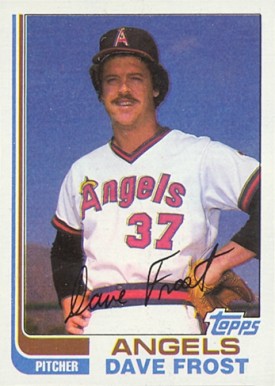
Card #24: Dave Frost


Who Can It Be Now?
Carl David Frost was born in November of 1952 in Long Beach, California, and he attended Millikan High School there.  During his years in high school, his baseball team won the CIF championship in 1969 and the CIF basketball championship in 1970.  Straight out of high school, he was not drafted by any major league team, so he went to junior college.  

He first attended Long Beach City College, where he played both baseball and basketball.  At LBCC, he was the MVP of the 1971 State Basketball Championship for junior colleges on a team coached by basketball coaching legend Lute Olson.  After a year at LBCC, he enrolled at Stanford University and again played basketball and baseball there.  Seeing his athletic ability, the Chicago White Sox decided to select Frost  in the 18th Round of the 1974 June Draft with pick number 412.

Frost started in rookie ball and pitched well -- a 1.80 ERA, as one would expect for a college pitcher in rookie ball.   As teams were more likely to do in those days, Frost skipped A-ball and went to AA in 1975, throwing 171 innings at a 3.21 ERA despite a 5-14 record. The White Sox saw his record and thought he needed another year in AA, and kept him there through 1976.  In 1977, he got a September callup to Chicago.  

After the 1977 season and in what have been a dream opportunity for a Southern California kid, Frost was traded with Brian Downing and Chris Knapp to the California ANgels for Bobby Bonds, Thad Bosley, and Richard Dotson.  He pitched a half-season at Triple-A Salt Lake City in 1978 before making his Angels debut on June 24.  He didn't get any run support from his teammates, but Frost pitched decently in losing 3-0 against Jon Matlack (who threw a two-hit shutout).

1979 was Frost's big year in the majors, as Jim Fregosi rode the big righthander for 239-1/3 innings in 33 starts and, by advanced metrics, Frost was the team's best pitcher.  The Angels won the American League West Division title that year for owner Gene Autry, and, despite losing the ALCS to the Baltimore Orioles 3 games to 1, things seems bright for the Angels and for Frost.

But two starts into his 1980 season, Frost's elbow started to hurt -- badly.  According to Baseball in Long Beach by Bob Keisser, tests found fourteen bone chips in Frost's elbow. Today, Frost would have had surgery to remove the chips, fix any issues in the elbow, and perhaps had Tommy-John surgery.  He would miss a year, but he would continue forward in his career.  In the early 1980s, though, baseball tended to subscribe to the theory of "rub some dirt on it and it will get better."  So Frost tried to pitch through the pain.  

That didn't work, and the elbow problems forced Frost into an early retirement at the age of 30. 

Orange You Smart
Not only did Frost play two varsity sports at Stanford University, he also earned his degree in political science from there.  

After his baseball career ended, Frost spent four years in Chicago as a commodities broker. Frost commented on this period in a news article in 2006:
Not really the happiest time in my life.  I was a Long Beach guy living in Chicago, and working in a business I didn't particularly like.  And I wasn't exactly the world's greatest commodities broker.  When you come from a field in which you have to be among the world's best to work in -- major league baseball -- and then you find yourself working in something you're mediocre in, it was hard to take. And I'm sure I felt sorry for myself because of the premature finish of my baseball career.  The transition to regular life was tough for me.
He returned to Long Beach and, then, went to Azusa-Pacific and obtained a Master's degree in psychology.  At the time of the news article, Frost was serving as a counselor and facilitator for a group of domestic violence offenders to help rehabilitate them.  

Everybody Wants You
After Frost's 1982 Topps card went to press and was issued, the Angels allowed Frost to leave.  Within two weeks, the Kansas City Royals picked Frost up and signed him to a one year contract. 

Don't You Want Me?
The Royals were not enamored with Frost putting up a 5.51 ERA (which was identical to his ERA the year prior) and released Frost after the 1982 season.  Frost caught on with first Pittsburgh and then Philadelphia on minor league deals in 1983, but even in AAA in 1983, Frost put up a 5.50 ERA.  Amazing consistency is not always good.

A Few Minutes With Tony L.
In 2014, it seems strange to hear about a pitcher whose career ended due to bone chips in his elbow.  A quick Google search for "Pitcher bone chips" (not in quotes, obviously) shows that surgery to remove bone chips is very common.  A few examples of pitchers who have had bone chips removed or treated include New York Met Jennry Mejia, Washington National Stephen Strasburg, Cincinnati Red Mat Latos (who has since followed that surgery up with knee surgery and more forearm problems), Tampa Bay Ray Jeremy Hellickson, Colorado Rockie Tyler Chatwood, and Atlanta Brave Brandon Beachy (whose bone chip was followed by his second Tommy John surgery in less than 2 years).

Frost obviously was not as lucky as these guys -- most of whom seem likely to be able to continue their careers (Beachy being the one possible exception).  Even so, I question why Frost did not get the chips removed rather than pitching through it.  It's not like bone-chip-removal surgery is new -- a quick review of Terry Forster's Wikipedia page, for example, states that he had surgery after the 1978 World Series to remove bone chips from his elbow.

In any event, this could be one of those "sliding door" moments in time.  If Frost stayed healthy, or wasn't out of baseball at age 30, would he have gone into psychology and helped try to rehabilitate domestic violence offenders?  Would he have been able to apply his training in psychology to work with kids in the MLB Urban Youth Academy in Compton alongside Ken Landreaux and Don Buford

Sometimes, bad things happen to good people for a reason that can't be explained easily.

Tuesday, April 22, 2014

Card #21: Baltimore Orioles Future Stars


Who Can It Be Now?
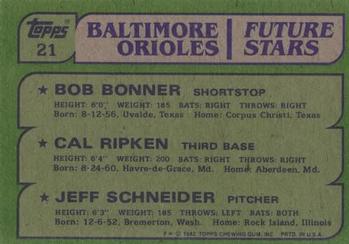
It's the best 3-headed rookie card in the entire 1982 Topps set, showing up at Card #21. Everyone who might read this blog must know who Cal Ripken is -- whether as a shortstop or at 3rd Base, as this card says -- so let's focus on Bonner and Schneider a bit.

First, Robert Averill Bonner -- Bobby, as he is known in most places -- was a Texan by birth and was age 25 when this card went to press.  He attended Texas A&M, and was selected by the Orioles in the third round of the 1978 June Draft.  Bonner had been drafted twice before -- in the 10th round out of high school in 1974 by the Expos and after his junior year at A&M by the Royals in the 9th round.  Immediately on signing, he was placed in the AA Southern League at Charlotte and struggled at the plate.  

Bonner actually debuted for the Orioles as a 23-year-old in 1980, making four plate appearances in four games.  He hit .296 over 27 at-bats in a 1981 stint with Baltimore, but even this small sample portended problems with his plate approach -- he walked only one time in 29 plate appearances.  Bonner lasted just 4 seasons -- 1980 through 1984.  He appeared in 61 games, had 108 at-bats, and had a slash line of .194/.219/259.  He even tried his hand at pitching in the minors in 1984 -- he was drafted as a pitcher out of high school -- but that was scrapped after he made 4 unsuccessful appearances.  Bonner appeared on cards in the 1982 Donruss set and in the 1983 Fleer set.

In comparison to his other non-Ripken cardmate, however, Bonner had a long career. Jeffrey Theodore Schneider was born in Bremerton, Washington on December 6, 1952, but graduated high school from Alleman Catholic in Rock Island, Illinois before attending Iowa State University.  Schneider was drafted twice -- once right of out high school by the Cubs in the 18th round of the June 1970 draft and by the Rangers in the 2nd Round of the January 1973 draft, but he did not sign either time.  He was only signed in 1974 by the Phillies as an amateur free agent.  The Orioles then picked him up in the 1978 Rule 5 draft.

Schneider apparently made it on this card on the strength of his 1981 year at Rochester, where he served as a closer of sorts for the Rochester Red Wings.  He picked up 12 saves and finished 34 games for Rochester with a 2.35 ERA.  Schneider's problem was control -- over any one full season, he never had a BB/9 ratio of under 4.  

On the strength of that minor league season, the Orioles called him up in August of 1981. Schneider made 11 appearance for the O's, allowing 27 hits, 12 walks, and 4 home runs in 24 innings.  More tellingly, he appearance in a game that the Orioles won just once -- a 12-inning affair against Seattle on August 25 in which got the final out for his one and only save in his major league career.  He made his final appearance as a major leaguer against the Yankees in October of that year, and this card is his only appearance on a baseball card as a major leaguer during his career.

Goody Two Shoes
This category -- hopefully one of the last I will have to introduce, but you just never know -- will cover those players whose faith and religion have helped define their life.  Here, it applies to Bobby Bonner.  The major source of information on Bonner anywhere on the internet comes from the faith-based missionary organization that Bonner helped found called International African Missions -- I AM, for short.  

According to his biography on that site, Bonner and his wife first went on a mission trip to Africa in 1988 to Zambia.  The site then reprinted an interview that Bonner did with the website "Ripken in the Minors" -- which, by all indications, is an excellent site serving as an oral history of sorts for Cal Ripken's career.  That interview is an excellent source for information both on Cal and on Bonner.  There is one part of that interview that truly makes Bonner fit this category well:
I went to spring training and hit over .300 in spring training.  Joe Altobelli was our new manager.  He called me into his office and said they were going to send me back to the minor leagues and asked if I wanted to know why.  I"m thinking to myself that they've moved Ripken to short so I'm out of a job but I said, "I don't know why you're sending me down."  
He said, "You're taking this Jesus thing a little to far." And I said, "What?"  I was shocked.  He said, "You make everybody nervous." And I said, "What?"   He said, "You don't fit in.  You bring your Bible to the ballpark and talk about Jesus all the time."
I said, "Let me ask you something, Joe.  Do I play hard when I'm on the field?" He said, "Yeah, and we're not concerned about that.  We're concerned about your other things.  You have to leave Jesus in Church.  You can't bring Him to the ballpark with you."  
I said, "Joe, you don't know your Bible, man.  He lives in my heart and goes wherever I go."
Joe said these words to me and I'll never forget them.  He said, "Well, he ain't goin' to Baltimore."
Everybody Wants You
While Bonner mentions in the remainder of his interview with the Ripken site that he could not get Baltimore to trade him, Schneider did not have that same problem.  In fact, he was sent to the California Angels with Doug DeCinces -- a move that opened up third base for Cal Ripken -- in exchange for Dan Ford.

Don't You Want Me?
On the other side of the coin, Schneider also pitched so poorly in AAA Spokane for the Angels -- 24 innings, 6 strikeouts, 19 hits, 19 walks -- that he either was sent to Toronto or released by the Angels and signed by Toronto.  It did not make any ripple in any of the agate print I can find online, though.  

A Few Minutes with Tony L.
Of course, Cal Ripken is the star of this card and this card is the star of the 1982 Topps set. Cal was the 1982 American League Rookie of the Year, the 1983 AL Most Valuable Playerthe 1991 Most Valuable Player, a two-time Gold Glove winner, an eight-time Silver Slugger winner, an 18-time All-Star, and a shoo-in as a first ballot Hall of Famer in 2007 when he received 98.5% of the vote.  He's one of those guys -- as was his ballot-mate, Tony Gwynn -- about whom you ask the BBWAA voters who did not vote for him the question: What more was he supposed to do to make the Hall of Fame? Cure cancer?

It was interesting to me to see what happened to Bonner and Schneider.  Bonner comes across in his interview with the Ripken in the Minors site as you would expect a pastor to be -- eloquent, full of stories, and engaging.  He was and is determined, and he has faith that his path has been the one that God has chosen for him.  He speaks as a man of passion -- the passion that he has found his purpose in life and is carrying it out.

Schneider's interview is one of a man who appears very guarded.  I don't know, of course, how much editing went into each interview posted on line there, but Schneider's answers are short, clipped, and terse.  

As an aside, all three men on this card appeared in the thirty-three inning marathon baseball game in April and June of 1981 between the Pawtucket Red Sox and the Rochester Red Wings.  The game was a pitchers duel.  Schneider struck out 8 men in 5-1/3 innings that game after coming on in the ninth inning to pitch.  The game was suspended at 4:09 AM after 32 innings were played.  19 people were left in the stands at this point.  

The game was picked up again on June 23 in front of almost 6,000 fans and multiple television networks.  Interest in the game had picked up tremendously because, after all, the major leagues were in the middle of a players' strike.  Future major leaguer Marty Barrett scored the inning run in the game on a hit by Dave Koza (who never made the majors).  

The box score for that game is a fun one to review, if only to see lines like Red Wing Dallas Williams's 13 0 0 0 box score line -- 0-13 is a slump, not a game line!  Interestingly, the losing pitcher was Steve Grilli -- the father of current Pirates closer Jason Grilli.

Saturday, April 19, 2014

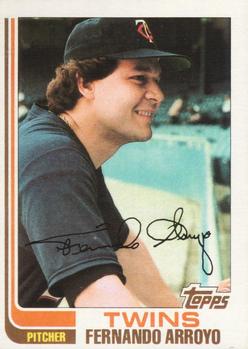
Card #18: Fernando Arroyo


Who Can it Be Now?
Fernando Arroyo was born March 21, 1952 in Sacramento, California.  The Detroit Tigers drafted him straight out of Luther Burbank High School in Sacramento in the 10th Round of the 1970 June Draft.  Without a doubt, he was the second best player drafted in that round, as the Reds picked Ray Knight 6 picks earlier.  

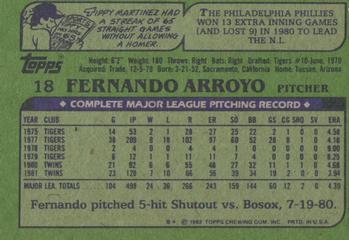
Arroyo signed with Detroit and began working his way through the Tiger Minor League system.  He spent 2 years at AA and a full season at AAA in 1974 before appearing in 14 games in 1975 with Detroit.  1976 and 1977 were atypical -- he spent the entire year in AAA in 1976 and the entire year in the majors in 1977.  

Otherwise, Arroyo was one of those guys who was the first to get sent down when a roster spot was needed for someone but also of being the first guy called up when someone went down.  In other words, Arroyo was essentially a replacement level player -- never good enough to stick for good in the major but never bad enough -- before 1982 -- to get cut.

Arroyo was traded in December of 1979 to the Minnesota Twins.  He kept up his yo-yo act between AAA and the majors for a couple of seasons, and then spent the entirety of 1981 on the major league roster -- one can speculate that the 1981 players' strike cost the Twins the opportunity to send Arroyo back down to AAA again.

1982 was the last time that Arroyo appeared on a baseball card as a player.  Oddly enough, he appears twice in the 1982 Topps set -- on this card and then again on the "Team Leaders" checklist for his 3.94 ERA in 1981...a fact which pretty much underlines the absurdity of that concept.

Arroyo's big problem is that he was an extreme soft tosser.  In his career, he only walked 2.7 batters per nine innings -- that's not too bad.  On the flip side, he only struck out 2.9 batters per nine innings.  That's awful.  He also gave up nearly 10 hits per nine innings as well. Pitchers do not have long or successful careers when they can't strike guys out.

Don't You Want Me?
We've seen the "Everybody Wants You" tag used before for a player who was traded for during 1982.  Here's the flip side -- a player whose team (or multiple teams) cut him during 1982.  

After looking at the transaction log, perhaps I should rename this category Fernando after Arroyo and that 1976 Abba song.  1982 was a tough year to be Fernando Arroyo in terms of remaining employed.  After pitching just 13-2/3 innings during the first six weeks of the season (at a 5.25 ERA, mind you) -- well, to be fair, all of the innings were before April 22 -- the Twins decided that they no longer needed their returning ERA leader and released him on May 18.

A week later, Arroyo signed with the Oakland Athletics.  They put Arroyo on the mound for 4 appearances in AAA Tacoma and in Oakland for 22-1/3 innings.  In those 22-1/3 innings, Arroyo posted a 5.24 ERA.  That apparently was not what Oakland had in mind when they signed him, so they release him on July 27 -- about two months later.

Perhaps needing someone to fill out a staff in AAA, the Chicago White Sox signed Arroyo and had him pitch in AAA Edmonton for the rest of the year.  Arroyo pitched for the Sox's AAA affiliate again the next two years -- this time in Denver.  Before the 1984 season, the Sox cut him, resigned him, and then let him move to Mexico to pitch for the Yucatan Leones.  

Arroyo's final appearance in the majors was his only one after 1982 -- and it came in a mid-August game in 1986.  He came in, faced three batters, and walked all three of them.  That was the end for him.  

He went on to be a pitching coach in the minors for Detroit, Florida, and Oakland and even went along with Jerry Royster for two seasons of being a pitching coach in the Taiwan Major League.  As with many major league baseball players, he eventually was inducted into his local baseball Hall of Fame in 2013.

A Few Minutes with Tony L.
I probably could not have picked Fernando Arroyo out of a police lineup in 1982.  Or today, for that matter.  He only faced the Brewers one time in 1982, pitching 2 innings for Oakland. For his career, Milwaukee teed off on him (as they did to a lot of pitchers in the late 1970s and early 1980s), hitting .296/.330/.495 with 9 homers in 201 plate appearances.

One of the interesting (to me) things that this blog is allowing me to do is find out what the players have done with their post-major-league/post-1982-Topps lives. Some players are more interesting than others, obviously; I mean, Steve Carlton being certifiably crazy is a great story.  Arroyo's life appears to have been pretty mundane by comparison -- I mean, being a pitching coach in Taiwan (without any demonstrated or claimed Chinese language skills) is pretty cool, but it's not like there are any stories about anything crazy happening to Arroyo over there. 

So, all I've got is this:  Arroyo is now the President and CEO of ARMTRAK LLC in Vero Beach, Florida, according to his LinkedIn page.  Armtrack is a product that Arroyo invented to help pitchers to avoid arm injuries and develop the proper throwing motion.  Hopefully it works and is successful.  

Good luck, Mr. Arroyo -- and tell us some stories about Taiwan!