Wednesday, May 13, 2015

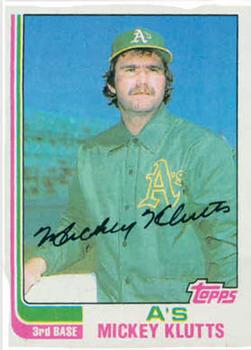
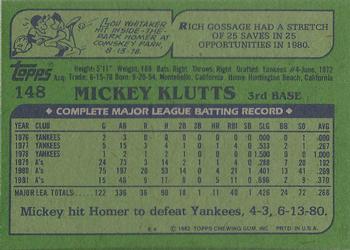
Card #148: Mickey Klutts

Who Can It Be Now?
Gene Ellis Klutts was born on September 20, 1954, in Montebello, California.  The New York Yankees selected him in the fourth round of the 1972 June Draft straight out of El Rancho High School in Pico Rivera, California.  

Klutts signed immediately and, as a 17-year-old, played for Johnson City in the Appalachian League.  Even as a young player, though, Klutts was destined to be a utilityman.  The Yankees played him at 2B, shortstop, and 3B as he worked his way up through the system. 

He played more short than third, but he never really seemed to be the Yankee's top choice for either position.  With Graig Nettles at third, of course, shortstop became where he would be more likely to play.  His opportunity appeared to be coming in 1977, though. He had debuted in New York at 21 in 1976, and incumbent Fred Stanley did not appear to be an impediment to Klutts stepping into the starting role.  Then, on a play at second in the spring of 1976, Klutts made a tag at second and pulled his hand away in pain. 

The Yankees told reporters that Klutts had a "jammed-sprain."  The reality was that he had a broken finger, but the Yankees apparently were not convinced Klutts could be a starter and were negotiating to trade for Bucky Dent with the White Sox.  They feared the price for Dent would increase if the White Sox were aware of Klutts's injury, so out came that Yankee version of news-speak.  Dent became the Yankees' starting shortstop and broke Red Sox hearts in 1978; Klutts went on to be the co-MVP of the International League in 1976.

As it turned out, Klutts never got the chance to play in New York -- coming to bat just 24 times over three seasons before being traded at the trade deadline in 1978 to the Oakland A's for Gary Thomasson.  

Injuries hampered his career as well, lending credence to nominative determinism (the theory that a person's name can have a significant role in determining key aspects of job, profession, or even character).  According to Baseball Library, Klutts was disabled "at least ten times" and "suffered one injury when he ran into a tarp." One article in 1978 mentioned that he went on the DL when he broke his left thumb "while warming up relief pitcher Ken Clay in the bullpen . . . ."  The title of that article? "What a Klutts!"

Klutts spent most of four seasons with the A's before they too decided at the end of the 1982 season that Klutts was not the answer to their third-base needs.  In fairness, Klutts was never the starter -- he only kept the position warm for real players like Carney Lansford. After 1982, Klutts signed with the Toronto Blue Jays.  He received 45 plate appearances there before his major league career ended.

Mustache Check:  Yes, indeed.  Gene has a mustache.

A Few Minutes with Tony L.
Other than his incredibly memorable name and all the jokes that went with it, I knew and thought very little of Mickey Klutts as a kid.  I mean, look at his stats -- does that appear to be the stat line of a guy who made an impression on opposing teams' fans? Not particularly, I'd say.  

I found an old blog that may or may not have a basis in reality about how Gene Klutts got to be known as Mickey.  The theory here was that the Yankees touted him as Mickey in order to draw parallels to Mickey Mantle. They wanted to teach Klutts to switch hit, supposedly, and then become the center fielder.  Now, I don't know how much credence to put into this story, but I have no other information as to how "Gene Ellis" became "Mickey".  

I also haven't the foggiest idea what Klutts has done since retirement. He apparently is a pretty good TTM signer, since I've seen a number of autographs of his online. He lives in Lake Isabella, California, according to "Contact Any Celebrity.com" (and, not to be too disparaging, but if Klutts is on that site, they may not be kidding by saying you can contact ANY celebrity).  And, despite featuring for just 20 at bats in New York over three seasons, he still comes back and is invited back to the Bronx for those Yankee Old-Timers games.

Anyone else have anything to share?

Monday, May 11, 2015

Card #147: Denny Walling

Who Can It Be Now?
Dennis Martin Walling was born on April 17, 1954 in Neptune, New Jersey. He attended community college in New Jersey before attending a second community college...er, Clemson University in South Carolina. 

He was drafted initially after his junior college days in the 8th round by the San Francisco Giants in 1974.  He did not sign and went to Clemson for a year where his efforts and ability made him the first pick overall in the 1975 June Secondary Draft by the Oakland Athletics. After signing with the A's, he went straight to the major leagues, going 1-for-8 in limited duty in September of 1975 for the AL West Champions.

Perhaps due to their "win-now" mentality, or maybe Walling just wasn't what they thought he was when they drafted him, but the A's gave Walling a grand total of 19 plate appearances over two year before trading him with cash to the Houston Astros at the trade deadline in 1977 for Willie Crawford.  

Crawford played the rest of 1977 with the A's, played two years in Mexico, and was out of baseball.  In comparison, Walling became a long-time Astro pinch-hitter for those Houston clubs of the late 1970s through the mid-1980s.  He averaged less than three plate appearances per game played for Houston (1072 G, 2929 PA) over eleven-and-a-half seasons (not counting his 3 game cameo in 1992 at the very end of his career).

Walling was never much of a power hitter, and he hit just 49 homers in his entire career. Some of that had to do with the cavernous Astrodome, certainly, but Walling was a guy who would come to bat and be willing to take a walk or, often, get the bat on the ball.  He struck out in less than 10% of his plate appearances in his career.

During the 1988 season, Walling was traded to the St. Louis Cardinals for Bob Forsch. Apparently, the teams wanted to swap a hitter near the end of his career for a pitcher near the end of his career.  Walling stuck in St. Louis as a bat off the bench through 1990, played in Texas a little in 1991, then hung up his spikes after the 3-game, 3-plate appearance performance in Houston in 1992.

Mustache Check: Mr. Ginger, oh your mustache has grown. Don't you know that you're the only one to say, OK.  (Figure out that reference...)

Family Ties
According to the Baseball-Reference.com Bullpen, Denny Walling's older brother Gregory Walling played 47 games for Covington in the Appalachian League in 1967 in the Astros system. He walked a lot, but Gregory's .225/.363/.265 slash line did not convince the Astros to keep him beyond that one season.

A Few Minutes with Tony L.
Yes, I am going to resurrect this blog a bit.  I miss the history aspects of it.  

I remember Denny Walling from watching the postseason in the early 1980s and again in 1986.  Walling struggled mightily against the Mets in the National League Championship Series in 1986 -- .158/.158/.211 in 19 AB -- but he was far from the only one who struggled. Of players with more than 10 at bats for the Astros, only Craig Reynolds -- 4 for 12 -- hit better than .300.  Walling ended up picking up four at-bats in the epic game 6 of that NLCS -- the one that went 16 innings and finished with the Astros coming up one run short in their rally to tie the game again after the Mets scored 3 in the top of the 16th off Aurelio Lopez and Jeff Calhoun.

Since his retirement as a player, Walling has been a coach. He spent time with the Oakland A's and New York Mets when old pal Art Howe was the manager.  After that and from 2007 to 2014, Walling was a hitting instructor in the Orioles system -- first as a roving instructor, and then as the Triple-A Norfolk Tides batting coach from 2012 through 2014.  After the 2014 season, Walling -- now 60 years old -- decided to retire.

Sunday, February 8, 2015

Card #146: Mike Griffin


Who Can It Be Now?
Michael Leroy Griffin was born on June 26, 1957, in Colusa, California.  Griffin was the third-round pick in the 1976 June draft of the Texas Rangers out of Woodland High School in Woodland, California.

After two years in the Rangers system, Griffin was part of a 9-player trade in November of 1978 in which he, Juan Beniquez, Paul Mirabella, and Dave Righetti were traded to the New York Yankees in return for Mike Heath, Dave Rajsich, Larry McCall, Domingo Ramos, Sparky Lyle, and cash. The next year -- 1979 -- Griffin made his major league debut with the Yankees.

Getting traded and moving around was a big part of Griffin's career. He was traded again in 1981 as the player to be named later (along with Doug Bird and $400,000) going to the Cubs in exchange for Rick Reuschel. Bird and Griffin pitched back-to-back 1-run games against the Dodgers in August of 1981, leading to some typical Tommy LaSorda hyperbole: "Who are those guys? Christy Mathewson and Walter Johnson?"

No, Tommy. No they are not.

Griffin's stay in Chicago did not last long -- only to the end of spring training in 1982 -- at which point he was traded to the Expos for Dan Briggs.  Griffin never appeared in the major leagues for the Expos, and at the end of August was traded again. This time, he went to San Diego in exchange for future White Sox and Mets manager Jerry Manuel.  

Griffin bounced around the minors for a few years after that -- going to the Rangers system in 1983, to Kansas City's system after 1984, and then to Baltimore after 1986. He made 23 appearances as an Oriole in 1987 for a team in sharp decline and did not pitch very well. 

He was back on the streets as a free agent after the 1988 season, but then the Cincinnati Reds gave him one last shot at the big leagues. He pitched 4-1/3 innings in 3 appearances in 1989, and that was the end of his big-league career.

Mustache Check 
Yes.  It's ginger bristles, but it counts.

Everybody Wants You
To get traded twice in the 1982 season, Griffin had to be wanted by two different teams as well. Because otherwise there's nothing, Griffin is a Wanted Man.

A Few Minutes with Tony L.
The only thing I remember about Mike Griffin was this card. As a ten-year-old, I don't think I'd ever seen as many freckles on any one person as appear on Griffin in this photo. As a pitcher, though, he is as memorable as the remnants of a drunken night after 20 shots.  In other words, "he did what?"

Since his retirement as an active player, Griffin has spent most of his time as a minor-league pitching coach. Starting in 1993 with Triple-A Indianapolis, Griffin spent several years in the Cincinnati Reds system as a pitching coach. After leaving the Reds system, Griffin hooked on with the Boston Red Sox in 1999. Griffin coached for 9 seasons (1999-2007) in the Red Sox system before joining the Baltimore Orioles organization. After spending 2008 in Double-A Bowie, Griffin has become a fixture as the pitching coach for Baltimore's Triple-A team, the Norfolk Tides, in the International League and coached there through 2014.

Saturday, February 7, 2015

Card #145: Bob Horner


Who Can It Be Now?
James Robert Horner was born in Junction City, Kansas, on August 6, 1957. Horner moved to Arizona as a child and graduated from Apollo High school in Glendale, Arizona. Straight out of high school, Horner was selected with the 357th pick overall in the 1975 June draft (15th round) by the Oakland Athletics. Of course, he turned the A's down and decided instead to attend Arizona State University.  

Horner had an incredible career at ASU, leading him to be awarded the first-ever Golden Spikes Award by USA Baseball and the MLBPA. Horner's success led the Atlanta Braves to select Horner first overall in the 1978 June Draft. Considering that the Braves other options at third base were Rod Gilbreath (lifetime .248/.320/.329) or putting outfielder Barry Bonnell there, the Braves decided that they had nothing to lose and plugged Horner into their major league lineup immediately on his signing. 

Based on his 23 homers in 89 games, Horner was named as the NL Rookie of the Year in 1978, beating out Padres shortstop Ozzie Smith and Pirates pitcher Don Robinson. Based solely on their statistics and using WAR, Robinson should have been named as the Rookie of the Year, but certainly some of the hype going from college to the majors directly had to help Horner's candidacy. That season, the player that similarity scores put as most similar was a 21-year-old Miguel Cabrera. Yeah, it was a very good year.

Horner always had excellent power, and over time his batting eye developed reasonably well also. The problem he had was staying healthy. He played over 140 games in a season just twice -- in 1982 and again in 1986. He was an All-Star once -- in 1982 -- and received votes for the MVP award three times (1979, 1980, and 1983).  Yet the question with Horner was always why he did not live up to the first-overall-pick hype. Certainly, some of that had to do with Horner's less-than-good conditioning, and some of it was just bad luck.

After the 1986 season, the owners' collusion led Horner to get his best contract offer from the Yakult Swallows in the Japanese Central League. In 93 games there, Horner smacked 31 homers and hit .327/.423/.683. Horner came back from Japan after one season -- leaving a number of very derogatory remarks about Japanese baseball in his wake -- and played 60 games for the St. Louis Cardinals before everyone in the major leagues made it clear to Horner that his big-league career was over.

Mustache Check
Nope, the 23-year-old Horner did not join in the spirit of the day and remained clean shaven.

Trivial Pursuit
Horner has a few great trivial points about him.  

  • He is, to my knowledge, the last player to come directly out of college and play in the major leagues. 
  • He famously never appeared in a minor league baseball game. 
  • He hit four home runs in a game on July 6, 1986, at Atlanta-Fulton County Stadium against the Montreal Expos. In typical Braves fashion for the mid-to-late 1980s (and probably for 2015 too), the Braves lost the game 11-8.
  • He was, as mentioned above, the first winner of the now very prestigious Golden Spikes Award. 
  • Along with Jason Jennings and Buster Posey, he was one of three Golden Spikes winners to be Rookie of the Year. He's the only one to do it in the same year.
A Few Minutes with Tony L.
Of course I knew who Bob Horner was in the early 1980s. His exploits of coming straight from college to the major leagues made everyone who was a baseball fan aware of him.  A fun fact for me from the back of this card is that Horner is listed as living in Dunwoody, Georgia. Dunwoody is where my wife and I call home now, so that is pretty cool to me.

I met Horner once in my life. He was signing autographs at a construction-industry even on behalf of the Siemens Corporation about 12 or 13 years ago. He was in a reasonably jovial mood at the event.  To be fair, it wasn't a big line or anything either, since the event required registration fees to be paid, so perhaps that had something to do with it as well.

Horner no longer lives in Dunwoody (otherwise, I might pop over to his house...so that is lucky for him, I suppose).  Horner lives now in Irving, Texas, and has for over thirty years now.  When asked in 2010 "What are you up to these days?" in an interview with the Atlanta Journal Constitution, his reply was, "I don't do anything." Another website I found indicated that he does do some things around Irving, though -- he is a food pantry volunteer there.

At least he's not just playing golf. 

Saturday, January 31, 2015

Card #144: Fred Breining


Who Can It Be Now?
Fred Lawrence Breining was born on November 15, 1955 in San Francisco, California. He grew up in the City of San Francisco and attended high school there.  He then matriculated at the College of San Mateo, a community college in San Mateo. The Pittsburgh Pirates drafted him in the third round of the 1974 January Draft (Regular Phase) and Breining signed shortly thereafter.

Breining's career stalled out in the Pittsburgh system, and it appeared as though he had plateaued and reached his level in 1978 in Triple-A. He got rocked for a 6.38 ERA in 55 innings at Columbus that year, and things were not looking good for him. But, in 1979, Breining was a throw-in in a trade between Pittsburgh and San Francisco. Breining went back to his hometown club (along with pitchers Al Holland and Ed Whitson) in exchange for the one star in the trade -- Bill Madlock -- along with Lenny Randle and one of the Dave Robertses.  That trade at the end of June of 1979 seemed to revitalize Breining, leading to his call-up in 1980.

Just 25 in 1981 despite 7 years of professional baseball under his belt, Breining looked to be a legitimate major league pitcher (despite a FIP that was 1.25 runs per nine innings higher than his ERA). He backed that up in 1982 with a stellar season -- 11-6 record, 3.08 ERA (3.00 FIP) and 2 complete games in 9 starts. He moved to the rotation in 1983 and racked up 202-2/3 innings over 32 starts with an 11-12 record and a 3.82 ERA.

The real controversy in his career came in late 1983 and early 1984. Breining was traded early in spring training to Montreal for Al Oliver. When he arrived for spring training, his shoulder was tender to the touch. Breining said his shoulder was hurt the previous September, and the Giants claimed they knew nothing about it. Eventually, the Giants sent a second pitcher, Andy McGaffigan, to Montreal to make up for the issue.  That didn't help Breining's career -- he pitched 6-2/3 innings for the Expos in 1984 and never pitched in the major leagues again.

Mustache Check: It's a wispy mustache more appropriate for a teen, but there is definitely one there.

The Verdict
The Great Recession of 2008 to, well, probably around 2013 or so caused a lot of people financial harm. Many folks were so far underwater on their mortgages that, try though they might, they were unable to refinance their homes and lost the house. Still others got close to that precipice of foreclosure but attempted to stave it off with lawsuits.

It is into this final category that Fred Breining appears to fall. Breining and his wife appear to have tried to refinance their home, gotten the runaround from their various mortgage companies, and, then, only got a denial for refinancing and had to resort to court. This court order from July 2014 granted the finance company's motion to dismiss, but gave Breining and his wife leave to amend their pleading. I'm not sure how it's played out, but I feel for them.

A Few Minutes with Tony L.
Breining never pitched in the AL and pitched only for a few years in the majors, so I can't say that I recall him at all. In fact, if you pressed me on who the guy in the picture is, I would have guessed Mike LaCoss due to the gnarly glasses Breining has on here.

It appears that Breining has spent most of his post-baseball career serving as a private pitching coach and attempting to be an inventor. A quick look at his LinkedIn page shows that he has been giving private pitching lessons for the last 26 years in California. Indeed, Fred's page mentions that he had 7 students drafted in the 2010 to 2012 drafts.

That said, I don't know that he really understands Twitter at all.

Tuesday, January 27, 2015

Card #143: Mookie Wilson

Programming Note: Yes, I'm back. Finally. Here's the thing, though -- life has gotten incredibly busy for me. So much so that I do not have the time to write up the big career stories that I was writing. Instead, going forward, the posts will look more like this one -- a much shorter "Who Can It Be Now?" along with whatever category posts I have and maybe a paragraph wrap-up with my thoughts.


Who Can It Be Now?
William Hayward Wilson -- Mookie -- was born on February 9, 1956, in Bamberg, South Carolina. He became a South Carolina Gamecock eventually, spending his junior year in Columbia. His junior year was good enough to make him the Mets second round pick (42nd overall) in 1977.

If you know one thing about Mookie Wilson's career, you know that he was the guy who tapped the dribbler in the tenth inning of Game 6 of the 1986 World Series -- the dribbler that went through Bill Buckner's legs and scored the winning run. Wilson was one of only a few holdovers on that '86 team from the early 1980s Mets -- most of which were not very good teams.  

Mookie spent parts of ten seasons in Flushing, and, indeed, stands 15th at present in career wins above replacement among all New York Mets players -- just behind Howard Johnson and just ahead of David Cone's Mets years. After he left the Mets, he finished his career off with three seasons in Toronto. His career came to a close after the 1991 American League Championship Series in which the Jays lost to the eventual World Series Champions, the Minnesota Twins.

Mustache Check: Mookie is definitely whiskered.

Family Ties
In a convoluted and potentially uncomfortable family tie, Mookie's stepson is former major leaguer Preston Wilson. Mookie is also Preston's uncle, because Preston's natural father was Mookie's brother Robert.  

Mookie also had two other brothers who played minor league baseball.  Younger brother John Wilson was the Mets 17th round pick in the 1982 January Draft -- which pretty much guarantees that John was not regarded highly despite impressive speed in the minor leagues. 

The youngest of the three Wilson brothers to play professionally was Phil Wilson, who was a fifth round pick of the Minnesota Twins in 1984. Phil had trouble making enough contact to get past Triple-A.

Freeze-Frame
Mookie Wilson parlayed his fame in the 1986 World Series into a TV appearance. He joined Keith Hernandez, Mark Ingram (the Dolphins and Giants WR who fathered the running back who attended Alabama), Sean Landeta, Pee-wee Herman, Jeremy Irons, Madeline Kahn, Itzhak Perlman, Paul Simon, and Rhea Perlman, among others, in singing "Put Down the Duckie" in a 1988 "All-Star Musical Special" of the same name for Sesame Street.

The World According to Garp
In April of last year, Mookie released a book called "Mookie: Life, Baseball, and the '86 Mets." If you are a Mets fan, or if you like good baseball books, this may be one to pick up. The book has been reviewed 21 times on Amazon, and it has received 17 5-star reviews and 4 4-star reviews.  

A Few Minutes With Tony L.
Mookie's distinctive nickname made him well-known to all fans of baseball in the 1980s. A number of the reviews of his book mention how much Mookie loved baseball -- playing the game and being around it.  

It should come as no surprise, then, that he has spent a great deal of his post-playing career as a coach for his New York Mets. He was unhappy to be named as a club ambassador last spring, however, because it was a role he received after being pushed out of his on-field role. Indeed, this link has excerpts from his book in which he said that he had "basically become a hood ornament for the Mets" after his demotion from being an on-field staff member in 2011. 

Tuesday, December 9, 2014

Card #142: Dave LaRoche


Who Can It Be Now?
David Eugene LaRoche was born on May 14, 1948, in Colorado Springs, Colorado. Well, actually, David Garcia was born on that date in Colorado Springs. His parents divorced when he was young, and Dave took on his stepfather's name as a child. LaRoche is actually of Mexican heritage, not French as his surname would imply.

LaRoche grew up in Torrance, California, and attended high school as West High School there. The California Angels drafted LaRoche in 1966 in the 20th round, but LaRoche did not sign with the Angels at that time. Seven months later, the Angels selected LaRoche again in the fifth round of the January Draft's Secondary Phase. LaRoche signed in March and reported to Quad Cities in the Midwest League...as an outfielder. After hitting a combined .227 over two stops, however, LaRoche came back to the Midwest League as a pitcher in 1968 to start his fast ascent through the Angels' farm system.

LaRoche spent all of 1968 in the Midwest League and showed some promise. Though neither Baseball Reference nor The Baseball Cube has complete stats for him in 1968, what we do know is that his ERA was good (2.36, though with 10 unearned runs in 84 innings) and that he walked 29 versus 80 strikeouts. That was sufficient promise for the Angels to move him to the more competitive California League for 22 innings in 1969 and then to the Texas League in El Paso thereafter. Rather than getting annihilated in that noted hitters' ballpark, LaRoche put up a respectable 2.94 ERA. 

He was assigned to pitch in Triple-A Hawaii to start the 1970 season. Throughout his minor league career, he almost always was a reliever -- a position which likely hastened his promotion to the major leagues on May 11, 1970.  His first task: face Carl Yastrzemski in the top of the 16th inning. He was able to get Yaz to fly out, and, in the process, picked up his first major league win when the Angels scored a run in the bottom of the inning. 

Being a reliever, though, put LaRoche in a fairly tenuous situation on the roster, it seems. After giving up 4 runs (3 earned) 5 days after his debut, either he was sent back to Triple-A or he did not appear for a month. I'm guessing it was Triple-A. After an appearance on June 14, either he was again sent back down or, once again, did not appear for nearly a month. But, once he was back up with the Angels in July, it appears that he stayed in the major leagues for good through both 1970 and 1971. Over those two season, he had success as well -- 121-2/3 innings, 107 strikeouts against 48 walks and a 2.88 ERA (supported by FIP).

Yet, when Harry Dalton was hired by the Angels to be its general manager after the 1971 season, the first trade he made was to send LaRoche to the Minnesota Twins for infielder Leo Cardenas. Minnesota manager Bill Rigney was very happy about the trade, saying that "LaRoche just may be the best left-handed relief pitcher in the American League." Even then, however, Dalton recognized that bullpen arms are fairly fungible: "Frankly, we felt it would be easier to come up with a replacement in the bullpen than a major league shortstop."

LaRoche spent just the 1972 season with the Twins, posting a 2.83 ERA and a 5-7 record and recording 10 saves in 95-1/3 innings. The Twins got better in 1972 over 1971, but it was not enough to save Bill Rigney's job or to keep LaRoche in Minnesota. Apparently, the feeling was mutual. According to Wikipedia (quoting from The Twins at the Met), Bert Blyleven said that LaRoche told a reporter that LaRoche wanted to be the Twins' player rep for the union because "all the player reps under Calvin Griffith get traded."

So, when the season ended, LaRoche got his wish and was traded again -- exactly one year after the previous trade -- this time to the Chicago Cubs. The Cubs gave up minor league pitcher Bob Maneely, pitcher Joe Decker, and pitcher Bill Hands to get LaRoche. 

The two years that LaRoche spent on Chicago's North Side were not good. His 1973 season was one of his worst in the major leagues -- a 5.80 ERA in 54-1/3 innings (4.65 FIP) -- and 1974 was bad enough to see him start the season as a starter in Triple-A before getting called up to the majors on May 15.

So, when the Cleveland Indians offered pitcher Milt Wilcox to the Cubs for LaRoche and outfielder Brock Davis on February 25, 1975, the Cubs jumped on it. Getting out of Wrigley and back in the American League appeared to agree with LaRoche. In his two and a half seasons as an Indian, he totaled 42 saves, set an Indians team record with 21 saves in the 1976 season (which has been surpassed many, many times now), and made his first of two All-Star Game appearances of his career in 1976.

Yet, by 1977, the Indians and LaRoche had failed to work out a contract for LaRoche to play with the team past the 1977 season. As a result, the team decided to trade him. This trade took LaRoche back to Anaheim along with then-minor league pitcher Dave Schuler in exchange for Bruce Bochte, Sid Monge, and $250,000 cash. 

After the trade, LaRoche stayed in California through spring training in 1981. The Angels had signed another lefty, former Brewer pitcher Bill Travers, as a free agent in the offseason to one of the worst-ever free agent contracts. Because Travers was going to have to make the team, LaRoche was cut. Travers pitched terribly, got hurt, and never made an impact in California, and LaRoche ended up joining the Yankees.

In New York, LaRoche gained notoriety for one unorthodox pitch: the "La Lob." Rather than describe it, here's a clip from This Week in Baseball to show you Gorman Thomas flailing at it, though my favorite part of the entire clip is seeing Thomas -- the guy who lived to hit balls out of the ballpark -- attempting to BUNT the Lob for a base hit.


LaRoche finished his career with the Yankees. The 1982 season for him was one spent on the Columbus shuttle, back and forth between the Bronx, as the Yankees identified him as the pitcher no one would claim off waivers when they optioned him back to Triple-A. 

In 1983, LaRoche did not make the Yankees team out of spring training. He decided to step away from baseball for a while that year to spend time with his wife Patty, who was pregnant with son Andy. But, once Patty got past the difficult stages of her pregnancy, LaRoche hooked on with the Yankees. He made one final big-league appearance on August 23, 1983 against Oakland. He tried to make the Yankees one last time out of spring training in 1984 but failed.

Mustache Check: Nope, LaRoche is clean-shaven here.

Family Ties
As fans of today's game likely know, Dave LaRoche has two sons that played major league baseball.  The older boy, Adam, came up in the Atlanta Braves system. After playing in Pittsburgh, Boston, Atlanta, Arizona, and Washington, Adam signed a 2-year, $25 million contract to play first base for the Chicago White Sox on November 25, 2014.

Younger son Andy came up through the Dodgers system before spending three years in Pittsburgh (and playing together with his brother). Andy spent 2014 in the Toronto system at Triple-A Buffalo.  Dave cites to photos he received of the two taking practice swings together and of Andy making a play at third and throwing the runner out at first with a throw to Adam as being very rewarding to him.

Goody Two Shoes
In a 1982 news article, Dave cited to his faith and a religious experience that he and his wife Patty had gone through in 1979 as helping him to become more mellow.

A Few Minutes with Tony L.
I very clearly remember that La Lob thrown to Gorman Thomas and, by extension, I clearly remember Dave LaRoche. Looking at LaRoche's lifetime stats, it appears that he always pitched well against Milwaukee. Of course, considering that LaRoche spent most of his career in the AL -- and that career included a lot of bad years for Milwaukee in the early 1970s -- I'm not all that surprised.

After LaRoche did not make the Yankees in 1984, he was hired on by the Yankees as a minor league coach. He spent the 1989 and 1991 seasons as the bullpen coach for the Chicago White Sox, sandwiching a season as the White Sox pitching coach in 1990. He then moved on with his pal Jeff Torborg to the New York Mets where LaRoche spent two more seasons as a bullpen coach. 

For the rest of his working career, LaRoche was a minor-league pitching coach. Indeed, in 2014, LaRoche came out of retirement to help the New York Mets fill a gap when the Brooklyn Cyclones regular pitching coach, Tom Signore, missed time due to an injury. But, as he says on his LinkedIn page, "I am un retired for 4 months. Then back to retirement."

Maybe Adam will buy his dad a new car or something.